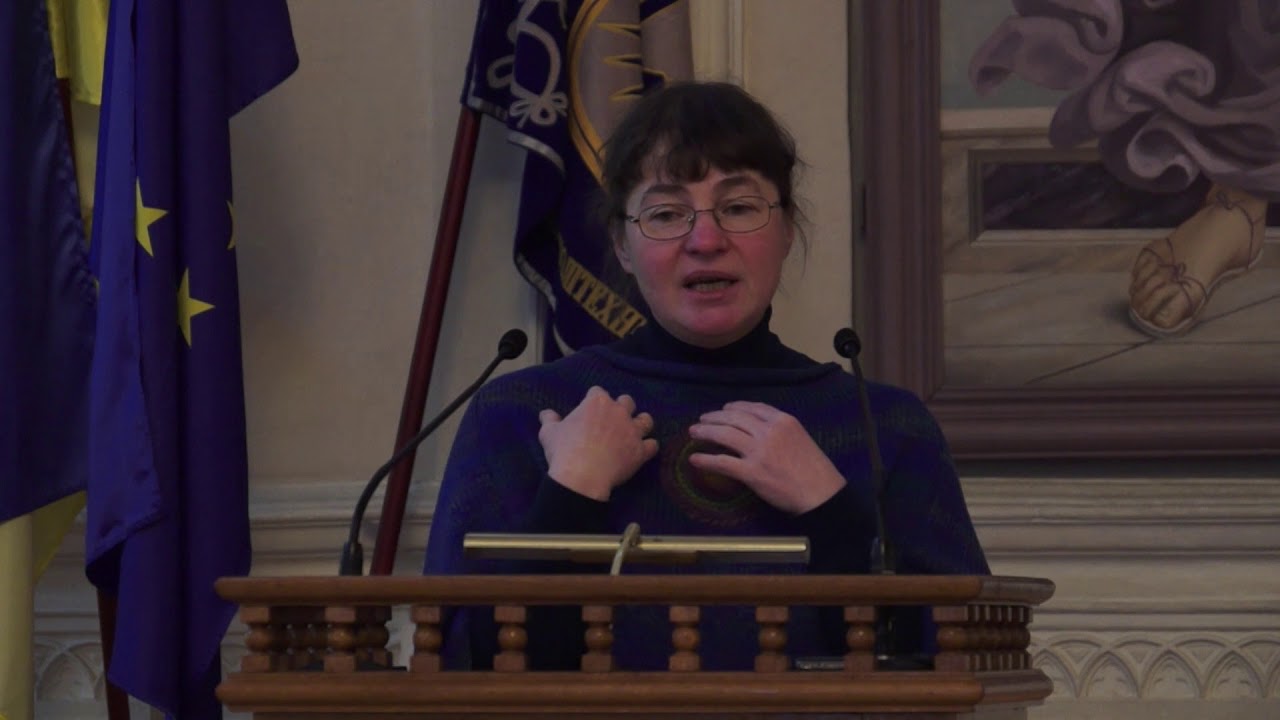
Doctor of Sciences in Public Administration · Professor
Learning that builds capability. Research that strengthens public services.
Prof. Svitlana Chukut brings over 25 years of experience in higher education, information policy and digital governance. Her work at George Brown Polytechnic includes 17 course initiatives and more than 50 modules, using Brightspace, H5P and scenario-based assessment. She contributed to Ukraine’s national Concept for the Development of E-Governance.
219records in the publication catalogue, newest first92courses & modules — the author's full catalogue22awards & honours43licenses & certifications94works in Google Scholar1,956citations in Google Scholar20h-index in Google Scholar40i10-index in Google Scholar
Full academic CV
Academic CV in English and French
Education, academic and professional appointments, research, publications and service. Download the full CV or explore professional bios with selected work and evidence for each collaboration pathway.
English · 19 pages · PDF / French · 21 pages · PDF
For universities, colleges and public-service organisations
Expertise and collaboration
Prof. Svitlana Chukut brings together learning design, applied research and academic leadership. The pathways below connect her experience with concrete work, supporting documents and opportunities for collaboration.
Explore a focused professional bio for each pathway, with selected work, supporting links and a two-page PDF in English and French.
George Brown Polytechnic · Toronto
Learning design and curriculum
Prof. Svitlana Chukut’s work spans 17 course initiatives and more than 50 modules across hospitality, construction and work-integrated learning. She develops learning outcomes, gamified activities, simulations, branching scenarios and authentic assessment, with relevant sources and practical application.
Her research connects e-governance, interoperability, smart cities and digital inclusion with the institutional conditions that shape public services. It includes comparative studies, research on public servants’ AI skills and contributions to Ukraine’s national E-Governance Development Concept.
Departmental leadership, programme development in Specialty 281, Public Administration and Management, national higher education standards and accreditation expertise inform her approach to academic quality. Her supervision connects graduate research with policy, public services and organisational practice.
Four independent bilingual simulations turn public-engagement challenges into opportunities to practise decisions, consider different perspectives and reflect on feedback. They provide a starting point for discussion with municipalities, educators and community organisations about facilitated workshops and locally relevant learning.
Curriculum Developer2024–2025 · George Brown Polytechnic · Toronto, CanadaProfessor2013–2025 · National Technical University of Ukraine «Igor Sikorsky Kyiv Polytechnic Institute»Head of the Information Policy Department2007–2012 · National Academy of Public Administration under the President of UkraineEditor-in-chief2009–2011 · E-Governance journalExpert working-group member2008–2010 · Ukraine’s first E-Governance Development ConceptFounder of the Young Scientists Union2001–2010 · National Academy of Public Administration under the President of Ukraine
Professional profile
From philosophy — to the digital state
Prof. Svitlana Chukut’s work over three decades connects public institutions and the citizens they serve. Her contributions range from early courses in information policy in Ukraine to research and civil-service training in digital governance.
Communication strategies are essential to institutions and organisations engaged in public administration. They establish a clear direction and translate an institution’s central purpose into key messages for each audience.
Prof. Svitlana Chukut · article “Communication Strategies in Public Management and Administration”, 2021 · source · translated from Ukrainian
Collaboration enquiries
Contact details for lectures, strategy sessions, communications audits and professional training.
Prof. Chukut’s research, teaching and public-sector practice span philosophy, public communication and digital governance. Over three decades, she has contributed to the development of Ukraine’s approaches to public communication and e-governance.
Doctor of Sciencesin Public AdministrationPhDin Social PhilosophyProfessorDepartment of Theory and Practice of Management — Igor Sikorsky Kyiv Polytechnic InstituteGuarantorPhD programme in Public Administration and Management (2018–2025)ExpertScientific and Methodological Commission of the Ministry of Education and Science of Ukraine — public administration
Prof. Svitlana Chukut’s approach to teaching public administration and digital governance is informed by her research on public institutions and services.
Teaching Philosophy
I want students to leave my classroom able to make and defend a public decision when the evidence is incomplete, interests conflict and the people affected have different needs.
I start with a problem a public institution could face and give students the concepts they need to work through it. In SMART CITY: FUTURE – TODAY, a simulation I designed, students apply public-management theory to a municipal decision, weigh stakeholder priorities and explain their choices. A debrief lets them revisit whose needs they considered, what evidence they used and how they would change their recommendation. I bring the same questions into discussions of digital public services and responsible AI.
In a course on digital governance, I would ask students to compare two public services, identify a barrier facing a particular group and write a brief recommending a change. I would assess the quality of the evidence, the feasibility of the proposal and how clearly students explain the trade-offs. Feedback on a draft would give them a chance to revise. In AI-related assignments, I ask students to verify claims against reliable sources, document how they used the tool and explain which judgements they made themselves.
Accessible by design. At George Brown Polytechnic, I developed accessible learning materials, scenario-based activities and assessments for online and blended courses in Brightspace and H5P. I design for clear navigation and manageable stages, with accessible formats and explicit criteria that help students plan their work and direct their attention to the learning task.
Research mentorship. I help students turn a broad interest into a question they can answer, choose a defensible method and explain the limits of their evidence. I have supervised more than 60 master’s theses and guided five doctoral researchers through successful defences. I also support students who want to develop their findings for a conference, publication or research competition.
Evidence for course improvement. I use student feedback and patterns in their work to decide where a case, an instruction or an assessment criterion needs revision. At Igor Sikorsky Kyiv Polytechnic Institute, student feedback placed two of my university-wide electives, Smart Cities and Fundamentals of E-Governance, in the top ten. I treat that feedback as one source of evidence alongside the work students produce.
How can public institutions use digital technologies to sustain essential services, earn public trust and expand participation, particularly during war and recovery?
Prof. Chukut’s research connects information policy with the design and implementation of digital public services. Her early work on cultural continuity examined how societies preserve and transmit knowledge. She applied this perspective to electronic parliaments, administrative services and government–public communication, examining how institutions make decisions visible and enable meaningful citizen participation. In 2010, she helped draft Ukraine’s national E-Governance Development Concept, bringing comparative research and institutional analysis into a national policy framework.
Prof. Chukut combines legal and policy analysis, international comparison, case studies and stakeholder consultation to trace policy from its legal basis to implementation. She has applied these methods to registered research programmes, guidance for public authorities, civil-service training and university courses. The work covers policy design, implementation and evaluation, including a social audit and work associated with the Swiss–Ukrainian EGAP programme.
Digital government and institutional resilience. Through Orbicom and a registered KPI project on the Sustainable Development Goals, Prof. Chukut examines how public institutions communicate and sustain services during war, and how they respond to disinformation and generative AI.
AI, smart cities and recovery. As principal investigator on a GISU project, Prof. Chukut leads mixed-methods research on how AI might support tourism in wartime and post-war Ukraine. The study examines economic opportunities, data governance, privacy, misinformation and cybersecurity.
Digital inclusion and public-sector capacity. Prof. Chukut’s publications examine access to electronic services for vulnerable groups and civil servants’ competencies in AI. Her proposals on displacement and educational reintegration investigate how people can access digital services and continue learning when ordinary provision is disrupted.
Began as a philosopher, asking how people understand one another. That question led to information policy and then to e-governance: a field where communication becomes service, and service becomes trust.
since 2024George Brown Polytechnic, Toronto
Curriculum development and digital-learning production.
2013–2025National Technical University of Ukraine «Igor Sikorsky Kyiv Polytechnic Institute»
Professor, academic lead (guarantor) of the PhD programme in Public Management and Administration, and expert with the National Research Foundation of Ukraine.
2007–2012National Academy of Public Administration under the President of Ukraine
Headed the Information Policy Department, founded the Information Policy specialisation, and helped develop Ukraine's first E-Governance Development Concept.
Signature contributions
25+ years of teaching
University teaching and research in public administration, information policy and e-governance.
2010 — the national Concept
Co-author of the Concept of E-Governance Development, approved by the Cabinet of Ministers of Ukraine.
60+ Master's theses
Supervision of Master's theses and defended doctoral dissertations; guarantor of the PhD programme.
300 → 1,000+ participants
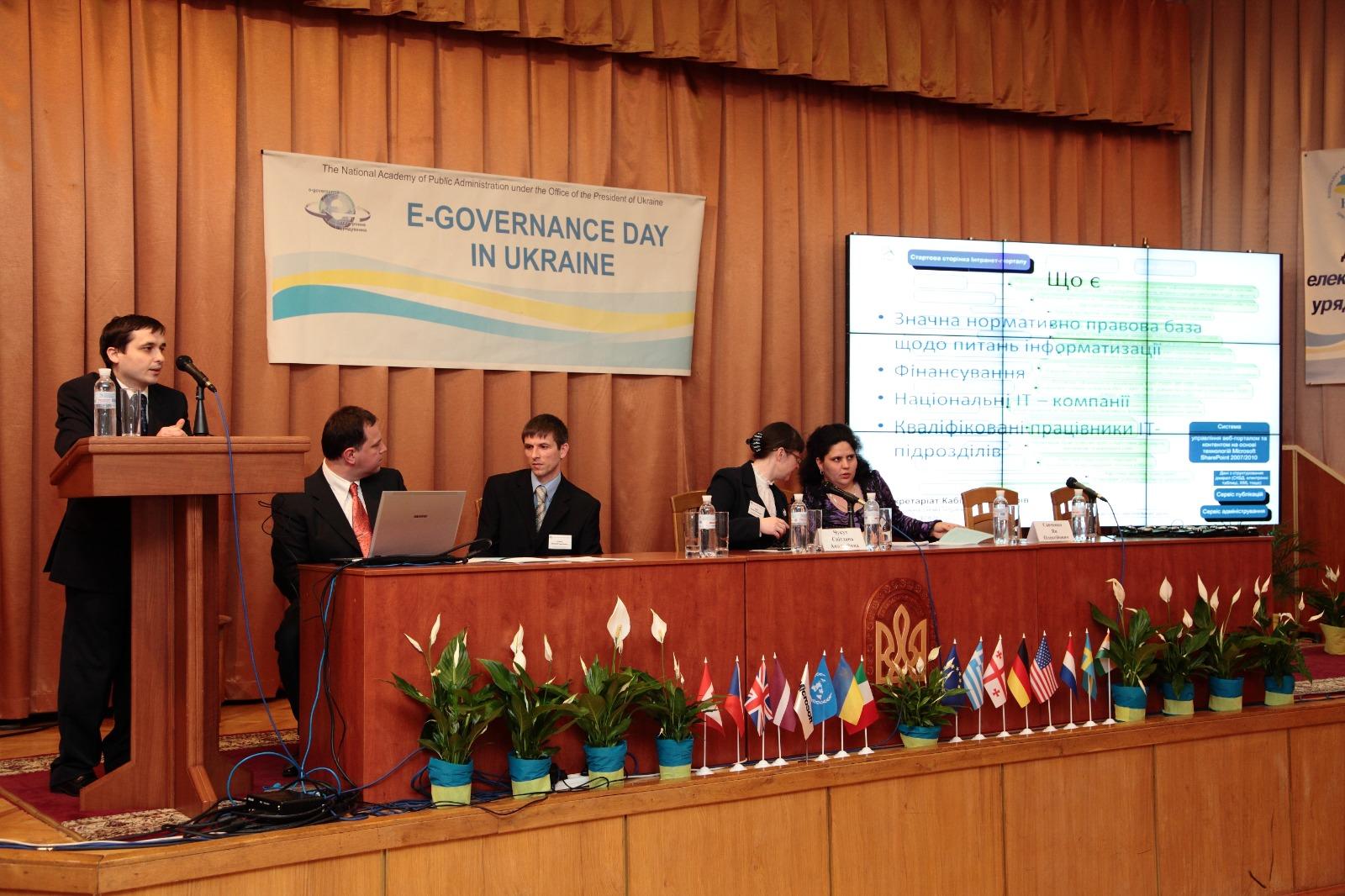
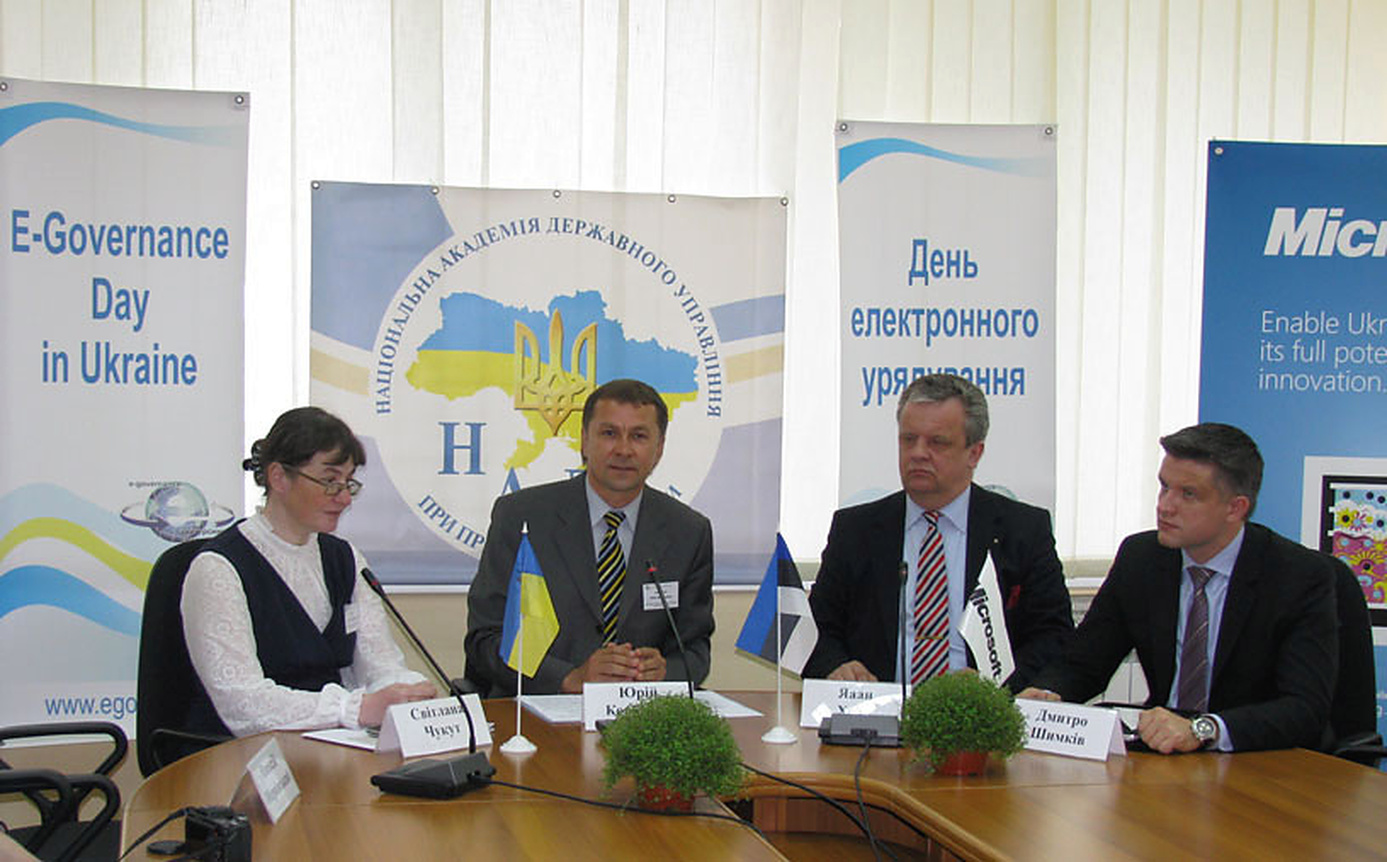
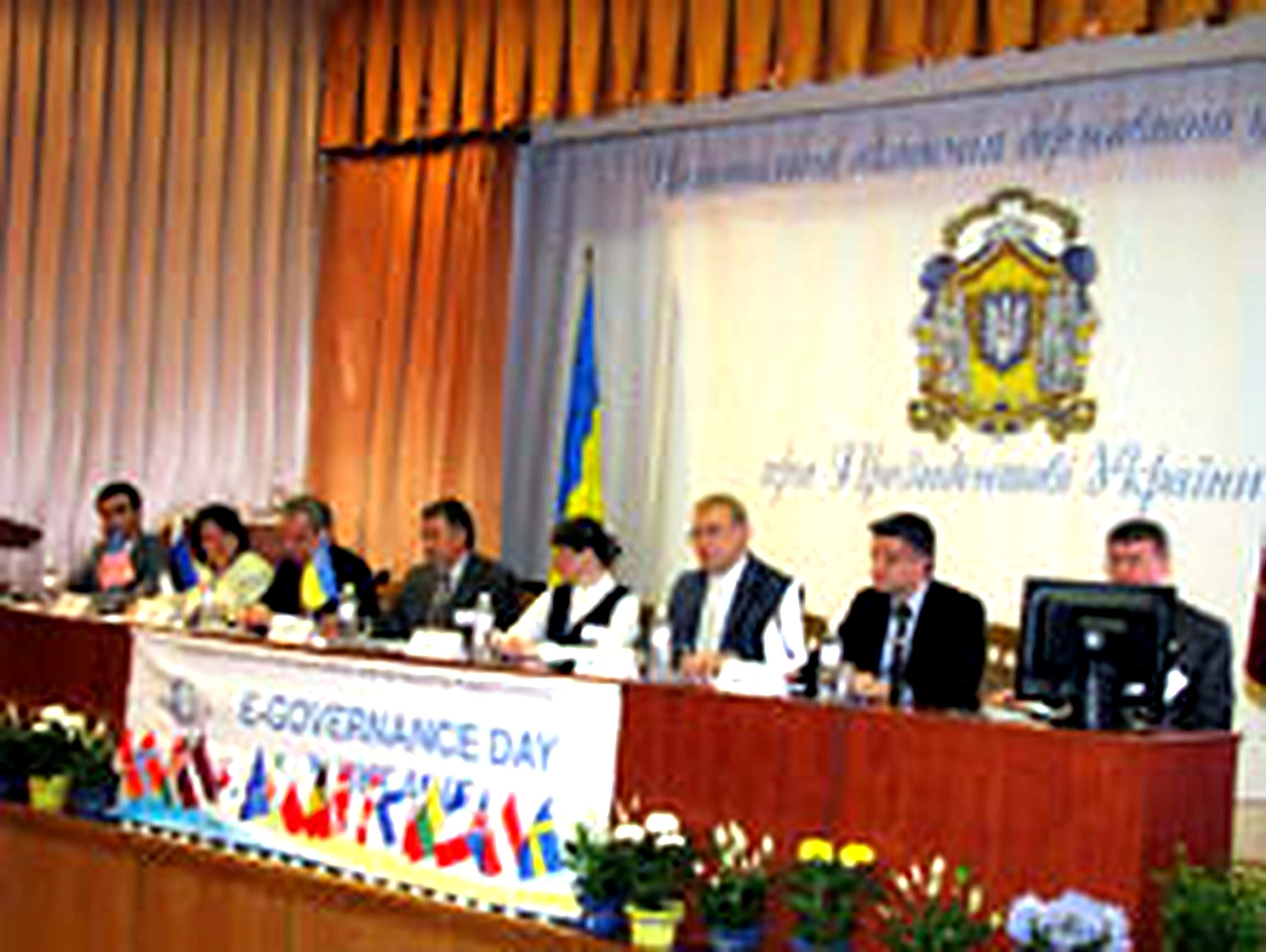
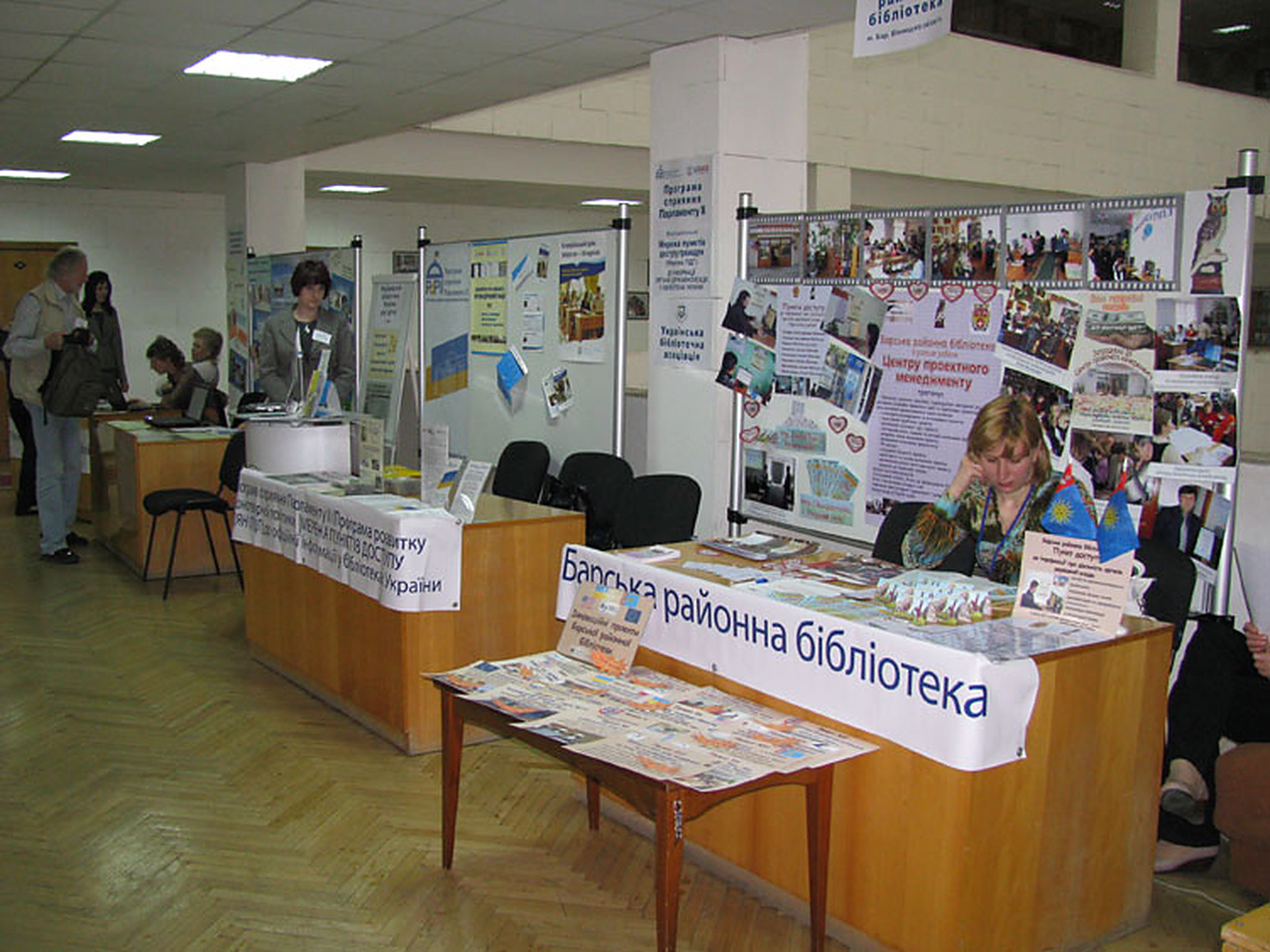
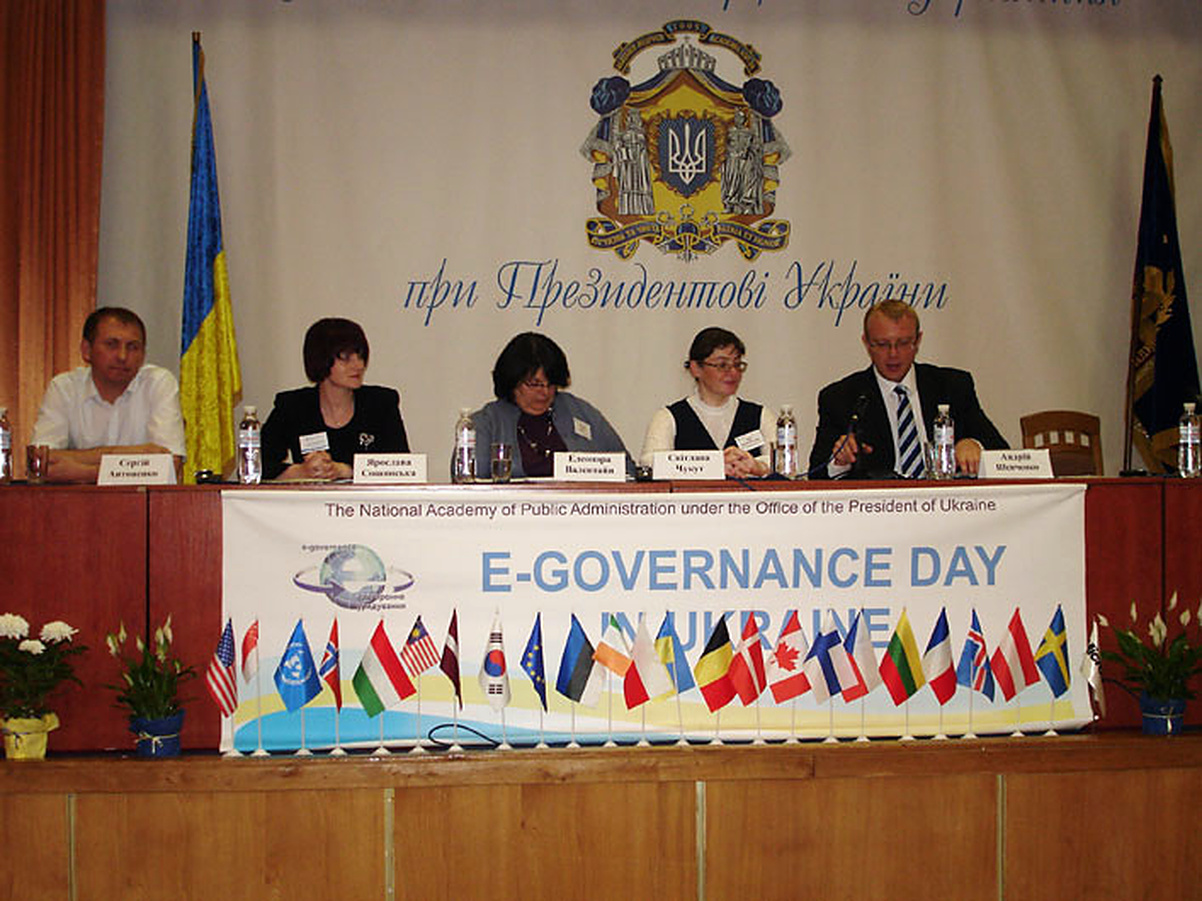
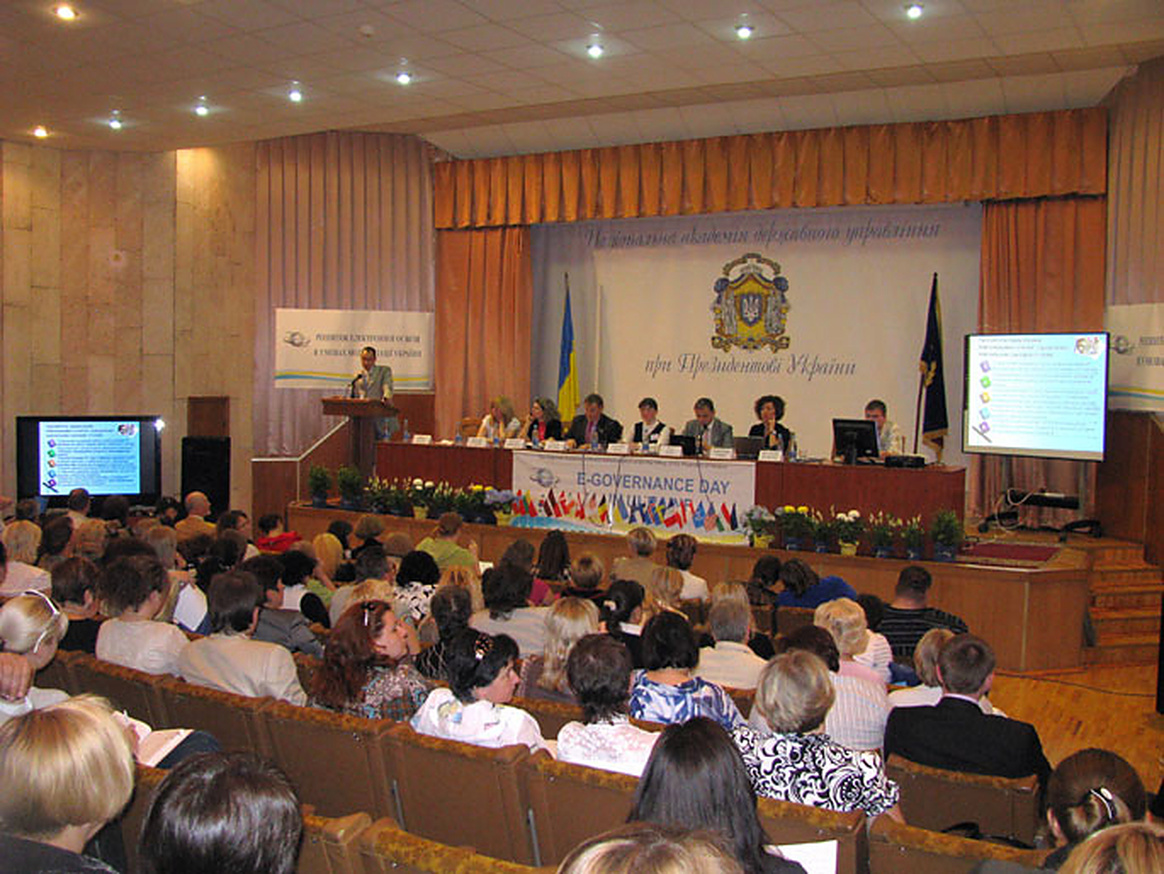
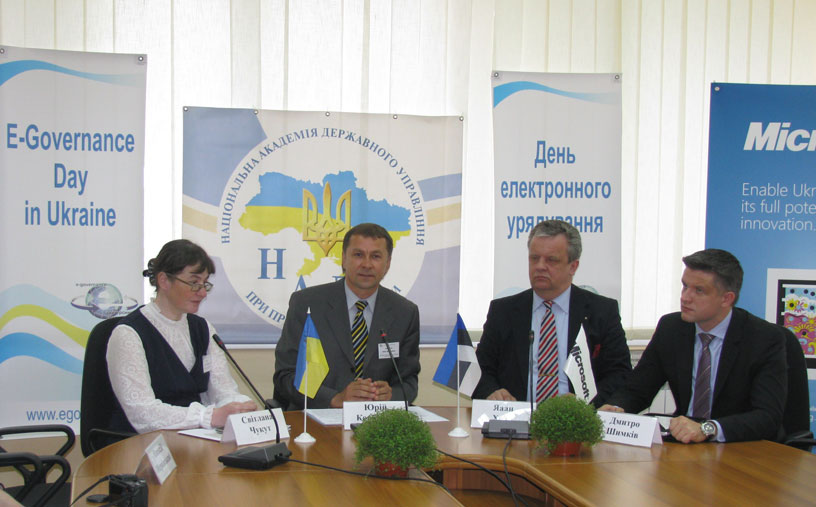
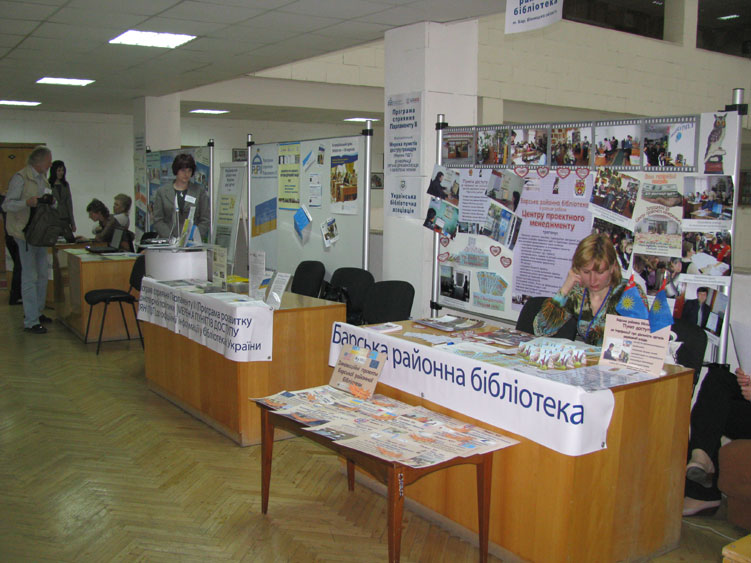
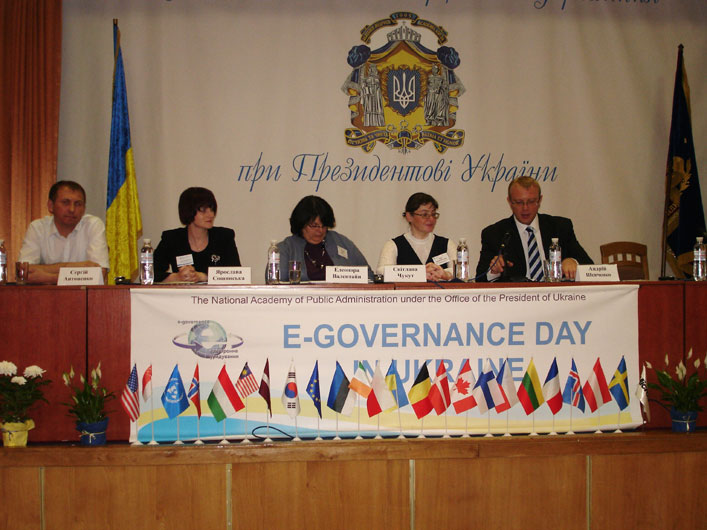
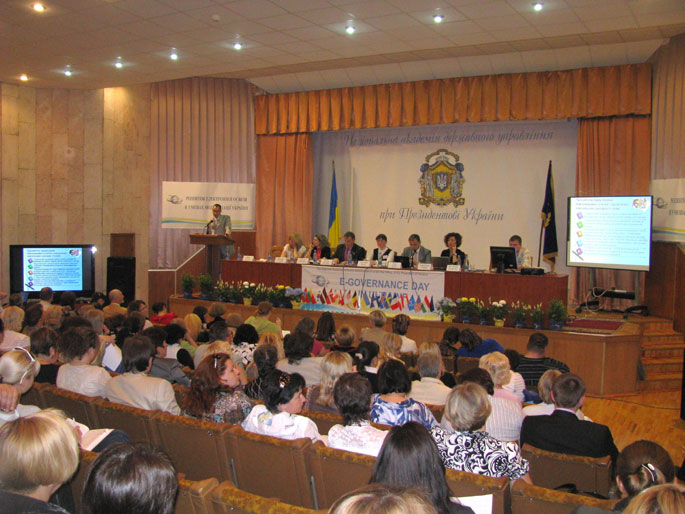
Initiator of the E-Governance Days (2008–2011).
2021 — First Open University Student Olympiad
Initiated and organised the First Open University Student Olympiad in E-Governance and chaired its jury.
Canada–Ukraine academic bridge: curriculum development and learning-content production.
Education
The knowledge foundation
Degrees, defended dissertations and academic ranks, from 1989 to the WES Canada credential verification.
Credential Verification — WES Canada
2023
Ukrainian academic credentials verified by World Education Services (WES) Canada.
Academic Ranks
2000 · 2002
Academic title of Professor conferred in 2002; academic title of Associate Professor conferred in 2000.
Highest scientific degree
Doctor of Sciences in Public Administration
1999 · Ukrainian Academy of Public Administration under the President of Ukraine
Doctoral dissertation: “Reproduction of the Generational Integrity of Spiritual Culture (Managerial Aspect)”; scientific consultant: Professor Vitalii Skurativskyi.
PhD in Social Philosophy
1993 · Taras Shevchenko National University of Kyiv
PhD dissertation: “Succession of Spiritual Culture: A Socio-Philosophical Analysis”; supervisor: Professor Ivan Nadolnyi.
Specialist Degree in Philosophy, with Honours
1989 · Taras Shevchenko National University of Kyiv
Degree in Philosophy awarded with honours.
Timeline
Career step by step
Academic and professional appointments in Ukraine and Canada, 1993–2026.
Creative Producer, George Brown Polytechnic (Toronto)
October 2025 – April 2026
Continued developing courses and led the production of digital learning materials for multidisciplinary postsecondary projects. She designed gamified activities, simulations and branching scenarios that let learners practise decisions they would face in the workplace. She developed assessments aligned with course outcomes and current labour-market needs, selected authoritative sources for course readings and activities, and applied accessibility principles and responsible AI practices in digital production.
Content Producer, George Brown Polytechnic (Toronto)
September – October 2025
Continued course and module development for online and blended delivery. She developed gamified exercises, simulations and branching scenarios based on workplace situations, designed assessments to measure how learners applied what they had learned, and selected reliable, relevant sources to support the course content.
George Brown changed the job titles as part of a college-wide effort to cut costs and reduce staffing. Course development remained part of her work in both production roles.
Key role
Curriculum Developer, George Brown Polytechnic (Toronto)
June 2024 – September 2025
Contributed to 17 course initiatives and more than 50 practice-oriented modules across work-integrated learning, regulatory compliance, financial services, hospitality and tourism, mass timber, construction entrepreneurship, and transition to nursing practice. Designed competency-based frameworks, scenario-based activities, authentic assessments and H5P learning objects for Brightspace (D2L). Worked with academic leads, instructional designers and subject-matter experts to align materials with learning outcomes, professional standards and AODA/WCAG accessibility expectations.
Key role
Professor, Department of Theory and Practice of Management, National Technical University of Ukraine «Igor Sikorsky Kyiv Polytechnic Institute»
September 2013 – September 2025
Taught and conducted research in public administration, digital government, e-democracy, smart cities, communication, AI and sustainable development. Helped develop bachelor’s, master’s and PhD programmes and national standards for all three levels, and supported accreditation. Developed more than 10 online and hybrid courses in Moodle and supervised more than 60 doctoral and master’s research projects, advising students on research design, data collection, writing and publication. Served as PhD programme guarantor and on the master’s programme’s scientific and methodological commission (2018–2025). In 2021, she initiated and organised the Open University Student Olympiad in E-Governance and chaired its jury.
Head of the Department of Theory and Practice of Management, Igor Sikorsky Kyiv Polytechnic Institute
February 2015 – February 2021
Led the department’s academic and operational work, including faculty coordination, programme delivery, curriculum development, research and institutional collaboration. Coordinated initiatives across functions and supported licensing, accreditation and quality improvement for Public Governance and Administration programmes. The 2019 conference programme identifies her as acting head.
Key role
Head of the Chair of Information Policy, National Academy of Public Administration under the President of Ukraine
January 2007 – January 2012
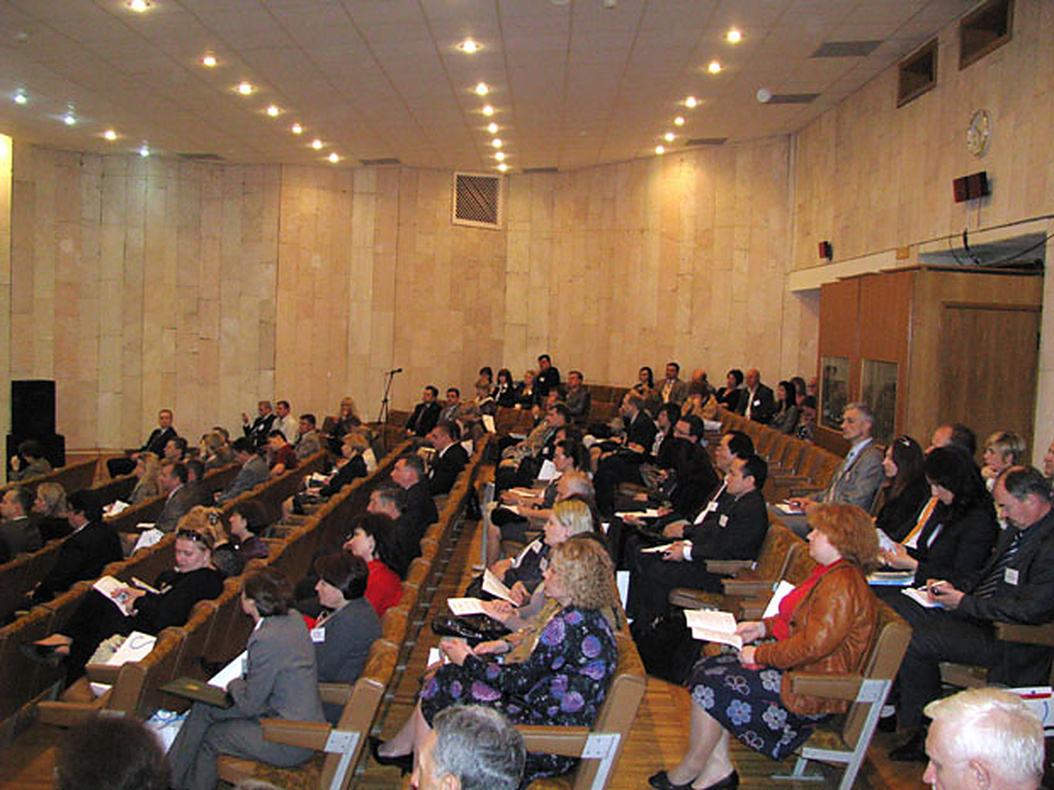
Led faculty and curriculum development, research and programme improvement in information policy, public administration and e-governance. Developed an educational qualification and master’s programme in Electronic Government for civil servants, integrating public administration theory, digital-service delivery and professional training for officials in central and local government. Initiated and led Ukraine’s E-Governance Days, which grew from 300 participants in 2008 to more than 1,000 across the 2011 forum.
Scholarly leadership
Editor-in-Chief of the journal “E-Governance”
2009–2011
Led the international scholarly journal E-Governance from 2009 to 2011 as editor-in-chief. The journal provided a dedicated venue for research on electronic government and public administration.
National contribution
Member of the Working Group on the Concept of E-Governance Development in Ukraine
2008–2010
Co-developed Ukraine’s national E-Governance Development Concept in a working group supported by the International Renaissance Foundation. The Cabinet of Ministers approved the concept by Order No. 2250-r on 13 December 2010. She also served on the Public Council of the State Committee for Informatization of Ukraine (2008–2011).
Professor and Deputy Head of the Chair of Information Policy, National Academy of Public Administration under the President of Ukraine
October 2001 – January 2007
Developed master’s specialisations in Information Processes in Public Administration and Information Policy and Information Technologies. Designed distance-learning curricula in Information Policy and Public Relations, and designed and delivered 10 short professional training programmes for public servants. Also developed an e-governance module for master’s students through an international public administration reform project involving the Academy and the Higher School of Management and Law in Berlin.
Associate Professor, Department of Philosophy and Methodology of Public Administration, National Academy of Public Administration under the President of Ukraine
November 1999 – September 2001
Designed and taught graduate courses in Information Society, Cultural Policy and Public Administration in the Department of Philosophy and Methodology of Public Administration. Alongside graduate teaching, delivered lectures and professional training for public servants.
Assistant Professor, Ukrainian Medical Dental Academy
August 1993 – September 1996
Taught Philosophy, Sociology, Philosophical Anthropology, Deontology in Medicine and Ethics at the Ukrainian Medical Dental Academy in Poltava. Developed curricula, syllabi, semester plans, assessment materials, reading lists and teaching resources for students at the academy.
Documented registry
Awards & honours
Twenty-two distinctions — newest first.
Certificate of Gratitude
Faculty of Sociology and Law, National Technical University of Ukraine «Igor Sikorsky Kyiv Polytechnic Institute»
Gratitude of the Faculty of Sociology and Law of the National Technical University of Ukraine «Igor Sikorsky Kyiv Polytechnic Institute» (2023).
Gratitude for preparing the winner (1st place)
International competition of student scientific works “Managerial, social and behavioral sciences in the implementation of the principles of sustainable development”
Gratitude for a significant contribution to the development of student science and the high-quality preparation of the winner (1st place) in the international competition of student research papers. May 2023; associated with the National Technical University of Ukraine «Igor Sikorsky Kyiv Polytechnic Institute».
Certificate of gratitude — order No. 102 of 10 May 2023, Ivano-Frankivsk National Technical University of Oil and Gas
Certificate of Acknowledgement — “Black Sea Science 2023”
Odesa National University of Technology
Certificate of Acknowledgement (No. BSS-2023.4.36) of the International Competition of Student Scientific Works “Black Sea Science 2023”, organised by the Odesa National University of Technology (Odesa, Ukraine), awarded in recognition of excellent work as a scientific supervisor for the participant in the field of “Power Engineering and Energy Efficiency”.
Acknowledgement for advancing student research
Ivano-Frankivsk National Technical University of Oil and Gas
Gratitude for a significant contribution to the development of student science and the high-quality preparation of the winner (2nd place) in the international competition of student research papers “Managerial, social and behavioral sciences in the implementation of the principles of sustainable development”. May 2022; associated with the National Technical University of Ukraine «Igor Sikorsky Kyiv Polytechnic Institute».
Field competition commission recognition
Field Competition Commission, All-Ukrainian Student Research Competition
The competition commission recognised Prof. Chukut for supervising prize-winning and second-round entries in Public Administration and Management.
Diploma, second place
National Agency of Ukraine on Civil Service
Together with Ya. Tsymbalenko — distinction in the “Master’s training in 281 Public Administration” category of the Best Practices of Educational Innovation competition.
Acknowledgement as an organising-committee member
National Technical University of Ukraine «Igor Sikorsky Kyiv Polytechnic Institute»
Open University Student Olympiad in E-Governance.
Acknowledgement as a jury member
National Technical University of Ukraine «Igor Sikorsky Kyiv Polytechnic Institute»
Open University Student Olympiad in E-Governance.
Acknowledgement for coaching a prize-winner
Kyiv National Economic University
Coached O. Shyts, who placed second in the All-Ukrainian student research competition in Public Administration.
Certificate of gratitude of the Kyiv National Economic University named after Vadym Hetman, 8 April 2021
Diploma for high scientific and pedagogical professionalism
Kyiv National University of Trade and Economics
Diploma for preparing the winners (1st and 2nd places) of the All-Ukrainian competition of student research papers in public administration and management. April 2021.
Diploma, third place
National Agency of Ukraine on Civil Service
“Master’s training in 281 Public Administration” category of the Best Practices of Educational Innovation competition.
Framed diploma, third place — National Agency of Ukraine on Civil Service, October 2020
Certificate of merit for academic mentorship
Kyiv National University of Trade and Economics
Coached the third-place prize-winners.
Acknowledgement
Ministry of Education and Science of UkraineCertificate of gratitude of the Ministry of Education and Science of Ukraine, signed by Minister Liliia Hrynevych
Acknowledgement for service on the field commission
Kyiv National University of Trade and Economics
All-Ukrainian student research competition in Public Administration.
Acknowledgement as a jury member
National Technical University of Ukraine «Igor Sikorsky Kyiv Polytechnic Institute»
All-Ukrainian Student Olympiad in Public Administration.
Acknowledgement for organising the Student Olympiad
National Technical University of Ukraine «Igor Sikorsky Kyiv Polytechnic Institute»
Gratitude (Podjaka) for a high level of organisation and conduct of the second stage of the All-Ukrainian Student Olympiad in the specialty “Public Management and Administration”, held on 15–17 May 2019 at the National Technical University of Ukraine «Igor Sikorsky Kyiv Polytechnic Institute» (Kyiv).
Honorary distinction of the Academic Council
National Technical University of Ukraine «Igor Sikorsky Kyiv Polytechnic Institute»Honorary diploma of the National Technical University of Ukraine «Igor Sikorsky Kyiv Polytechnic Institute»
Acknowledgement to the supervisor of winners
Faculty of Sociology and Law, National Technical University of Ukraine «Igor Sikorsky Kyiv Polytechnic Institute»
Public thanks as scientific supervisor of the All-Ukrainian competition winners: one 1st place and two 2nd-place diplomas.
Certificate of merit for coaching prize-winners
Kyiv National University of Trade and Economics
On 12 April 2018, the university awarded this certificate for supervising a winner in the second round of the All-Ukrainian Student Research Competition in Public Governance and Administration (2017–2018).
Acknowledgement for organising the Student Olympiad
National Technical University of Ukraine «Igor Sikorsky Kyiv Polytechnic Institute»
Gratitude (Podjaka) for a high level of organisation and conduct of the second stage of the All-Ukrainian Student Olympiad in the specialty “Public Management and Administration”, held on 28–30 March 2018 at the National Technical University of Ukraine «Igor Sikorsky Kyiv Polytechnic Institute» (Kyiv).
Acknowledgement
National Technical University of Ukraine «Igor Sikorsky Kyiv Polytechnic Institute»
Gratitude (Podjaka) for a high level of organisation and conduct of the second stage of the All-Ukrainian Student Olympiad in the discipline «Strategic Management», held on 26–28 April 2017 in Kyiv at the National Technical University of Ukraine «Igor Sikorsky Kyiv Polytechnic Institute». Signed by the head of the Olympiad organising committee, P. O. Kyrychok.
Honorary certificate
National Academy for Public Administration under the President of Ukraine
Qualifications and professional development
Certificates & training
The documented qualifications: the most recent certifications first, then the established training.
43
Licenses & certifications
43 licenses and certifications — from the World Bank (2001) to the University of Oxford and UNESCO certificate (2026). Documented and most recent entries follow.
Recent certifications
2026 · 31 October 2026
AI and Digital Transformation in Government
University of Oxford — Saïd Business School · in partnership with UNESCO
A programme of the University of Oxford’s Saïd Business School, developed in partnership with UNESCO, on applying artificial intelligence and digital transformation in government — practical skills, strategic tools and ethical frameworks of direct value to public servants and researchers.
Certificate signed by Caroline Williams, Executive Director, Oxford Saïd Online, and Guilherme Canela, Director for Digital Policies, UNESCO. Developed by Saïd Business School, University of Oxford; CPD certified course.
Certificate “AI and Digital Transformation in Government” issued to Prof. Svitlana Chukut on 31 October 2026.
Navigating AI: AI AgentsInstitute of Public Administration of Canada (IPAC) · May 2026 Credential ID: feeb7815-8406-444e-adc5-cc97c0d5af7dAI Prompts for Gamified Learning DesignGeorge Brown Polytechnic · LinkedIn Learning · February 2026Introduction to AI LiteracyAcadia University · February 2026How to Design and Deliver Training ProgramsGeorge Brown Polytechnic · LinkedIn Learning · February 2026Navigating AI: AI Agents for Public ServiceInstitute of Public Administration of Canada (IPAC) · February 2026 Credential ID: 262f80b2-029d-427d-a367-53ca6c70c92aMicrosoft AI SkillsMicrosoftNavigating AI: A Practical Guide for Public ServantsInstitute of Public Administration of Canada (IPAC) · May 2025 Credential ID: 938b0d9f-f4ae-436d-afcf-5bfeb995dcffNavigating AI: A Practical Guide for Public ServantsInstitute of Public Administration of Canada (IPAC) · December 2024 Credential ID: d56fa1c5-e04c-4627-b55d-8066242dce2bFuture Skills: Artificial Intelligence — How It Impacts Human CreativityGeorge Brown Polytechnic · September 2024Digital Proficiency: Microsoft ExcelGeorge Brown Polytechnic · August 2024Future Skills: Digital Confidence — Translate Trials into SuccessesGeorge Brown Polytechnic · August 2024Working Together: The Code and the AODAGeorge Brown Polytechnic · July 2024Doing the Work: An Introduction to Anti-RacismGeorge Brown Polytechnic · July 2024Respect in the Workplace: Workplace Violence & Harassment Prevention for EmployeesGeorge Brown Polytechnic · July 2024AODA General RequirementsGeorge Brown Polytechnic · July 2024AODA Information and Communication StandardGeorge Brown Polytechnic · July 2024AODA Customer Service StandardGeorge Brown Polytechnic · July 2024Prompt Engineering for EducatorsVanderbilt University · May 2024 Credential ID: 934Z8SXTAQVVGenerative AI for Educators & TeachersVanderbilt University · May 2024 Credential ID: JD8XR7BUTM6BGPT Vision: Seeing the World through Generative AIVanderbilt University · May 2024 Credential ID: UZGHT6SLWNC7Generative AI AssistantsVanderbilt University · May 2024 Credential ID: F7FFS4XZJ7ZJOpenAI GPTs: Creating Your Own Custom AI AssistantsVanderbilt University · May 2024 Credential ID: V3EETH9FWLB9Certificate of Participation — German and Slavic Studies II International Multidisciplinary Conference “Main Challenges and Issues of University Education in War Conditions: Ukraine – 2022-2024”University of Manitoba · April 2024Prompt Engineering SpecializationVanderbilt University · December 2023 Credential ID: ATX2F7LAH2PNChatGPT Advanced Data AnalysisVanderbilt University · December 2023 Credential ID: RFF2UQXG47VSTrustworthy Generative AIVanderbilt University · December 2023 Credential ID: D6YJ8QCMNVZQPrompt Engineering for ChatGPTVanderbilt University · December 2023 Credential ID: 74TUDPQ559A3Generative AI for LeadersVanderbilt University · December 2023 Credential ID: 725LSSUVGMGJCertificate in Curriculum DevelopmentCanadian College of Educators · December 2023Generative AI for EveryoneDeepLearning.AI · November 2023 Credential ID: 3FY5F87MF6EVAI Foundations: Prompt Engineering with ChatGPTArizona State University · November 2023 Credential ID: WGLG48P2PG2CInnovative Teaching with ChatGPTVanderbilt University · November 2023 Credential ID: 6J38FNCS4HKDAn Introduction to Qualitative Methods in Research in the United StatesUkraine Global Faculty · Jonathan Cisco · September 2023 Credential ID: 64fa8f7fbc2ce217c30cbe1dAn Introduction to the Use of Quantitative Methods in Research in the United StatesUkraine Global Faculty · Jonathan Cisco Credential ID: 64faabcb5131864b090556efCourse on Research Ethics based on the Tri-Council Policy Statement (TCPS 2: CORE)Tri-agency Institutional Programs Secretariat, Canada · July 2023 Certificate #0000942553Certificate of AppreciationAlliance of Guangzhou International Sister-City Universities (GISU) · July 2023 Teaching programme: “Research on innovations, sustainability and mechanisms of tourism development: challenges and opportunities for Ukraine”Enhanced Language Training (ELT) — Teaching and EducationCOSTI, Canada · June 2023Certificate of ParticipationAlliance of Guangzhou International Sister-City Universities (GISU) · Digital and Entrepreneurship Academy · October 2021 Programme “SMART Cities and Tourism”; presentation: “Development of SMART cities: current trends, challenges and threats” · 28 October 2021
Documented qualifications
2021 · August
Fundamentals of test theory
Completed the Ministry of Education and Science of Ukraine training “Fundamentals of Test Theory, development and review of test tasks”.
2019 · September
Expert on accreditation of educational programs
Completed the Prometheus online training for Agence nationale d'assurance qualité de l'enseignement supérieur. Credential ID: db509020286646e7878573586e5f1592.
What the document says (original in Ukrainian): the National Agency for Higher Education Quality Assurance of Ukraine, through the Prometheus online learning platform, certifies that Prof. Svitlana Anatoliivna Chukut successfully completed the course “Expert on Accreditation of Educational Programs: Online Training”. Issued 19 October 2019.
2017 · № 14122017-30
DOCCU project
Completed the 90-hour (3 ECTS credits) master-trainer programme in education for democratic citizenship, human rights and civic competencies. The Swiss-Ukrainian DOCCU project trained university instructors who teach in master’s programmes in Public Governance and Administration. Issued in Kyiv on 14 December 2017.
2012 · № 42281
Copyright certificate
Received a copyright certificate for the collection “E-Governance: Concept, Methodology, Tools and Programmes” from the State Intellectual Property Service of Ukraine. Authors: Prof. Svitlana Chukut and Olha Zahvoiska. Published in Bulletin No. 27 of 2 July 2012. Holder of the economic rights: Prof. Svitlana Chukut. UANIPIO registry record →
2011 · April
Public-sector modernisation
Completed training in public-sector modernisation through e-government, organised by National University of Kyiv-Mohyla Academy, the Main Department of Civil Service, and Telenor / European Competence Ltd.
2001 · June
Theory and practice of distance learning
Completed the World Bank GDLN programme with UADU and the Institute of Administrative, Economic and Political Management.
The complete list comprises 43 licenses and certifications.
Prof. Svitlana Chukut studies how public institutions govern technology and deliver services when trust, access and continuity are under pressure. Her work brings comparative public administration and information policy together with research on digital services, civic participation and responsible AI. She has led registered research programmes, contributed to national policy, and translated findings into practitioner guides, local pilots and university teaching.
Digital government and public trust
E-Governance & Digital Government
Digital Inclusion & E-Democracy
Information Policy
Crisis & Wartime Digital Governance
European Integration of Digital Governance
AI, smart cities and public services
Smart Cities & Smart Governance
Artificial Intelligence in Public Administration
Human-Centred Digital Transformation
Information, culture and inclusion
Digital Culture & Cultural Diversity
Generational Continuity & Spiritual Culture
Open Data, Open Science & Open Education
Digital learning and professional capacity
Gamification & Microlearning
Generative AI in Education
Future-Ready Workforce & Lifelong Learning
Methods and analytical approach
Comparative policy analysis. Her work compares institutional arrangements and digital-government practices across jurisdictions, with attention to the conditions required for their adaptation.
Documentary and historical analysis. Legislation, institutional records and archives provide evidence of how public responsibilities, information policy and administrative practices have developed.
Case studies and programme analysis. Studies of electronic services and smart-city initiatives examine implementation in its organisational context, including participation, service continuity and access.
Stakeholder perspectives. Consultation and practitioner engagement inform the analysis of implementation constraints and the translation of research into guidance for public institutions.
Research-informed learning design. Research on digital governance, AI-assisted learning and gamification informs scenarios, teaching resources and professional-development activities.
Qualitative and quantitative evidence. Her portfolio includes mixed-methods projects and research on public servants’ AI competencies. The research question and available evidence determine the analytical approach.
Knowledge mobilisation. Publications, practitioner guides, policy contributions and teaching connect research findings with institutional decisions and professional practice.
Accessibility and inclusion. Her applied work considers barriers associated with disability, language and cultural context. Accessibility principles inform the design of digital learning resources.
Research projects and partnerships
The portfolio traces how questions about transparency, public participation and institutional capacity developed into research on digital services, responsible AI and recovery. Each project identifies her role, the question investigated and the outputs where documented.
Principal investigator — artificial intelligence, smart tourism and Ukraine’s recovery
2024 · GISU Research 2024
Principal investigator and research supervisor. The study uses mixed methods to assess where AI may support tourism services and economic recovery in Ukraine, and what safeguards are needed to manage privacy, data governance, misinformation and cybersecurity risks. Its policy questions concern both wartime operations and post-war recovery. The academic CV records an award of CNY 500,000.
Orbicom's Collaborative Research Projects “Digital transformation of public administration and local government: challenges and opportunities for achieving SDGs”
Mar 2023 – Sep 2025
Research collaboration through the Orbicom network and Igor Sikorsky Kyiv Polytechnic Institute. The work considers how wartime conditions reshape the way Ukrainian institutions communicate with the public and organise digital services. It also examines the implications of AI for the production and reliability of public information.
Digital transformation of public administration and local government for the Sustainable Development Goals
2023–2028
Research supervisor for KPI’s registered project No. 0123U101483. The project asks how national and local authorities can use digital transformation to advance the Sustainable Development Goals. It examines wartime public communication, disinformation and open-source intelligence, as well as how institutions respond to the risks and opportunities of generative AI.
Research contract — audit of Energoatom activities
2021
Conducted a social audit of Energoatom activities concerning employees and the public under the Environmental and Social Action Plan. The work focused on the social commitments of the Comprehensive Safety Upgrade Program for Ukrainian nuclear power units, including how the programme addressed information and consultation with affected groups. Contract No. D/0201.01/3011.01.
GISU Alliance – 2022 · Tourism / Smart Cities
Aug 2021 – Feb 2024
Research contributor through Igor Sikorsky Kyiv Polytechnic Institute. The GISU Alliance project examined business strategies for rebuilding tourism after COVID-19, including how technology could support resilience and recovery. Prof. Chukut extended the discussion to Ukraine’s wartime context through her 2023 symposium contribution on smart tourism, a topic she later pursued in a joint journal article.
The GISU Alliance presented her with a Certificate of Appreciation on 11 July 2023 for teaching in its programme on innovation, sustainability and tourism development in Ukraine.
Modern trends in the implementation of e-governance in Ukraine: best practices
2018–2021 in the departmental register
Research supervisor, state registration No. 0118U100305. The project compared Ukrainian and international e-governance practices to identify which approaches could be adapted to Ukraine and what institutional conditions would make implementation feasible. The academic CV lists January 2018 to December 2020.
Research supervisor, state registration No. 0115U000019. The team examined e-parliament, civic participation in smart cities and local e-governance. Across these settings it studied how digital tools change the relationship between institutions and residents, and what public authorities need to put them into practice. Findings informed university teaching.
E-Governance for Accountability and Community Participation — EGAP (Switzerland)
Aug 2015 – Dec 2017
Expert in the Swiss-funded E-Governance for Accountability and Community Participation programme. The assignment brought her expertise in Ukrainian public administration to an implementation programme that connected electronic public services with government accountability and opportunities for residents to participate in local decisions.
Theoretical, methodological, organizational and institutional principles of e-governance implementation
Jan 2010 – Dec 2011
Research supervisor, state registration No. 0201U004833. Led the Academy team in comparing models for organising e-governance at national, regional and local levels, with Olha Zahvoiska responsible for project execution. The work fed directly into policy drafting and a master’s course in e-governance.
Final report and documented outputs
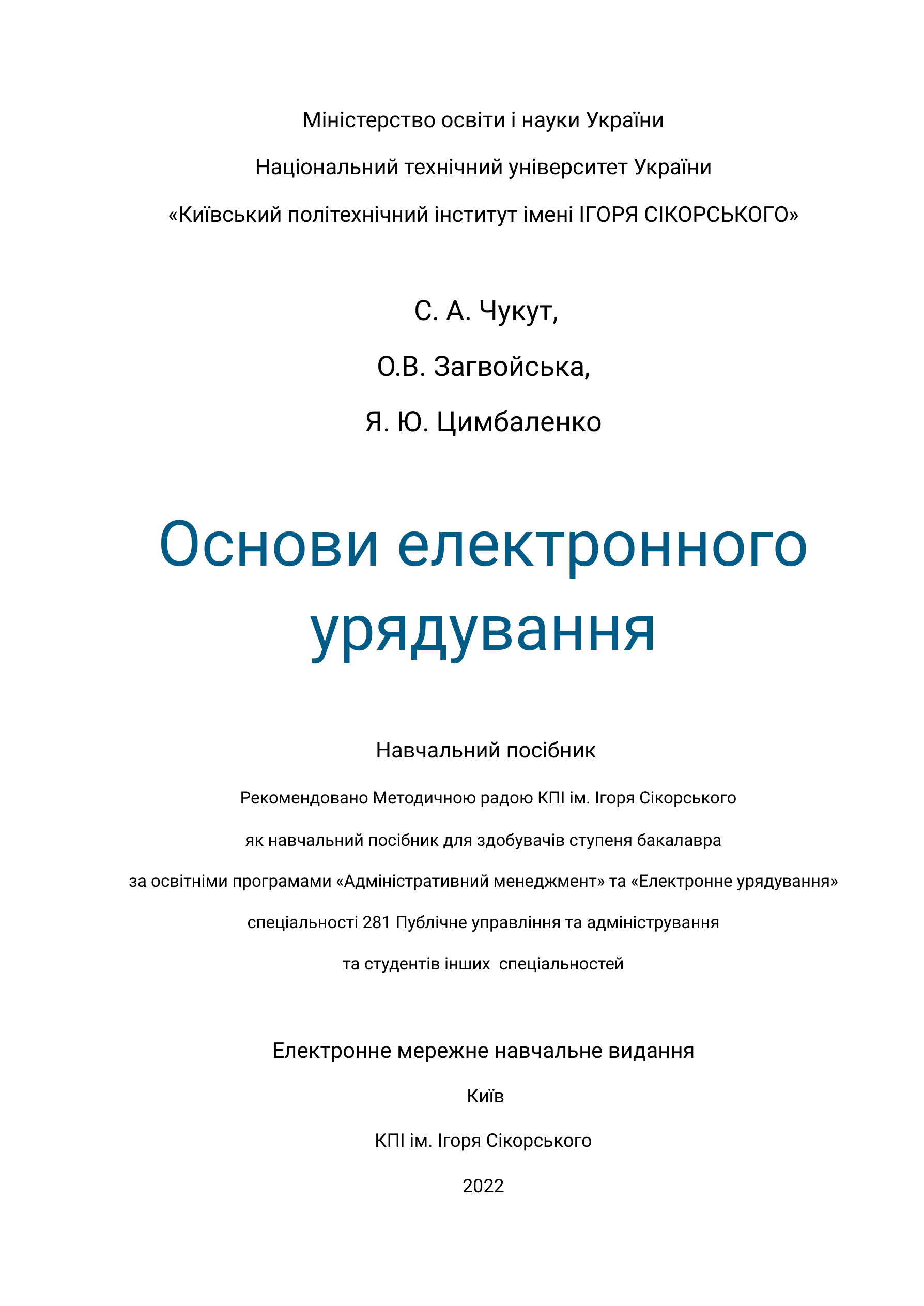
Final report of the Academy research project carried out by the Information Policy Chair under Prof. Svitlana Chukut's scientific supervision (responsible executor: Olha Zahvoiska), completed in December 2011 (180 pp., 152 sources). The project studied the patterns of e-governance formation in Ukraine and abroad, its essence, methods and principles and its institutional implementation models at the national, regional and local levels, and the foreign experience of master's programmes in e-governance. Its team took a direct part in drafting the Electronic Government Development Concept for Ukraine and its implementation plan, and in drafting the statutes of the profile central executive bodies. The project's outputs include the methodical and information-analytical materials of the normative course of the same name for the master's specialty "E-Governance", the first two issues of the international journal "E-Governance", and conference and E-Governance Days materials; its results were implemented in the profile unit of the Secretariat of the Cabinet of Ministers of Ukraine and the State Agency for Science, Education and Informatisation of Ukraine, and used in the Academy's teaching.
Elaboration of Concept for the Development of E-Governance in Ukraine
Jan 2009 – Dec 2010
Co-author and working-group member. With support from the International Renaissance Foundation, the group brought Ukrainian institutions and international e-governance experts together to develop a national framework. Prof. Chukut contributed comparative and institutional research that informed the drafting of the Concept and its implementation plan. The Cabinet of Ministers approved the Concept on 13 December 2010 by Order No. 2250-r.
Establishing mechanisms of effective interaction between the Government, the public and the media: theoretical and applied aspect
Jan 2009 – Dec 2010
Research supervisor, with Olha Zahvoiska responsible for project execution (No. 0109U003027). The project studied how government institutions, media and civic organisations interact, and how public bodies can support civic responsibility. The team developed teaching guidance and a textbook on communication in public administration. It piloted civic-responsibility work in Kherson oblast and Crimea, and its results were used by the Public Relations Department of the Cabinet Secretariat.
Research and methodological guide: government–civil society engagement
2010
Scientific supervisor (fifteen-author collective). Kyiv: National Academy of Public Administration under the President of Ukraine, 2010. — 64 pp. A product of research project No. 0109U003027: civic responsibility and civil society, government–public interaction and media influence, sociocultural project design at the regional level, risks in communication projects, the project-based introduction of e-governance and e-democracy in the regions (the 'School of E-Governance' pilot), media propaganda and 'dirty' PR technologies, non-governmental analytical centres.
Developing scientific and methodological support for public relations in executive bodies
Jan – Dec 2008
Research supervisor and general editor, state registration No. 0107U005909. The team examined how executive authorities organise public relations and translated the findings into a 72-page methodological guide for practitioners, published in Kyiv in 2008.
Promoting public administration reform and cooperation in the field of training
Sep 2005 – Dec 2008
Expert in the German-supported public administration reform and civil-service training project implemented by Ukraine’s National Academy of Public Administration and the Higher School of Management and Law in Berlin. She developed a master’s module on e-governance, bringing comparative experience into the professional preparation of public administrators in Ukraine.
Practical use of electronic government and governance — methodological recommendations
2007
Compiled with T. V. Dzhyha, O. P. Poprotskyi, A. V. Borovska and O. V. Karpenko. Kyiv: National Academy of Public Administration under the President of Ukraine, 2007. — 32 pp. Issued within the collection 'Applied scientific developments for use by employees of state authorities and local self-government bodies'; approved by the Academy's Academic Council on 24 May 2007 (protocol No. 134/5-13).
E-governance development: prospects and obstacles in Ukraine and abroad
2006
Research report of the National Academy of Public Administration under the President of Ukraine. The report compared Ukrainian and international experience to identify the institutional conditions and barriers to implementing e-governance.
Selected research proposals
Digital Inclusion of Vulnerable Groups in Smart Cities (2022) — Proposal to the National Research Foundation of Ukraine. Proposed measuring digital inclusion, assessing needs through mixed methods, comparing policy scenarios and developing a roadmap for more equitable access to smart-city services.
Digital Skills / Ukrainian Forced Female Migrants in Latvia (2022) — Ukrainian–Latvian proposal examining how access to technology and digital skills could support the social inclusion of Ukrainian women forcibly displaced to Latvia.
Digital & Educational Reintegration of Youth from De-Occupied Territories (2022) — Proposal on how digital tools and educational provision could help young people from liberated and temporarily occupied territories reconnect with Ukrainian education, framed in the context of national security.
Digital Educational Reintegration of Youth (SDGs) (2021) — Proposal linking digital access and educational continuity for young people from temporarily occupied territories with Ukraine’s Sustainable Development Goals.
Supervision
Graduate & doctoral supervision
From the research question through to the defence, Prof. Svitlana Chukut supervises work in public administration, information policy and digital governance. Her supervision spans the National Academy of Public Administration and Igor Sikorsky Kyiv Polytechnic Institute.
master’s theses supervised
60+
doctoral dissertations defended
5
student projects recognised in national competitions
11
Defended doctoral dissertations
Guarantor of KPI’s PhD programme in Public Governance and Administration (2018–2025) and member of specialised dissertation defence councils.
Anna Ishchenko
Digital Transformation of Public Administration in the Context of Gender Mainstreaming
PhD in Public Governance and Administration
The dissertation examines how gender mainstreaming can improve access to digital public services and shape the transformation of Ukraine’s civil service. It combines a survey of public officials, in-depth interviews with experts, and analysis of legislation and policy documents. It traces the development of digital accessibility in Ukraine and uses the empirical findings on digital competencies to formulate recommendations for gender-responsive policy and professional development in the civil service.
Mechanisms for Implementing E-Governance at the Local Level
Candidate of Sciences in Public Administration
The dissertation develops a framework for implementing e-governance at the local level. It reviews Ukraine’s legal arrangements and compares international practices, including German coordination across levels of government and European interoperability principles. Its recommendations connect technical standards with municipal governance, including coordination among national, regional and local authorities, citizen involvement in decision-making, and urban living labs for testing services with the people who use them.
Government Information Campaigns on European Integration in Poland: A Theoretical and Methodological Approach
Candidate of Sciences in Public Administration
The dissertation compares Poland’s government communication on European integration in 1999–2004 with Ukraine’s in 2004–2007. It examines campaign design through target audiences, messages, channels and feedback, and links the effectiveness of Poland’s campaign to the sequencing and execution of its main stages. It refines the classification of campaigns by purpose and offers recommendations for informing the Ukrainian public about European integration.
Formation of Public Opinion: Mechanisms of State Regulation of Information Flows
Candidate of Sciences in Public Administration
The dissertation studies the formation and expression of public opinion under the influence of information flows. It proposes a theoretical model of how shared attitudes form and analyses the channels through which they are expressed, including surveys, petitions, public debate and the media. It examines how public authorities can support open expression and how regulation can address covert influence while preserving the conditions for public opinion to develop freely.
Formation of the Information Society in Ukraine in the Context of Integration into the European Union (Public-Administration Aspect)
Candidate of Sciences in Public Administration
The dissertation examines the policy and institutional conditions for developing Ukraine’s information society as the country pursues European integration. It reviews European approaches to coordination and legislation and considers Ukraine’s needs in telecommunications, public-sector information systems and personal data protection. Its recommendations include a state programme to encourage the use of information and communication technologies and an information and analysis centre to support national and local authorities.
Use of Artificial Intelligence in the Modernization of Public Administration and E-Governance in Ukraine
Building on her master’s work on the Internet of Things, this research examines how AI can modernise public administration and digital services in Ukraine.
Improving Government-Citizen Interaction through Mobile Applications
The thesis examines how public authorities use mobile apps to deliver services and communicate with residents. It reviews Ukraine’s legal framework for mobile government and compares Diia and local apps with international examples. The comparison informs recommendations for improving the accessibility and quality of mobile services and making communication with residents more responsive.
Digitalization of Archival Processes in the Context of Formation of the National Archival Fund and Its Integration into the Global Information Space
The thesis examines how digitisation changes the way Ukraine’s National Archival Fund preserves records and makes them accessible. It covers the legal framework, the organisation of archival records, and practical decisions about equipment, software and documentation standards. Drawing on international experience, it proposes ways to improve access to digitised collections and integrate Ukrainian archives into the global information space.
Application of Internet of Things Technologies in Sectoral E-Governance: International and Ukrainian Experience
The thesis compares Ukrainian and international uses of the Internet of Things in sectoral e-governance. It asks how data from connected devices can inform the operation of public services across sectors. Kruts’s related research provides concrete examples in healthcare and urban infrastructure, including remote monitoring, the management of health data and municipal applications of connected devices.
Digital Marketing in Communications of Public Administration Bodies: International Experience and Ukrainian Practices
The thesis looks at digital marketing as a means for public authorities to communicate with residents. Its comparative scope covers Ukrainian practices and international experience. The topic raises practical questions about selecting digital channels for different audiences, making information about public services easier to find, and creating opportunities for residents to respond to government communications.
Data Analytics in Public Administration: International and Ukrainian Experience
The thesis examines how public institutions can turn large datasets into information for decisions and service delivery. It reviews international and Ukrainian applications of big data, discusses methods for collecting and analysing data, and considers the privacy issues that arise when public authorities use them. The work connects analytical capacity with practical questions about institutional readiness and implementation in Ukraine.
Introducing Electronic Services in the Reintegration of Temporarily Non-Government-Controlled Territories
The thesis asks how residents of territories temporarily outside government control can obtain Ukrainian administrative services in the context of reintegration. It reviews service delivery in Donbas, including the role of administrative service centres, and draws on Estonia’s experience with digital government. The recommendations consider how online access and electronic identification can complement in-person support where distance and movement restrictions make services harder to reach.
Using E-Democracy Tools to Improve Interaction between Government and Citizens
The thesis examines how digital participation tools can improve interaction between public authorities and residents. Its focus is the link between opportunities to express preferences online and the public decisions those contributions can inform. A related example from Volochai’s public work is Kyiv’s participatory budget, where residents take part in choosing proposals for municipal funding.
Government Portal as a Tool for Implementing E-Governance
The thesis considers the government portal as a point of entry to Ukraine’s digital administration. It focuses on how a single portal can organise information from multiple public bodies and guide residents to relevant online services. Puchynets also presented on the Ukrainian government portal at the Forum of Direct Democracy, addressing its problems and opportunities for improvement.
Introducing Electronic Services for Vulnerable Population Groups: International and Ukrainian Experience
The thesis examines how digital services can be made accessible to people who face barriers related to disability, digital skills or access to technology. It reviews Ukrainian rules and compares international approaches, including Denmark’s experience with digital services and user support. The work offers recommendations for national and local authorities on accessible design, digital literacy and support for people who need help using online services.
Implementation of Electronic Services at the Municipal Level: Best European Practices
The thesis takes municipal service delivery as the starting point for comparing European e-government practices. It asks which elements of those practices may be relevant to Ukrainian municipalities and what adaptation would require at the local level. The focus is on how residents find and use public services online and how municipal authorities organise those services.
Mechanisms of State Regulation of Public Procurement
The thesis analyses how Ukraine regulates public procurement and how electronic tenders change the way public spending can be scrutinised. It examines procurement rules, the rollout of ProZorro, and tools such as DoZorro for flagging and following up on concerns. The study treats competition, accountability and effective oversight as conditions for making procurement reform work.
Establishing Electronic Interagency Cooperation among Ukrainian Public Authorities with Reference to International Experience
The thesis studies how Ukrainian public authorities can exchange data electronically so that residents can access services that draw on information held by multiple agencies. It compares Estonia’s approach to digital identity and data exchange with Ukraine’s legal and institutional arrangements, including the early development of Trembita. The recommendations address institutional coordination, staff training and the conditions for reliable interagency exchange.
Several projects led to conference presentations or peer-reviewed articles.
Lidiia Shumska and Oleksandra Shyts
Social inclusion in smart energy systems during wartime
1st place · International competition
The winning project places social inclusion at the centre of smart energy planning during wartime. It asks how digital energy infrastructure can serve groups with different needs while supporting sustainable development in Ukraine. The authors’ related publications examine how big data can inform smart grids and how cities can address barriers to inclusion. KPI records two specialist publications and three conference presentations arising from the work.
E-governance and the Sustainable Development Goals during COVID-19
2nd place · International competition
The award-winning study examines how digital government can support the Sustainable Development Goals during the COVID-19 pandemic. One concrete strand of Skreminskyi’s related work compares mobile apps used internationally to help control the spread of COVID-19. That example connects the contest topic to the practical problem of maintaining a public response when face-to-face contact is restricted. KPI records three publications arising from the study.
Introducing Social Inclusion in Smart Cities: Best International and Ukrainian Experience
Shyts compares Ukrainian and international approaches to social inclusion in smart cities. The paper reviews the policy framework and examines how digital inequality can limit access to municipal services even as new technologies make those services easier to deliver. It recommends that municipal authorities consider who can use digital services, identify groups at risk of isolation and account for their needs when designing urban initiatives.
Introducing Electronic Health Services Using Internet of Things Technologies
Kruts examines how connected devices and electronic medical records can support digital health services. The paper compares European practices and the use of de-identified electronic records in the United States, then reviews the development of Ukraine’s eHealth system. Its recommendations address the practical use of connected technologies alongside the protection of patient information.
Electronic Services as a Tool for Reintegrating Temporarily Non-Government-Controlled Territories
The authors examine how people in temporarily occupied areas of Donetsk and Luhansk could access Ukrainian administrative services. They draw on Croatia’s reintegration experience and Finland’s digital public services. The paper proposes a single digital access point for Donbas and a public information campaign to explain how residents could use the services remotely.
Electronic Services for Vulnerable Groups: Ukrainian and International Experience
Tsiptsiura compares Ukraine’s framework for digital services with international practice and examines barriers for people who need accessible or assisted services. The paper proposes an index to assess how accessible Ukraine’s digital services are and uses the comparison to inform recommendations. The project connects digital inclusion with a practical method for evaluating public services.
Kruts studies how connected devices can be used in municipal services and compares Ukrainian and international practice. The paper examines opportunities for automation and data analysis alongside privacy, data protection and cybersecurity risks. It offers implementation recommendations for Ukrainian public authorities, including municipal administrations.
Best International Practices in Smart-City Development and Opportunities for Their Implementation in Ukraine
Feshchenko compares smart-city initiatives in Singapore, Amsterdam and Chicago and examines Kyiv’s early smart-city programme in light of those examples. The paper looks at how open data, connected devices and urban living labs can support municipal services and the testing of new approaches. It identifies practices Ukrainian cities could adapt to their own institutional and regulatory circumstances.
Directions for Implementing the E-Governance Development Experience of Chile and Belgium in Ukraine
Pashchak and Plotnikova examine how Chile and Belgium organised digital public services. Chile’s Trámite Fácil portal and digital support for start-ups illustrate ways to make administrative procedures easier to find and use. Belgium’s federal portal and electronic ID provide examples of service access and authentication. The authors consider how elements of these approaches could be adapted to Ukraine’s emerging e-governance system.
Transitioning Procurement to Electronic Format as an Effective Anti-Corruption Tool
Kuts examines how moving tenders online can help detect corruption risks in public procurement. The study reviews the stages of a tender and compares international e-procurement experience before analysing Ukraine’s ProZorro system. It explains how public tender information, risk indicators and DoZorro monitoring support scrutiny, and discusses oversight practices that can turn flagged issues into follow-up.
Introducing Electronic Interoperability as a Necessary Condition for E-Governance Development: International and Ukrainian Experience
Prylepko’s competition presentation uses Estonia’s electronic ID and X-Road data exchange as examples of the infrastructure needed for integrated public services. It describes how Ukraine began adapting the Estonian approach through Trembita and illustrates its early use in land-lease registration. Recommendations cover public communication, funding and training for officials who implement interagency services.
The presentation traces Ukraine’s early digital-government reforms, including electronic trust services and the adoption of a digital economy strategy. It uses public-service examples to show how those reforms affected practical delivery.
The comparison centres on Estonia’s electronic identity card and X-Road data exchange. The Ukrainian case follows the adaptation of X-Road as Trembita and a 2017 electronic service for registering land-lease agreements.
Prylepko recommends informing the public, securing funding, and training or retraining public officials. The presentation also cites a conference paper from November 2017 and reports that Rent-Alliance used the research results.
Kateryna Konashevska and Olena Kyseliova
Implementing the E-Democracy Development Experience of Japan and New Zealand in Ukraine
Konashevska and Kyseliova compare Japan’s and New Zealand’s approaches to e-democracy. They examine ways people can access parliamentary information and communicate with public institutions, including New Zealand’s parliamentary portal. The authors compare those examples with Ukraine’s tools for electronic participation and consider how institutional websites can support public feedback and dialogue.
European Practices of Electronic-Service Delivery in Law Enforcement and Prospects for Their Implementation in Ukraine
Poliarna and Riabets compare digital police services in European countries, including the United Kingdom, Sweden and Denmark, with the services available in Ukraine at the time. The paper examines how police websites provide information and let residents complete routine procedures online. It identifies ways Ukrainian police agencies could improve access to information and broaden the range of services available digitally.
The expert and trust roles: research evaluation, doctoral programmes, education quality and government working groups.
2010–2011
Policy and regulatory development for digital government
While heading the Department of Information Policy at the National Academy of Public Administration under the President of Ukraine, Prof. Svitlana Chukut contributed to policy proposals on e-governance and the information society. The department’s 2010–2011 work addressed executive coordination, draft regulatory instruments, public services and training for civil servants.
The Cabinet of Ministers approved Ukraine’s E-Governance Development Concept, which she co-developed, on 13 December 2010 and approved its implementation plan on 26 September 2011. The Academy documents below present proposals prepared during that period.
Prof. Chukut’s 2007–2011 departmental report records her participation in developing and discussing the draft Law on Access to Public Information. It also documents collaboration with the Cabinet Secretariat, the Council of Ministers of the Autonomous Republic of Crimea, and the Kherson regional and Novovorontsovka district administrations on research and its practical application.
The 2009 forum recommendations also called for a national concept, common standards and dedicated civil-service training. Academy correspondence shows how the National Academy sought support for professional recognition of e-governance and how the programme’s design responded to the staffing needs of state authorities.
Evaluating research projects for the National Research Foundation of Ukraine (since 2020). In 2024, she carried out expert evaluation of two research projects: “Forming a methodology of public management for the development of social engineering based on digital platforms in post-war Ukraine” and “Public administration in the field of healthcare: effective models under modern challenges”.
Education
Academic Lead, PhD Programme 281
Academic lead (guarantor) for the PhD programme in Public Management and Administration at the National Technical University of Ukraine «Igor Sikorsky Kyiv Polytechnic Institute» (2018–2025).
Quality assurance
Deputy Chair, National Agency for Higher Education Quality Assurance Field-Specific Expert Council
Deputy chair of Field-Specific Expert Council 28 for Public Administration and Management (2019–2020).
Government
NSDC & Presidential Secretariat working groups
Worked on state-administration information systems and procedures for implementing NSDC decisions.
Publishing
Editor-in-chief
Led the international journal E-Governance (2009–2011).
International
EGAP project expert
Expert on the Swiss-Ukrainian E-Governance for Government Accountability project (2015–2017).
Regional government · Expert council
Scientific and Technical Council of the Kyiv Regional State Administration
Expert of the Scientific and Technical Council of the Department of Economy of the Kyiv Regional State Administration (since September 2021): evaluation of local development projects, including the digital transformation of public administration.
Jury · Student competitions
First Open University Student Olympiad in E-Governance (2021)
Initiated and organised the 18–19 May 2021 Olympiad at Igor Sikorsky Kyiv Polytechnic Institute and chaired its jury. The event connected students with public-sector practitioners through competitions, training and internship opportunities.
Scientific and Methodological Commission of the KPI Master’s programme
Member of the scientific and methodological commission of the Master’s programme in Public Administration and Management at Igor Sikorsky Kyiv Polytechnic Institute (2018–2025).
Jury · Student competitions
National student competition juries in public administration
Deputy chair of the jury of the All-Ukrainian Student Olympiad in the specialty “Public Administration” at Igor Sikorsky Kyiv Polytechnic Institute (2018 and 2019) and member of the jury of the All-Ukrainian Competition of Student Research Papers in Public Administration (2019).
Education · Standards
Chair of Sub-commission 281, Scientific and Methodological Council of the Ministry of Education and Science
Chair of Sub-commission 281 “Public Administration and Management” (March 2016 – September 2019): led the development of higher-education standards for the Bachelor’s, Master’s and PhD levels.
Government · Advisory council
Public Council of the State Committee for Informatization of Ukraine
Member of the Public Council of the State Committee for Informatization of Ukraine (2008–2011), alongside the working group on the national E-Governance Development Concept.
Government · Expert commission
Scientific and Expert Commission on Information Sector Affairs
Annex 1 to Order No. 44 of 2 March 2011 of the State Committee for Television and Radio Broadcasting of Ukraine lists Prof. Svitlana Chukut as a commission member, with her consent. At the time, she headed the Department of Information Policy at the National Academy of Public Administration under the President of Ukraine. The commission’s mandate was to provide expert assessments of applied research and development in the mass media sector.
Documentary source — Order No. 44, points 1 and 2 and Annex 1.
Government · Local
Working group on implementing e-governance in Brovary
Member of the working group on implementing e-governance in the city of Brovary; earlier she advised on developing the city's local educational network.
Attestation
Expert council of the Higher Attestation Commission of Ukraine — “Social Communications”
Member of the expert council of the Higher Attestation Commission of Ukraine for the field “Social Communications”.
Doctoral studies
Specialised academic council D 26.810.02
2009–2011. Served on the dissertation defence council at the National Academy of Public Administration under the President of Ukraine in the field of Public Administration, specialty 25.00.02, Mechanisms of Public Administration.
Academy councils
Councils of the National Academy of Public Administration
Member of the scientific-expert council, the scientific-methodical council and the council on informatization of the National Academy of Public Administration under the President of Ukraine.
Education
Scientific and Methodological Council of the Ministry of Education and Science
2008–2012. Served on the Scientific and Methodological Council of the Ministry of Education and Science of Ukraine in the field of Public Administration.
Doctoral studies
Specialised academic council D 26.891.02
2019–2021. Served on the council for Doctor of Sciences and Candidate of Sciences dissertation defences in Public Governance and Administration at the Institute for Personnel Training of the State Employment Service of Ukraine.
Education
Commission of the KPI Academic Council
Member of the commission for preparing proposals to legislative and normative documents of the Academic Council of Igor Sikorsky Kyiv Polytechnic Institute (since 2019).
International network
NISPAcee
Member of NISPAcee, the Network of Institutes and Schools of Public Administration in Central and Eastern Europe (2007–2014).
Scholarly service
Editorial, peer-review & scholarly service
From 2001 to 2024, her service included grant and dissertation assessment, journal leadership, manuscript peer review, and membership on academic councils and government working groups.
Research funding review
Grant proposal reviewer, National Research Foundation of Ukraine
Conducted expert reviews of two research proposals submitted to a competitive funding call of the National Research Foundation of Ukraine.
Grant proposal reviewer, National Research Foundation of Ukraine
Reviewed proposals submitted to a competitive funding call of the National Research Foundation of Ukraine on infodemics, online community management during COVID-19, and postgraduate teacher education under unpredictable conditions.
Research proposal reviewer, Ministry of Education and Science of Ukraine
2019–2022
Conducted expert reviews of research proposals submitted for funding from the Ministry.
Editorial roles and manuscript peer review
Peer reviewer, Journal of Information Policy
Reviewed a manuscript on information and communication technologies in governance and e-governance initiatives in India.
Manuscript reviewer
Reviewed a study on the Unified Professional Entrance Test, regulatory influence and the effectiveness of educational services.
Editorial board member, “Democratic Governance”
2008–2012
Served on the editorial board of Democratic Governance (Демократичне врядування), an electronic scholarly journal.
Editorial board member, publications of the National Academy of Public Administration under the President of Ukraine
2006–2012
Served on the editorial boards of the Bulletin (Вісник) and the Collection of Scientific Works (Збірник наукових праць) of the National Academy of Public Administration under the President of Ukraine.
Editorial board member, “Strategic Priorities”
2010–2011
Editorial board of the journal “Strategic Priorities”.
Editor-in-Chief, journal “E-Governance”
2009–2011
Led the specialised journal devoted to e-governance.
Dissertation assessment and academic councils
Dissertation reviewer, Public Administration
2001–2022
Conducted expert assessments on multiple occasions of dissertations submitted for Doctor of Sciences and Candidate of Sciences degrees in Public Administration.
Member, Specialised Academic Council D 26.891.02
2019–2021
Served on the council for Doctor of Sciences and Candidate of Sciences dissertation defences in Public Governance and Administration at the Institute for Personnel Training of the State Employment Service of Ukraine.
Member, Specialised Academic Council D 26.810.02
2009–2011
Served on the dissertation defence council at the National Academy of Public Administration under the President of Ukraine in the field of Public Administration, specialty 25.00.02, Mechanisms of Public Administration.
Member, Scientific and Methodological Council
2008–2012
Served on the Scientific and Methodological Council of the Ministry of Education and Science of Ukraine in the field of Public Administration.
Government working groups
Member, interagency working group of the National Security and Defence Council of Ukraine
2009–2011
Helped draft the procedure governing implementation of the Council’s decisions by the Cabinet of Ministers of Ukraine.
Member, working group of the Secretariat of the President of Ukraine
2008–2009
Contributed to the design, implementation, and operation of an information system on the activities of local state administrations.
Volunteering & civic expert work
Volunteering
Four volunteering roles: higher-education quality, education standards, research and regional development.
Expert of the Scientific and Technical Council
Department of Economy, Kyiv Regional State Administration
Since September 2021. Field: Politics — evaluation of local development projects, including the digital transformation of public administration.
Expert
National Research Foundation of Ukraine (National Research Foundation of Ukraine)
May 2020 – September 2025 · 5 years 5 months. Science and Technology: expert evaluation of national-level research projects.
Deputy Chair of the Expert Council on Public Governance and Administration
The National Agency for Higher Education Quality Assurance — Agence nationale d'assurance qualité de l'enseignement supérieur
October 2019 – April 2020 · 7 months. Field: Education — expert evaluation and accreditation of higher education programs in the field of public administration and management.
Chair of a Sub-commission on Public Governance and Administration, Scientific and Methodological Council
Ministry of Education and Science of Ukraine
March 2016 – September 2019 · 3 years 7 months. Field: Education — management of the development of higher education standards for bachelor's, master's, and PhD levels.
People & shared work
Professional collaboration
Partnerships with public authorities, universities, technology specialists and international research networks connect Prof. Svitlana Chukut’s work on digital government with public policy, professional training and joint publications.
National government and public policy
Co-developed Ukraine’s national E-Governance Development Concept. The Cabinet Secretariat and other public authorities applied research on digital government and government–public communication. Her work also included the State Committee for Informatization, the Presidential Secretariat’s working group on information systems for local administrations, and the National Security and Defence Council’s interagency working group.
In 2011, she was appointed to a State Committee for Television and Radio Broadcasting commission that brought together representatives of public institutions, educational bodies, media law, publishing and professional organisations.Commission mandate and appointment details
The 2010 proposals identified the Cabinet Secretariat’s information resources and technology unit, the Presidential Administration, ministries, the State Committee for Informatization and the State Service of Special Communications among the bodies that would coordinate or carry out the proposed measures. In 2011, the department also outlined possible cooperation with the European Union on civil-service training, policy design and pilot projects.
Worked with the Kherson Regional State Administration on public communication, applied research and the regional Presidential Personnel Reserve project. Research recommendations were used by its press and information department and by the Novovorontsov district education department, where she supported the pilot School of E-Governance. Served on Brovary’s e-governance working group (2006–2009) and joined the Scientific and Technical Council of the Kyiv Regional State Administration in 2021 to assess local development projects. Contributed to a civic-responsibility project with the Council of Ministers of the Autonomous Republic of Crimea.
International partnerships and training
Served as an expert on the Swiss-supported E-Governance for Accountability and Community Participation (EGAP) programme (2015–2017). Earlier, worked on a German-supported civil-service training project with the Higher School of Management and Law in Berlin, developing an e-governance module for master’s students (2005–2008). Collaborated with Estonian experts on Ukraine’s national concept, and later with researchers through GISU and Orbicom on smart tourism, digital governance and the Sustainable Development Goals.
Ukrainian universities and national higher education standards
As chair of the Ministry of Education and Science’s Subcommission 281 (2016–2019), Prof. Svitlana Chukut worked with colleagues from Ukrainian universities to discuss, develop and refine the national higher education standards for Public Governance and Administration. This work brought together academic perspectives on graduate competencies and learning outcomes, and on how programmes could prepare students for work in public authorities and local government.
Cross-department collaboration at Igor Sikorsky Kyiv Polytechnic Institute
At KPI, Prof. Chukut collaborated across departments, including with colleagues in information technology. She brought a public administration perspective to questions that require both policy and technical expertise, such as how public services are designed, how institutions exchange information, and what digital competencies students and public servants need.
Joint research and publications
Joint publications range from comparative studies of interoperability and public service delivery to research on how institutions adapt during crises. With Anna Ischenko, Prof. Chukut studied Ukrainian public servants’ skills in using AI tools. With Alla Karapoziuk, she examined the digitisation of archival processes. Her team’s study of smart tourism brought together research on wartime adaptation, technology and economic recovery, while work with Olha Zahvoiska and Yana Tsymbalenko produced a university textbook on e-governance.
Public Administration ★Public Services ★E-GovernanceE-DemocracyDigital GovernanceE-ServicesInformation PolicySmart CitiesDigital InclusionSustainable Development
★ Public Administration and Public Services: demonstrated at the Institute of Public Administration of Canada course “Navigating AI: AI Agents for Public Service”; endorsed by Olha Zahvoiska (1 endorsement each).
Artificial intelligence & data
Artificial Intelligence (AI)Generative AI ToolsPrompt EngineeringBig DataSmart GridInteroperabilityDigital transformation of public servicesAcademic and research leadership
Communications
Communication StrategiesCommunication CampaignsPublic RelationsStakeholder engagement
Research & education
Qualitative Research MethodsQuantitative Research MethodsResearch EthicsInnovative TeachingAccreditation of Educational ProgrammesHigher Education StandardsMixed-methods researchSurvey and questionnaire designPolicy and regulatory analysisProgramme evaluationGrant and manuscript reviewResearch-to-policy translation
Languages: Ukrainian — native; English — professional working proficiency; French — beginner, currently pursuing structured study toward professional working proficiency.
Patents & copyright certificates
“E-Governance Institute”Trademark “E-Governance Institute”, Ukraine, 2012 · joint holder Olha ZahvoiskaCollection “E-governance: concept, methodology, tools and programs”Copyright certificate No. 42281 · issued 16 February 2012 · published 2 July 2012, Bulletin No. 27 · authors Prof. Svitlana Chukut and Olha Zahvoiska · holder of the economic rights: Prof. Svitlana Chukut UANIPIO registry record →
Professor of Public Management and Administration, Hryhorii Skovoroda University in Pereiaslav
Director of Housing, Municipal Services and Energy Efficiency, Kyiv Regional Military Administration
25 December 2023 · Reported directly to Prof. Svitlana Chukut
Oleksandr Poprotskyy highlights Chukut’s expertise, perseverance, focus on results and commitment to professional development.
Recommendation summary
Jennifer Sommer
Manager, Innovative Curriculum, George Brown Polytechnic
Jennifer Sommer highlights Chukut’s perseverance, creativity and dedication, together with her expertise in education policy, curriculum and innovation.
Recommendation summary
Olha Zahvoiska
Associate Professor in the Department of Theory and Practice of Management at Igor Sikorsky Kyiv Polytechnic Institute during her collaboration with Prof. Svitlana Chukut
Olha Zahvoiska describes their collaboration at the National Academy of Public Administration and Igor Sikorsky Kyiv Polytechnic Institute. She highlights the E-Governance Days, research linking e-governance and the Sustainable Development Goals, and their joint teaching of Smart Cities and Fundamentals of E-Governance.
Memberships & organisations
Association of Smart Cognitive CitiesMember · since October 2022Kyiv Regional State AdministrationMember of the Scientific and Technical Council · since September 2021National Research Foundation of UkraineExpert · since May 2020Agence nationale d'assurance qualité de l'enseignement supérieurDeputy Chair, Expert Council 28 “Public Administration and Management” · October 2019 – March 2020Scientific and Methodological Council, Ministry of Education and Science of UkraineChair, Sub-commission 281 “Public Administration and Management” · since April 2016Network of Institutes and Schools of Public Administration in Central and Eastern Europe (NISPAcee)Member · since 2007Smart Cities CouncilMember · Washington, D.C.
Legacy
Founding initiatives
Prof. Chukut helped establish new specialisations, a journal and a young scholars’ union, and contributed to developing an occupational classification entry.
since 2020
PhD programme in Public Management and Administration
Led development of the third-level doctoral programme of the National Technical University of Ukraine «Igor Sikorsky Kyiv Polytechnic Institute»; programme guarantor.
since 2020
Courses on the Sikorsky (Moodle) platform
Built complete distance-learning packages: Smart Cities, Fundamentals of E-Governance, E-Democracy and more.
since 2015
‘Modern Problems of Management’ conferences
Co-organiser of the series; deputy chair of the organising committee in 2019.
2015–2020
Two-level E-Governance programmes
Led development of National Technical University of Ukraine «Igor Sikorsky Kyiv Polytechnic Institute» bachelor's and master's programmes; authored core-discipline syllabi.
2013–2015
‘E-governance’ specialty
Developed and licensed the master’s specialisation at National Technical University of Ukraine «Igor Sikorsky Kyiv Polytechnic Institute»; led development of two-level programmes.
2009–2011
Editor-in-chief of ‘E-governance’ journal
Headed the international scholarly journal — confirmed by issue No.1/2010 masthead.
2007–2011
National Academy of Public Administration under the President of Ukraine Information Policy Department
Headed the department and the ‘Information Policy and Communications’ complex.
2008–2010
Ukraine’s first e-governance concept
Served on the working group funded by the International Renaissance Foundation; the Cabinet of Ministers adopted the concept.
2001–2010
Founder of the National Academy of Public Administration under the President of Ukraine Young Scientists Union
Created and headed the young scientists’ union of the National Academy of Public Administration.
2000s
‘Information Policy’ specialization
Initiated the first information policy specialisation and wrote the first textbook.
2000s
Profession 1229.7 in the classifier
Initiated the addition of ‘Head of e-governance organizational systems’ to the occupational classifier.
219records in the publication catalogue, newest first94works in Google Scholar1,956citations in Google Scholar20h-index in Google Scholar
Books
Books and contributions
Monographs, textbooks, edited collections and chapters by Prof. Svitlana Chukut as author, co-author or editor. Entries identify her role and link to the text or bibliographic record where available.
Title page, not a designed cover
2022 · 268 pp.
Fundamentals of Electronic Governance
Prof. Svitlana Chukut, Olha Zahvoiska and Yana Tsymbalenko. An electronic textbook published by National Technical University of Ukraine «Igor Sikorsky Kyiv Polytechnic Institute».
An eight-chapter introduction combining concepts, international comparisons, Ukrainian experience and research-based learning activities.
Description
This 268-page electronic textbook, published by Igor Sikorsky Kyiv Polytechnic Institute in 2022, provides a structured introduction to e-governance for undergraduate students in Specialty 281, Public Administration and Management, including the Administrative Management and E-Governance programmes. It also supports the university-wide course Fundamentals of Electronic Governance. Prof. Svitlana Chukut is a co-author and the responsible editor, alongside co-authors Olha Zahvoiska and Yana Tsymbalenko.
Its eight chapters connect conceptual foundations with the institutional and societal dimensions of digital government. They examine models of e-governance and implementation barriers; United Nations assessment methods and indices, including e-government development, online services, telecommunications infrastructure, human capital, e-participation and local online services; and the development of e-governance in Ukraine.
The treatment of digital public services addresses service maturity, interoperability, inclusion of vulnerable groups and the Diia portal, with examples from Austria and Denmark. Further chapters examine e-democracy, electronic petitions, e-parliament and electronic voting, including Council of Europe standards and experience from the United States and Estonia. The final chapter considers network warfare and the COVID-19 pandemic as challenges for digital governance and democratic participation.
The teaching framework extends beyond subject knowledge. The introduction identifies skills in evidence gathering, analysis, recommendations, teamwork and decision-making. The textbook includes individual research assignments, team-project requirements and suggested topics, a glossary and references. These elements support independent inquiry and discussion of how institutions can introduce digital services while considering participation, inclusion and implementation risks.
Domestic and Foreign Experience of Implementing E-Governance
Proceedings of the first E-Governance Day (Kyiv, 14 May 2008), National Academy of Public Administration under the President of Ukraine. General editor: Prof. Svitlana Chukut; co-editor: Olha Zahvoiska.
Description
Proceedings of the scientific-practical conference held at the National Academy of Public Administration under the President of Ukraine for E-Governance Day on 14 May 2008 (Kyiv, 2008, 128 pp.; general editors Prof. Svitlana Chukut and Olha Zahvoiska; recommended by the Academy's Academic Council, protocol No. 148/8-4 of 28 August 2008). The volume presents scientific-practical approaches, research results and implementation experience in e-governance and e-democracy: its sections cover e-governance at the central level and at the local level, electronic services, e-democracy, and the main tasks of e-government — including the role of the Microsoft corporation in carrying them out — and it closes with the recommendations adopted from E-Governance Day 2008. The materials, drawn from the leading domestic and foreign experience of e-governance in central, local and regional administration, are addressed to public-administration and business practitioners, heads of state and local authorities, enterprises, institutions and civil-society organisations, and to everyone who studies, researches, implements or uses e-governance technologies.
First edition · 2006Cover of the Ukrainian-language textbook
2006 · 663 pp.
Information Policy — a textbook
Heorhii Pocheptsov and Prof. Svitlana Chukut · Kyiv, Znannia
Description
A fundamental study guide offering a comprehensive examination of the theoretical, legal and managerial foundations of information policy in the context of building the information society, integrating the approaches of public administration, political science, law and the theory of strategic communications. Prof. Svitlana Chukut's authorial contribution covers the institutional-managerial and digital blocks of the discipline: the theoretical and methodological foundations of implementing electronic government, the stages of the digital transformation of public administration and the models of electronic democracy; a comparative analysis of successful world practices of information-society and e-governance development (the European Union, the USA, Great Britain, Estonia, Singapore); and the mechanisms of Ukraine's state information policy, the protection of information resources, citizens' access to public information and overcoming the digital divide. One of the first basic academic editions in Ukraine to integrate e-governance into a general course on state information policy, the book contains a complete teaching and methodological complex — a glossary, review questions, topics for research papers and the normative base — and is widely used in training specialists in public administration, political science, international relations and information security.
Second edition · 2008Cover of the Ukrainian-language textbook
2008 · 663 pp.
Information Policy — a textbook
Heorhii Pocheptsov and Prof. Svitlana Chukut · Kyiv, Znannia
Description
A fundamental study guide offering a comprehensive examination of the theoretical, legal and managerial foundations of information policy in the context of building the information society, integrating the approaches of public administration, political science, law and the theory of strategic communications. Prof. Svitlana Chukut's authorial contribution covers the institutional-managerial and digital blocks of the discipline: the theoretical and methodological foundations of implementing electronic government, the stages of the digital transformation of public administration and the models of electronic democracy; a comparative analysis of successful world practices of information-society and e-governance development (the European Union, the USA, Great Britain, Estonia, Singapore); and the mechanisms of Ukraine's state information policy, the protection of information resources, citizens' access to public information and overcoming the digital divide. One of the first basic academic editions in Ukraine to integrate e-governance into a general course on state information policy, the book contains a complete teaching and methodological complex — a glossary, review questions, topics for research papers and the normative base — and is widely used in training specialists in public administration, political science, international relations and information security.
Prof. Svitlana Chukut, Tetiana Dzhyha. Lecture outline, National Academy of Public Administration under the President of Ukraine, Kyiv, 2007.
Description
Lecture outline for the course "Information Policy in Ukraine" by Prof. Svitlana Chukut and Tetiana Dzhyha (Kyiv, 2007, 94 pp.). The outline sets out the main theoretical and methodological foundations of the discipline: it describes the key provisions of information policy, discloses the activity of the central authorities in the field of information, presents the main principles of foreign countries' information policy on building the information society, analyses the legal regulation of the information sphere and the main aspects of implementing e-governance in Ukraine and worldwide, and focuses on the principal problem and key issues of communicative policy in government bodies. Its chapters cover Ukraine's state information policy and the central authorities in the information sphere, foreign information policy on building the information society, and the legal regulation of the information sphere. The guide is intended for master's students of the National Academy of Public Administration under the President of Ukraine in the "Public Administration" specialty, and is also useful for practitioner managers, information-policy specialists, students and lecturers of economic specialties.
E-governance development at local and regional levels
Author of the volume, edited by Andrii Semenchenko and Valerii Dreshpak · Part 7. In: 'E-Governance and E-Democracy', a textbook in 15 parts. Kyiv: FOP Moskalenko O. M., 2017. — 72 pp. ISBN 978-966-2214-78-9
Description
Part 7 of the fifteen-part textbook "E-Governance and E-Democracy" (Kyiv, 2017), prepared within the EGAP programme "E-Governance for Accountability and Participation" with the support of the Swiss Agency for Development and Cooperation and approved by the Academic Council of the National Academy of Public Administration under the President of Ukraine. Prof. Chukut's part covers the development of e-governance at the local and regional levels: the concepts of the e-region and the e-city ("smart city"), the state of regional e-governance in Ukraine, the implementation experience of Lviv and Vinnytsia, and the main directions of e-governance development in Kyiv, including electronic administrative services at the local level. A second section presents best foreign practices — Australia, France, Switzerland and the United Arab Emirates. The 72-page part closes with self-check questions, recommended literature and assignments for practical classes, and is addressed to students of Public Management and Administration, civil servants and local officials in professional development, and representatives of civil-society organisations and business.
Chukut, S. A. (2017). E-governance development at local and regional levels. In A. I. Semenchenko & V. M. Dreshpak (Eds.), E-governance and e-democracy: A textbook in 15 parts. FOP Moskalenko O. M. https://library.pdpu.edu.ua/images/2018/NN/demokrat/07.pdf
Institutional and Organisational Foundations of E-Governance: Best Foreign Practices
Co-editor with Olha Zahvoiska · Kyiv, National Academy of Public Administration, 172 pp.
Description
A collective volume of the master's programme in e-governance, published in Kyiv in 2011 (172 pp.) under the general editorship of Prof. Svitlana Chukut and Olha Zahvoiska, and the opening title of the "E-Governance Library" series. Written by the programme's students within the department's research project on the foundations of e-governance, it surveys how seven countries — Austria, Belgium, Ireland, Russia, Singapore, Thailand and Finland — organise the institutional support of electronic government: the responsible bodies, coordination and legislation. Prof. Svitlana Chukut directed the work behind the volume and taught the e-governance discipline within which the research was carried out. Its preface draws the lesson for Ukraine: create a dedicated institutional structure for the information society and e-governance, and turn the existing IT units of state and local bodies into e-governance units.
Best practices in implementing e-governance: foreign experience (collection)
Co-editor with Olha Zahvoiska · Kyiv, 166 pp.
Description
Methodical materials for the discipline "Theoretical, methodological, organisational and institutional foundations of e-governance", published in Kyiv in 2010 (166 pp.) under the scientific editorship of Prof. Svitlana Chukut and Olha Zahvoiska and approved by the National Academy's Academic Council. Written by nine students of the master's programme in e-governance, the volume surveys best foreign practice in implementing electronic government across nine countries — Australia, India, Canada, Germany, Norway, South Korea, Russia, Singapore and the United States — from United Nations development indices and national strategies to flagship portals and services. Prof. Svitlana Chukut directed the work behind the volume and taught the discipline for which the materials were prepared.
General editor and author of the preface · Kyiv: National Academy of Public Administration under the President of Ukraine, 2008. — 200 pp.
Description
A collection of the best creative works of students of the new "Public Administration" specialty, written for the "E-Governance" discipline at the National Academy of Public Administration under the President of Ukraine (Kyiv, 2008, 200 pp.; author collective of ten students; general editor Prof. Svitlana Chukut). Ten country chapters survey how e-governance was implemented in Great Britain, Estonia, Canada, Germany, Poland, Russia, Singapore, the United States, France and Sweden. Addressed to everyone interested in the problems of implementing e-governance in Ukraine and in the world.
Edited by Prof. Svitlana Chukut and compiled with I. V. Klymenko and Kostiantyn Lynov · Kyiv: National Academy of Public Administration under the President of Ukraine. — 70 pp.
Description
Written for civil servants, researchers and professional learners, this reference guide covers e-government architecture, data and document standards, government portals and digital public services. The guide compares international models and relates them to implementation in Ukraine, from central government to regional and local authorities.
Co-author with Oleksandr Lytvynenko · Kyiv: National Academy of Public Administration under the President of Ukraine
Description
Part two examines information policy through the introduction of electronic government. It places the modernisation of Ukraine’s public administration in the context of the information society. The volume connects institutional and technical choices with access to information and the organisation of public services.
Co-author with Heorhii Pocheptsov · Kyiv, Ukrainian Academy of Public Administration
Description
This first part introduces key information policy issues to master’s students and compares Ukrainian and international practice. It includes a contribution on Ukraine’s national information policy.
The manual places that policy in the broader context of the state’s responsibilities in the information sphere. It provides a reference point for understanding how the subject was taught at the Ukrainian Academy of Public Administration.
Pocheptsov, H. H., & Chukut, S. A. (2002). Information policy, part 1. Ukrainian Academy of Public Administration.
Humanitarian Policy in Ukraine
Co-author with Vitalii Skurativskyi and Volodymyr Troshchynskyi · Kyiv: Ukrainian Academy of Public Administration; Milenium. — 262 pp.
Description
Textbook by Vitalii Skurativskyi, Volodymyr Troshchynskyi and Prof. Svitlana Chukut (UAPA Publishing House; Milenium, Kyiv, 2002, 262 pp.). One of the first systematic Ukrainian study guides devoted to the theoretical-methodological and applied aspects of public administration of the humanitarian sphere. The work comprehensively analyses the essence, structure and priorities of state humanitarian policy amid the transformation of Ukrainian society, with particular attention to the mechanisms of state regulation of the development of education, science, culture, language and information policy, and to the interaction of state authorities with civil-society institutions. The book systematises domestic and foreign experience of forming a state's humanitarian policy and establishes the basic conceptual and categorical apparatus for training specialists in public administration and local self-government; it became a basic source for teaching normative and elective disciplines in humanitarian and social policy in Ukrainian higher education institutions. Intended for students, master's students and doctoral candidates in the "Public Management and Administration" field, civil servants, local self-government officials and researchers.
The Genesis of Spiritual Culture (the Management Dimension)
Author · Monograph. Kyiv: Ukrainian Academy of Public Administration. — 256 pp.
Description
Prof. Chukut's monograph (Ukrainian Academy of Public Administration under the President of Ukraine, Kyiv, 1999; approved for publication by the Academy's Academic Council on 24 December 1998) studies the genesis of spiritual culture through the lens of public administration. Written at the turn of the millennium, it opens from the era's spiritual-culture problems — the devaluation of universal values, "creativity to order" measured by money and media accompaniment, the dominance of mass culture, the loss of trust in society's ideals, and the tension between uncritical borrowing of foreign culture and one-sided use of the national heritage. The first chapter traces the mutual conditioning of spiritual culture and state administration from the Ancient world through Hobbes ("the state as a precondition of culture") and Locke ("tradition and civil society"), German classical philosophy and the dialectical-materialist conception of history to the management of cultural continuity in the nineteenth and twentieth centuries. The second develops a methodology of continuity (succession): spiritual culture as a phenomenon of social life, its continuity characteristics and research methods, its subjects — the ruling elite as the subject of formal continuity and the creative elite of informal continuity — and its mechanisms, in which the ideal is the goal, choice the driver, and public opinion and values the medium. The third examines the forms of continuity — tradition as the principal form, the stereotype as its rudiment, innovation, ritual, habitus, archetype and symbol, and language as the transitional link between forms and means, including the language of politicians and its functioning in contemporary Ukrainian society. The fourth turns to the means: cultural heritage, social institutions and technical means, above all mass media and the computer production of information, within a national system of mass communication. An afterword draws the conclusions into state cultural policy — the support and management of culture.
Methodological recommendations for preparing and defending a qualification thesis
Co-author with Olha Ivanytska, Anatolii Melnychenko and Yuliia Bryl · National Technical University of Ukraine «Igor Sikorsky Kyiv Polytechnic Institute»
Description
A guide for Administrative Management students on preparing a qualification thesis and planning its oral defence. The guide is intended for undergraduate Administrative Management students. It sets out the stages of preparing the thesis and the expectations for writing, formatting and defending it.
Ivanytska, O. M., Melnychenko, A. A., Chukut, S. A., & Bryl, Y. O. (2020). Methodological recommendations for preparing and defending a qualification thesis. Igor Sikorsky Kyiv Polytechnic Institute. https://ela.kpi.ua/items/0e9d12d7-bd6a-4e02-8118-4f314070e6c4
Methodological recommendations on the writing, content and formatting of a qualification thesis
Compiled with Yana Tsymbalenko, Yevheniia Arkhypova and Yuliia Bryl · National Technical University of Ukraine «Igor Sikorsky Kyiv Polytechnic Institute»
Description
The guide specifies the content, writing, formatting and defence requirements for undergraduate E-Governance qualification theses. Written for undergraduate E-Governance students, the guide distinguishes requirements for the structure and content of the thesis from the expectations for formatting and the oral defence.
Chukut, S. A., Tsymbalenko, Y. Y., Arkhypova, Y. O., & Bryl, Y. O. (2020). Methodological recommendations on the writing, content and formatting of a qualification thesis. Igor Sikorsky Kyiv Polytechnic Institute. https://ela.kpi.ua/items/456c067e-f67c-4aa2-ab02-f9683c086d93
Research lead and contributor · Research guide. Kyiv: National Academy of Public Administration under the President of Ukraine. — 80 pp.
Description
The 2011 edition connects NGO participation, media and civic responsibility. It gives practitioners working with civil society ways to strengthen government–public interaction. The guide is intended for practitioners who work with government and civil society. It places participation in the context of media relations and the responsibilities of public institutions.
Establishing mechanisms of interaction between the Government and non-governmental public organisations
Research lead for a fifteen-author team · Scientific and methodical development. Kyiv: National Academy of Public Administration under the President of Ukraine, 2010. — 64 pp.
Description
A scientific and methodical development (Kyiv, 2010, 64 pp.) prepared by a fifteen-author collective under Prof. Chukut's scientific supervision as a product of the research project "Establishing mechanisms of effective interaction between the Government, the public and the media: theoretical and applied aspect" (state registration No. 0109U003027). It examines the formation of civic responsibility and its role in civil society, the interaction of the individual and the state in perceiving information, government–public interaction and media influence on these processes, sociocultural project design at the regional level, risks in communication projects, and the project-based introduction of e-governance and e-democracy in the regions, including the "School of E-Governance" pilot. It also addresses media propaganda and "dirty" PR technologies, non-governmental analytical centres, and the media's influence on the formation of civil society, and is addressed to students, lecturers, civil-society institutes and the government officials responsible for public and media relations.
Chukut, S., Zahvoiska, O., Drahomyretska, N., Dreshpak, V., Soloviov, S., Dzhyha, T., Kandahura, K., Matvieienko, I., Shmatovalenko, L., Fomenko, T., Loshkariova (Hrechishkina), Y., Demkiv, T., Derekh, I., Kupriianenko, L., & Martynets, N. (2010). Establishing mechanisms of interaction between the Government and non-governmental public organisations: Scientific and methodical development. National Academy of Public Administration under the President of Ukraine.
Co-author with Oleksandr Kukarin · Kyiv: National Academy of Public Administration under the President of Ukraine
Description
This course outline introduces core e-governance concepts and implementation principles. It links institutional and technology choices to the organisation of public services. The outline gives learners a framework for studying coordination across agencies, access to online services and the decisions that accompany implementation.
Information policy in Ukraine: practical class guidelines
Co-author with Olha Zahvoiska, Oleksandr Kukarin and Oleksandr Poprotskyi · Kyiv: National Academy of Public Administration under the President of Ukraine
Description
These recommendations support practical classes and independent study in the Information Policy in Ukraine course. They connect course concepts to public-administration situations. The guide structures practical work around analysing information policies and putting them into practice. The exercises complement coursework for future public administration specialists.
Scientific and methodological support for public relations in executive bodies
General editor and co-author · Methodical recommendations. Kyiv: National Academy of Public Administration under the President of Ukraine, 2008. — 72 pp.
Description
Methodical recommendations produced by a seven-author collective under Prof. Chukut's general editorship at the National Academy of Public Administration (Kyiv, 2008, 72 pp.), as a product of the research project "Developing scientific and methodological support for public relations in executive bodies" (state registration No. 0107U005909), which Prof. Chukut supervised. The recommendations set out the organisational foundations of public relations in executive bodies, the planning and legal regulation of the units responsible for media interaction and public relations, and the methods and technologies through which state authorities work with the media and the public. They are addressed to students of the "Public Administration" speciality and to the staff of those units.
Communicative policy in public authorities: lecture outline
Co-author with Tetiana Dzhyha · Kyiv: NAPA Publishing House, 2008. — 72 pp.
Description
Lecture outline for the course "Communicative Policy in Government Bodies" by Prof. Svitlana Chukut and Tetiana Dzhyha (NAPA Publishing House, Kyiv, 2008, 72 pp.; approved by the Academic Council of the National Academy of Public Administration under the President of Ukraine, protocol No. 111/11-1 of 11 November 2008). The outline sets out the main theoretical and methodological foundations of the discipline: it defines the key provisions of communicative policy, presents the main tasks of the communication units of government bodies, analyses foreign experience in implementing communicative policy, and discloses the principal technologies of interaction with the public. Its chapters cover the democratisation of decision-making in Ukraine, the regulatory and legal framework for authorities' interaction with the public, the tasks and functions of communication units, foreign practice, and the planning of executive bodies' communications with the public and the media. The guide is intended for master's students of the National Academy in the "Public Administration" specialty, specialisation "Information Processes in Public Administration", and is also useful for practitioner managers and specialists in information policy, communications and public relations.
Information policy and e-governance: course outline
Co-author with Oleksandr Kukarin · Kyiv: National Academy of Public Administration under the President of Ukraine
Description
This course outline connects information policy to how digital administrations operate. It covers the organisation of information exchange and the delivery of online services. The outline allows readers to consider information policy alongside the administrative decisions needed to provide online services.
Author · Kyiv: National Academy of Public Administration under the President of Ukraine
Description
A companion to the Information Policy in Ukraine course, this guide supports class preparation and analysis of public institutions’ role in information policy. The recommendations support the study of state responsibilities, rules governing information and their implications for Ukrainian public institutions.
Communicative policy in public authorities: distance course guide
Co-author with Tetiana Dzhyha and A. V. Barovska · Kyiv: National Academy of Public Administration under the President of Ukraine, 2007. — 39 pp.
Description
Methodological recommendations for students of the distance course "Communicative Policy in Government Bodies", compiled by Prof. Svitlana Chukut with Tetiana Dzhyha and Anna Barovska (National Academy of Public Administration under the President of Ukraine, Kyiv, 2007, 39 pp.). The recommendations support a professional-development course for staff of executive bodies responsible for interaction with the media and the public: its task is to train highly qualified personnel able to develop, analyse and implement state communicative policy and to introduce advanced public-administration technologies to world and European standards. They set out the course's goals — to disclose the principles of state authorities' interaction with the public, the methods of working with civic associations and the media, the current state of Ukrainian authorities' interaction with the media, its most pressing problems and ways of solving them — and its learning outcomes: understanding the essence of the current stage of state communicative policy in Ukraine, applying communicative and information technologies in preparing, adopting and implementing management decisions, informing the public through constant liaison with the media, and organising public support for decisions through briefings, press conferences and other public events. The learning strategy combines students' independent work on the course's set of teaching materials — including the textbook "Information Policy" by Heorhii Pocheptsov and Prof. Svitlana Chukut (2006), an electronic textbook, lecture notes and these recommendations — with interactive seminars and practical classes, computer testing in interactive mode, and discussion of practically significant problems of communicative policy.
Communicative policy in public authorities: course outline
Co-author with Tetiana Dzhyha · Kyiv: Secretariat of the Cabinet of Ministers of Ukraine, 2007. — 117 pp.
Description
Course outline for the distance course "Communicative Policy in Government Bodies" by Prof. Svitlana Chukut and Tetiana Dzhyha (Secretariat of the Cabinet of Ministers of Ukraine, Kyiv, 2007, 117 pp.), the core study guide of the distance course, accompanied by methodological recommendations for its students. The outline presents the foundations of communicative policy: the basic principles of communication — its models, the rules of interaction between authorities and the public, and communication as a two-way exchange whose quality shapes how the public perceives authority; the scientific approaches to forming the communicative policy of state authorities — the theories of democracy and public participation, the principles of public relations as cooperation rather than manipulation, and the task of building an effective dialogue and public trust in government; and the problems of reforming public administration in Ukraine in their communicative aspect — the administration's inefficiency and closedness, the doctrine of administrative services and the treatment of the private person as a client, the barriers to democratising decision-making identified in the Secretariat's White Paper, and the development of e-governance as a means of ensuring the transparency of power and its accountability to society.
Legal support of the information sphere in Ukraine and abroad
Co-author with R. Skrebets · Kyiv: National Academy of Public Administration under the President of Ukraine
Description
This self-study guide compares legal frameworks for the information sphere in Ukraine and abroad. It supports the study of rules governing institutions and information exchange. The two settings allow readers to compare institutional responsibilities and the legal tools that govern the circulation and use of information.
APA 7
Chukut, S. A., & Skrebets, R. (2007). Legal support of the information sphere in Ukraine and abroad [Teaching guide]. National Academy of Public Administration under the President of Ukraine.
Practical use of e-government and e-governance: guidelines
Co-author with Tetiana Dzhyha · Kyiv: National Academy of Public Administration under the President of Ukraine
Description
This guide helps civil servants and learners apply e-government and e-governance concepts to service delivery and institutional practice. The recommendations connect digital tools with the daily work of government and the needs of local authorities and service users.
APA 7
Chukut, S. A., & Dzhyha, T. V. (2007). Practical use of e-government and e-governance: Guidelines. National Academy of Public Administration under the President of Ukraine.
Author · Kyiv: National Academy of Public Administration under the President of Ukraine
Description
These recommendations structure independent study of e-governance principles and their application in the public sector. The guide helps participants prepare for training by structuring their study of institutional responsibilities and the introduction of electronic public services.
Information policy and public relations: methodological guide
Co-author with Ivan Nadolnyi · Kyiv: Centre of Educational Literature
Description
A methodological companion to the Information Policy and Public Relations course, designed to support independent study. Designed as a study aid, it connects the objectives of information policy with communication between institutions and the people they serve.
Chukut, S. A., & Nadolnyi, I. F. (2004). Information policy and public relations: Methodological guide. Centre of Educational Literature. https://ktpu.kpi.ua/navchalna-literatura/
Information policy and PR: distance course outline
Co-author with Heorhii Pocheptsov · Kyiv: Centre of Educational Literature. — 84 pp.
Description
A distance-learning outline connecting information policy, communications strategy and public relations practice. The outline structures distance study around the relationship between information flows, institutional strategy and communication with the public.
Pocheptsov, H. H., & Chukut, S. A. (2004). Information policy and PR: Distance course outline. Centre of Educational Literature. https://ktpu.kpi.ua/navchalna-literatura/
Cultural diversity in smart cities: experience of the European Union and challenges for Ukraine
Co-author with Olha Zahvoiska · Chapter 7.1. In: 'European Benchmarks of Public Administration'. Kyiv, 2023, pp. 185–194
Description
A chapter written with Olha Zahvoiska for the collective monograph "European Benchmarks of Public Administration" (Kyiv, 2023), in its section on European identity and cultural diversity. It examines what cultural diversity means inside a smart city — inclusive digital infrastructure, multilingual interfaces, digitally preserved heritage, cultural events and data-informed cultural planning — and sets out the European Union's approaches and legal framework for protecting it. Against that background it works through the challenges for Ukraine, from the ethnic and linguistic divide and the digital gap to the war's destruction of cultural heritage and the displacement of communities, and closes with recommendations for bringing Ukrainian legislation on smart cities into line with European requirements.
APA 7
Chukut, S., & Zahvoiska, O. (2023). Cultural diversity in smart cities: Experience of the European Union and challenges for Ukraine. In Y. Lykhach (Ed.), European benchmarks of public administration (pp. 185–194).
E-parliament development in Ukraine in current world context
Co-author with L. Lutsuk · Chapter in the collective monograph 'Time of Choice: Challenges of the Information Era', edited by O. A. Ivakin and D. V. Yakovlev. Odesa: Helvetyka Publishing House, 2016, pp. 360–371
Description
This chapter compares Ukraine’s development of an electronic parliament with international practice. It examines access to parliamentary information, transparency and opportunities for public participation. The chapter places these tools in the operation of a legislature and its relationship with the public. It is relevant to readers studying how parliamentary institutions modernise.
APA 7
Chukut, S., & Lutsuk, L. (2016). E-parliament development in Ukraine in current world context. In O. A. Ivakin & D. V. Yakovlev (Eds.), Time of Choice: Challenges of the Information Era (pp. 360–371). Helvetyka Publishing House.
Author · In Domestic and Foreign Experience of Implementing E-Governance
Description
Prof. Chukut's paper in the E-Governance Day 2008 proceedings (pp. 89–95). She defines e-democracy as the state ensuring the necessary preconditions for citizens to participate in developing and adopting state decisions with the help of modern information and communication technologies, and explains that e-governance builds the trust between government and citizens on which it rests — through participation in decision-making, openness, accountability and the prevention of corruption. She sets out the main stages of e-democracy's formation: e-informing, a one-way flow from state bodies to citizens (access to documents, catalogues, registers and indexes, published draft laws and white and green papers, online reports and guides, via email, web portals, mobile communication, information kiosks and discs — with the attendant problems of confidential information, state secrets, privacy and national security); e-consultation, in which the government asks citizens' opinion online and receives requests, complaints, proposals and survey answers in a limited two-way relationship hindered by the digital divide; e-participation, citizens' active, feedback-based involvement in decision-making and policy-making through government and public forums and chats, interactive games and virtual workspaces; and e-partnership, in which responsibility for decisions is shared by both sides on a basis of mutual trust — a stage still in its infancy. She closes with the problems to be solved — digital inequality, access for people with disabilities, ICT illiteracy, staffing, technical capacity, financing, legal status and accountability, security and privacy — and the ways to solve them, from ensuring access and re-engineering the civil service to amending legislation and combining ICT with traditional means.
Practical use of electronic government and governance. Applied scientific developments
Compiled with Tetiana Dzhyha, Oleksandr Poprotskyi, A. Borovska and O. Karpenko · In: 'Applied scientific developments for use by employees of state authorities and local self-government bodies'. Kyiv: National Academy of Public Administration under the President of Ukraine, 2007. — 32 pp.
Description
Methodical recommendations compiled by Prof. Chukut with Tetiana Dzhyha, Oleksandr Poprotskyi, Anastasiia Borovska and Oleksandr Karpenko (Kyiv: National Academy of Public Administration, 2007), issued within the Academy's collection "Applied scientific developments for use by employees of state authorities and local self-government bodies" and approved by the Academy's Academic Council on 24 May 2007. The recommendations set out the technologies and mechanisms for effective interaction between state authorities, local self-government and the public, and offer state and local bodies practical recommendations for introducing electronic government. They are addressed to master's students, postgraduates, doctoral students and all who study electronic governance.
Chukut, S., Dzhyha, T., Poprotskyi, O., Borovska, A., & Karpenko, O. (2007). Practical use of electronic government and governance: Methodical recommendations. National Academy of Public Administration.
Author · Chapter. 'Information Policy'. Part 1. Kyiv: Ukrainian Academy of Public Administration. Pp. 56–88
Description
This chapter in part one of Information Policy examines Ukraine’s state priorities and the role of public institutions in the information sector. The analysis situates information policy among the responsibilities of the state, focusing on the institutions that develop it and the areas of public life it governs.
Chukut, S. A. (2002). State information policy in Ukraine. In Information policy, part 1 (pp. 56–88). Ukrainian Academy of Public Administration under the President of Ukraine. https://ktpu.kpi.ua/navchalna-literatura/
Author · In Humanitarian Policy in Ukraine, Kyiv, Milenium
Description
This chapter in Humanitarian Policy in Ukraine examines the state’s role in cultural development and the institutional tools available to it. The chapter treats cultural development as an area of public policy and places government responsibilities in the context of support for cultural institutions and activities.
Author · In Humanitarian Policy in Ukraine, Kyiv, Milenium
Description
This chapter in Humanitarian Policy in Ukraine places science within public policy and examines the state’s responsibilities for research development. The chapter places scientific development within Ukraine’s humanitarian policy and considers the institutions and policy instruments that support research.
Comparative Analysis of E-Government Development in England and Ukraine
Author · In Public Administration in the Context of Ukraine’s Integration into the European Union, vol. 2
Description
A comparative analysis of how e-government was built in England and in Ukraine. The comparison places early Ukrainian initiatives in international context. It provides a way to examine how public strategies and administrative capacity shaped the transition to online services.
Chukut, S. A. (2002). Comparative analysis of e-government development in england and Ukraine. In Public administration in the context of Ukraine’s integration into the European Union, vol. 2. Ukrainian Academy of Public Administration under the President of Ukraine. https://ktpu.kpi.ua/navchalna-literatura/
Spiritual culture in Ukraine's humanitarian policy
Author · Chapter. 'Programme Ukraine 2010'. Kyiv: Ukrainian Academy of Public Administration
Description
A scientific and methodological development prepared at the Ukrainian Academy of Public Administration under the President of Ukraine (Kyiv, 1999), setting out how spiritual culture figures in Ukraine's humanitarian policy. Its first part places culture within state-building: culture as a society's unwritten beliefs, evaluations and accepted rules — analysed through technology, economy, social organisation, religion and symbolism — and spiritual culture not as a frozen result but as the process of creating, accumulating, transmitting and using cultural acquisitions, whose core mechanism is continuity, the reproduction of a generation's cultural integrity. The second part examines Ukraine's state cultural policy: against the command-administrative concept of "managing culture", which subordinated culture to politics and economics, it sets the concept of "supporting culture" recognised by developed democracies and grounded in culture's intrinsic value, while arguing that the cultural sphere reaches far beyond the arts — to education, science, freedom of conscience and of speech — as in UNESCO's definition of cultural policy as the sum of a society's conscious actions aimed at cultural goals. The third part works through nine directions of state policy in spiritual culture: legislative support, the information sphere, cultural heritage, language policy, rituals, ceremonies and holidays, the development of the cultural and artistic sphere, the cultures of national minorities, youth culture, and international cooperation — with the Ministry of Culture and Arts as the central executive body implementing policy in the field.
APA 7
Chukut, S. (1999). Spiritual culture in Ukraine's humanitarian policy. In Programme Ukraine 2010. Kyiv: Ukrainian Academy of Public Administration.
94works in Google Scholar1,956citations in Google Scholar20h-index40i10-index
AS OF NOVEMBER 2026
219 / 219
References follow APA 7 using the available publication details. Brackets indicate a document type or provide a title translation.
Links lead to Prof. Svitlana Chukut’s Google Scholar profile.
Organiser of the XIII Int. conf. 'Contemporary Problems of Management' Source
Organisational work for the 13th Contemporary Problems of Management conference at Igor Sikorsky Kyiv Polytechnic Institute in September 2025. The entry documents Prof. Svitlana Chukut’s organising role in a departmental conference on contemporary issues in management and public administration.
Talks · 2025 · National Technical University of Ukraine «Igor Sikorsky Kyiv Polytechnic Institute», 25.09.2025
Innovative Approaches to Smart Tourism during War and Post-War Recovery Source
Based on in-depth expert interviews, the study traces how Ukraine's tourism businesses adapted to the compounded shocks of the pandemic and the full-scale war — financial instability, closures and workforce migration. It identifies the strategies that worked, from digital transformation and remote service models to personalised offers, and examines the rise of military, solidarity and virtual tourism. Its conclusion points to lighter tax burdens, better regulation and stronger professional expertise as conditions for recovery.
APA 7Chukut, S. A., Yenin, M. N., Akimova, O. A., Ischenko, A. M., Perga, I. M., & Zahvoiska, O. V. (2025). Innovative approaches to smart tourism during war and post-war recovery: The case of Ukraine. Bulletin of NTUU “KPI”: Political Science. Sociology. Law, (1(65)), 58–67. https://doi.org/10.20535/2308-5053.2025.1(65).332550
Articles · 2025 · Bulletin of NTUU 'KPI': Political Science. Sociology. Law
Assessment of skills in using AI tools among public servants in Ukraine Source
A survey of Ukrainian civil servants, analysed with descriptive statistics and multivariate methods, maps their current command of AI tools through a gender lens. It shows how gender, age and job category relate to these skills, and argues that gender-responsive design makes AI-supported services more equitable and inclusive. The authors recommend national AI training programmes, experimentation centres and gender-sensitive digital policies to close the digital gender divide.
Faculty of Sociology and Law, National Technical University of Ukraine «Igor Sikorsky Kyiv Polytechnic Institute» coordinator for the MoU with Western Sydney University Source
Coordinated the signing of a memorandum of understanding with Western Sydney University on behalf of KPI’s Faculty of Sociology and Law. The memorandum formalised a relationship between the two institutions. The entry documents the Faculty of Sociology and Law’s role in establishing that academic cooperation.
APA 7Igor Sikorsky Kyiv Polytechnic Institute. (2024). Faculty of sociology and law, national technical university of Ukraine «Igor Sikorsky Kyiv Polytechnic institute» coordinator for the MoU with Western Sydney university [Collaboration record]. https://icd.kpi.ua/?p=18255
Talks · 2024 · National Technical University of Ukraine «Igor Sikorsky Kyiv Polytechnic Institute» — WSU
Organising e-service delivery in Ukraine during wartime Source
The authors review how state authorities and local governments in Ukraine kept electronic services running after the full-scale invasion, tracing the war's specific effects on this sphere. They compare Ukraine's Online Services Index and E-Government Development Index for 2016–2022, including the UN's revised 2022 methodology, and map the legal acts and institutions — above all the Ministry of Digital Transformation — behind service delivery. The article closes with proposals for further wartime research centred on the needs of citizens and business.
APA 7Chukut, S., & Karpenko, Y. (2023). Organising e-service delivery in Ukraine during wartime. Public Administration and Regional Development, (20), 589–613. https://doi.org/10.34132/pard2023.20.14
Articles · 2023 · Public Administration and Regional Development, No. 20, pp. 589–613
Digitising archival processes amid the National Archival Fond's formation Source
Drawing on foreign archival practice, the article examines how archival work is being digitised as Ukraine's National Archival Fond takes shape and integrates into the world information space. It compares the United States' NARA — with its comprehensive digital preservation strategy of standardisation, risk planning and file management — and the National Archives of Australia, and also considers Chinese and Polish experience. Both archives rely on cloud storage and use artificial intelligence to automate document processing, including metadata completion, which lowers maintenance costs.
APA 7Chukut, S., & Karapoziuk, A. (2023). Digitising archival processes amid the national archival fond's formation. Investytsiyi: Praktyka ta Dosvid, (24), 163–170. https://doi.org/10.32702/2306-6814.2023.24.163
Articles · 2023 · Investytsiyi: praktyka ta dosvid, No. 24, pp. 163–170
The Smart Tourism during the War and post-War Recovery: The Case of Ukraine Source
The study examines how the pandemic and the war affected tourism in Ukraine. It draws on expert interviews to identify recovery options and uses of digital tools in the sector.
The analysis distinguishes the pressures on tourism businesses from their responses, including adapting their offers and moving services online.
APA 7Chukut, S. A., Akimova, O., Ischenko, A., Yenin, M., Perga, I., & Zahvoiska, O. (2023). The smart tourism during the war and post-war recovery: The case of Ukraine. In Business rejuvenation, resilience, and creativity in a changing world and post pandemic future: Book of papers and posters for the 2023 GISU International Research Symposium (pp. 18–23). GISU Alliance. https://imathm.edu.lk/files/documents/file_name/1ab71bb9-f35d-42f4-a006-6234f88ff6a3/book_of_papers_and_posters.pdf
Conferences · 2023 · GISU symposium, Sydney, Australia (most active participant)
Artificial intelligence in public administration: challenges and threats
Conference theses in the proceedings of the XII International Conference "Contemporary Problems of Management" (Kyiv, 24 November 2023, pp. 147–150). Prof. Chukut notes that the risks of ICT in public administration have grown sharply with artificial intelligence — a field opened for government by the OECD's "Hello World" report — and, since Ukraine's EU membership bid makes European practice directly relevant, examines the European Union's approach: investment through Digital Europe and Horizon Europe, the European strategy for data, and the risk-based legal framework agreed in December 2023. She explains the AI Act's tiers: unacceptable-risk systems are banned (cognitive behavioural manipulation, social scoring, biometric categorisation, real-time remote biometric identification, with narrow law-enforcement exceptions); high-risk systems — most of them in public administration, from critical infrastructure and education to employment, essential services, law enforcement, migration and legal interpretation, including systems influencing elections — require assessment before deployment and throughout their life cycle, with citizens gaining rights to complain and to explanations; generative AI must disclose AI-generated content, prevent illegal content and publish summaries of training data, with systemic-risk general-purpose models evaluated and incidents reported; limited-risk systems owe minimal transparency, such as labelling deepfakes. Non-compliance fines run from 7.5 million euros or 1.5 percent of turnover to 35 million euros or 7 percent. She also points to the ELISE platform's open dataset of public-sector AI cases (143 by December 2023) and to CitizenLab's use of natural-language processing for civic participation.
APA 7Chukut, S. A. (2023). Artificial intelligence in public administration: Challenges and threats. In Proceedings of the XII International Scientific-Practical Conference “Contemporary Problems of Management” (pp. 147–150). Igor Sikorsky Kyiv Polytechnic Institute.
Conferences · 2023 · Proceedings of the XII International Conference 'Contemporary Problems of Management', Kyiv, 24 November 2023, pp. 147–150
Orbicom 'Digital transformation of public administration for SDGs'
How can governments and cities go digital in a way that also helps meet the Sustainable Development Goals — the UN's global goals for health, education, equality and the environment? This international Orbicom network project (March 2023 – September 2025) studies that question, and Prof. Svitlana Chukut takes part as a researcher associated with Igor Sikorsky Kyiv Polytechnic Institute, where she leads the university's registered initiative research theme 'Digital transformation of state administration and local self-government: challenges and opportunities for achieving the SDGs' (state registration No. 0123U101483) — fundamental research intended to produce methodological documents and analytical materials. The work runs in three strands: digitalisation of public administration at state and local levels, including her papers on organising electronic services in wartime (with Ye. Karpenko) and on digitalising archives (with A. Karapoziuk); smart cities and artificial intelligence, including the smart-tourism study, smart energy systems using big data (with L. Shumska) and the challenges and threats of artificial intelligence in public administration; and the impact of digitalisation on social processes and public administration. In the first reporting period alone (March 2023 – May 2024), the theme produced 12 articles in professional (category B) journals; student research was prepared for international competitions — a work by O. Shyts and L. Shumska took 1st place at the international competition on management, social and behavioural sciences in implementing sustainable development — and for the national Civil Service Day youth competition; and two project proposals were drafted: a Ukrainian–Latvian project on digital skills and access to digital technologies for Ukrainian forced migrant women in Latvia, and a proposal to the National Research Foundation of Ukraine on the digital and educational reintegration of young people from de-occupied and temporarily occupied territories. The results go straight into teaching: they were implemented in her courses — Fundamentals of E-Governance, Smart Cities, E-Democracy, E-Governance and E-Democracy, and Strategic Directions of E-Governance Development — five distance courses were developed and certified on the Sikorsky (Moodle) platform, and the team presented at four international conferences and seminars, including the 2023 GISU research symposium.
APA 7Orbicom 'digital transformation of public administration for SDGs' [Research project]. (2023–2025). Orbicom.
Projects · 2023–2025 · Participant
Public lecture 'How Social Media & E-Messaging are the Real Weapons in the Russia-Ukraine War' Source
A public lecture at the Rotary Club of Kingston on how social media and electronic messaging spread information and shape narratives during Russia’s war against Ukraine. The talk situates activity on these platforms within the broader context of public communication and the circulation of information during wartime.
Talks · 2023 · Rotary Club of Kingston, Ontario, Canada
Most active participant of the GISU international symposium Source
Recognition for participation in the GISU Alliance research symposium in Sydney, where research on the resilience of Ukrainian tourism was presented. The symposium proceedings contain the team’s paper on how Ukrainian tourism businesses responded to wartime disruption.
APA 7GISU Alliance. (2023). Most active participant of the GISU international symposium [Award record]. https://icd.kpi.ua/?p=18255
Talks · 2023 · Sydney, Australia
Gratitude for mentoring an international competition winner
Recognition for supervising a student research project that placed first in an international competition.
APA 7Gratitude for mentoring an international competition winner [Award record]. (2023).
Awards · 2023 · International competition
L. Shumska & O. Shyts
Student research work “Ensuring social inclusion in smart power systems to achieve sustainable development in conditions of war” by L. Shumska and O. Shyts, carried out under the scientific supervision of Prof. S. A. Chukut, Doctor of Sciences in Public Administration, Professor. The first study of social inclusion in the context of smart power systems: it analyses the experience of Poland, Scotland and the United Kingdom, and Canada, and develops recommendations for implementing the best foreign experience in Ukraine under wartime conditions. The work was presented at three international conferences, and its results were implemented at the Solomianska District State Administration in Kyiv, the Khmelnytskyi Nuclear Power Plant of Energoatom, the Sotsioplus centre and the “Drevo Nadii” charitable foundation; two articles and four conference papers were published.
Supervised research · 2023 · 1st place — Diploma of the 1st degree · international competition — Ensuring social inclusion in smart power systems to achieve sustainable development in conditions of war
Professional development in integrating ChatGPT into teaching and designing learning activities that use generative AI. In a teaching context, these uses raise practical questions about the tool’s role in an assignment, the work expected of learners and how that work will be assessed.
APA 7Vanderbilt University. (2023). Innovative teaching with ChatGPT [Training certificate].
Certificates · 2023 · Vanderbilt University
CERTIFICATE
Qualitative Methods in Research
Training from Ukraine Global Faculty on qualitative approaches and their use in designing a research study. Qualitative methods help investigate experiences, interpretations and practices. The choice of approach depends on the research question and the evidence needed to answer it.
APA 7Ukraine Global Faculty. (2023). Qualitative methods in research [Training certificate].
Certificates · 2023 · Ukraine Global Faculty
CERTIFICATE
Quantitative Methods in Research
Training from Ukraine Global Faculty on quantitative methods and their application to research questions. This area of research training addresses measurable data and how they can be analysed to describe patterns, compare groups or examine relationships between variables.
APA 7Ukraine Global Faculty. (2023). Quantitative methods in research [Training certificate].
Certificates · 2023 · Ukraine Global Faculty
CERTIFICATE
TCPS 2: CORE — Research Ethics
Canadian training in research ethics for studies involving humans, based on the Tri-Council Policy Statement. The Canadian framework addresses issues such as consent, privacy and risk assessment in studies involving participants.
APA 7Tri-agency Institutional Programs Secretariat. (2023). TCPS 2: CORE — research ethics [Training certificate].
COSTI training to develop English-language skills for the Canadian workplace. The programme situates language learning in workplace situations involving communication with colleagues, understanding instructions and interacting with the public.
APA 7COSTI. (2023). Enhanced language training (ELT) [Training certificate].
Certificates · 2023 · COSTI
Cultural diversity in smart cities: experience of the European Union and challenges for Ukraine
A chapter written with Olha Zahvoiska for the collective monograph "European Benchmarks of Public Administration" (Kyiv, 2023), in its section on European identity and cultural diversity. It examines what cultural diversity means inside a smart city — inclusive digital infrastructure, multilingual interfaces, digitally preserved heritage, cultural events and data-informed cultural planning — and sets out the European Union's approaches and legal framework for protecting it. Against that background it works through the challenges for Ukraine, from the ethnic and linguistic divide and the digital gap to the war's destruction of cultural heritage and the displacement of communities, and closes with recommendations for bringing Ukrainian legislation on smart cities into line with European requirements.
APA 7Chukut, S., & Zahvoiska, O. (2023). Cultural diversity in smart cities: Experience of the European Union and challenges for Ukraine. In Y. Lykhach (Ed.), European benchmarks of public administration (pp. 185–194).
Books & monographs · 2023 · Chapter 7.1. In: 'European Benchmarks of Public Administration'. Kyiv, 2023, pp. 185–194
Smart grids as a smart-city component using big data Source
The article sets out the conceptual links between the smart city, big data and smart energy grids, then examines management strategies in Canada (the Smart Metering Initiative), Denmark (EcoGrid 2.0) and South Korea (the Jeju Island testbed). In Ukraine, it finds, smart metering is being rolled out by private electricity suppliers rather than government initiative, with no legal definition of a smart grid or smart meter and no approved transition strategy. It identifies privacy and cybersecurity risks and offers practical recommendations for applying foreign experience while avoiding cyber threats.
APA 7Chukut, S., & Shumska, L. (2022). Smart grids as a smart-city component using big data. Investytsiyi: Praktyka ta Dosvid, 3, 88–95. https://doi.org/10.32702/2306-6814.2022.3.88
Articles · 2022 · Investytsiyi: praktyka ta dosvid, vol. 3, pp. 88–95
Fundamentals of Electronic Governance: a textbook Source
This 268-page electronic textbook, published by Igor Sikorsky Kyiv Polytechnic Institute in 2022, provides a structured introduction to e-governance for undergraduate students in Specialty 281, Public Administration and Management, including the Administrative Management and E-Governance programmes. It also supports the university-wide course Fundamentals of Electronic Governance. Prof. Svitlana Chukut is a co-author and the responsible editor, alongside co-authors Olha Zahvoiska and Yana Tsymbalenko.
Its eight chapters connect conceptual foundations with the institutional and societal dimensions of digital government. They examine models of e-governance and implementation barriers; United Nations assessment methods and indices, including e-government development, online services, telecommunications infrastructure, human capital, e-participation and local online services; and the development of e-governance in Ukraine.
The treatment of digital public services addresses service maturity, interoperability, inclusion of vulnerable groups and the Diia portal, with examples from Austria and Denmark. Further chapters examine e-democracy, electronic petitions, e-parliament and electronic voting, including Council of Europe standards and experience from the United States and Estonia. The final chapter considers network warfare and the COVID-19 pandemic as challenges for digital governance and democratic participation.
The teaching framework extends beyond subject knowledge. The introduction identifies skills in evidence gathering, analysis, recommendations, teamwork and decision-making. The textbook includes individual research assignments, team-project requirements and suggested topics, a glossary and references. These elements support independent inquiry and discussion of how institutions can introduce digital services while considering participation, inclusion and implementation risks.
Gratitude for mentoring an international competition winner
Recognition from Ivano-Frankivsk National Technical University of Oil and Gas for supervising a student project that received an international competition award.
APA 7Ivano-Frankivsk National Technical University of Oil and Gas. (2022). Gratitude for mentoring an international competition winner [Award record].
Awards · 2022 · Ivano-Frankivsk National Technical University of Oil and Gas
Student research work “Electronic governance in the process of achieving sustainable development goals in the context of the COVID-19 pandemic” by Mykyta Skreminskyi, carried out under the scientific supervision of Prof. S. A. Chukut, Doctor of Sciences in Public Administration, Professor. The work examines the role of e-governance in achieving the UN Sustainable Development Goals during the COVID-19 pandemic, when quarantine restrictions made e-governance an effective tool against the spread of infection. It analyses international and Ukrainian experience of the e-governance tools used against the pandemic and develops recommendations. Its results were implemented at the Educational and Scientific Centre of Applied Sociology “Sotsioplus”; the author has three publications.
APA 7Skreminskyi, M. (2022). Electronic governance in the process of achieving sustainable development goals in the context of the COVID-19 pandemic [Student research paper]. Igor Sikorsky Kyiv Polytechnic Institute. https://ktpu.kpi.ua/dosiahnennia-kafedry/
Supervised research · 2022 · 2nd place — Diploma of the 2nd degree · International competition of student scientific works “Managerial, Social and Behavioural Sciences in Implementing the Principles of Sustainable Development” — Electronic governance in the process of achieving sustainable development goals in the context of the COVID-19 pandemic
Student research work “Social inclusion and sustainable development” by Oleksandra Shyts, carried out under the scientific supervision of Prof. S. A. Chukut, Doctor of Sciences in Public Administration, Professor. The work studies social inclusion and sustainable development, including digital inclusion and digital inequality in smart cities; a survey found problems of accessibility, involvement and equality of opportunity in Ukraine and Kyiv. It analyses the best foreign practices and gives recommendations for Ukraine. Its results were implemented at the Sotsioplus centre; the author has three publications (2021).
APA 7Shyts, O. (2022). Social inclusion and sustainable development [Student research paper]. Igor Sikorsky Kyiv Polytechnic Institute.
Supervised research · 2022 · 1st place — Diploma of the 1st degree · Stage I · All-Ukrainian competition of student scientific works “Management of E-Business and Smart Technologies” — Social inclusion and sustainable development
Student research work “The experience of implementing the smart city in Zurich and the possibilities of its implementation in Ukraine” (competition code “Compbeg”) by Potapenko, carried out under the scientific supervision of Prof. S. A. Chukut, Doctor of Sciences in Public Administration, Professor. The work analyses the development of the smart city of Zurich in Switzerland and the possibilities of implementing this experience in Ukraine, comparing the components and development stages of smart cities in Switzerland and Ukraine. It was published in SWorldJournal (issue 11, 2022, Bulgaria) and presented at the III All-Ukrainian conference in Kyiv (2021); its results and recommendations were implemented at EVON LLC (implementation certificate).
APA 7Potapenko, S. (2022). The experience of implementing the smart city in Zurich and the possibilities of its implementation in Ukraine [Student research paper]. Igor Sikorsky Kyiv Polytechnic Institute.
Supervised research · 2022 · 3rd place — Diploma of the 3rd degree · Stage I · All-Ukrainian competition of student scientific works “Management of E-Business and Smart Technologies” — The experience of implementing the smart city in Zurich and the possibilities of its implementation in Ukraine
Ensuring social inclusion in smart cities: challenges and current trends Source
The study unpacks the concepts of digital inequality, the digital divide, digital illiteracy and digital and social inclusion, showing how digital inequality deepens social inequality. It reviews the legal frameworks at international and EU level and the practice of individual smart cities such as Vienna, and derives the core requirements for accessibility when modern technologies are not adapted to the most vulnerable citizens. Ukrainian experience is then assessed against those requirements, and ways of securing inclusion in Ukraine are proposed.
APA 7Chukut, S., & Shyts, O. (2021). Ensuring social inclusion in smart cities: Challenges and current trends. Derzhavne Upravlinnia, (1). https://doi.org/10.32702/2307-2156-2021.1.5
Communication strategies in public management and administration: foreign and Ukrainian experience Source
After defining communication, communication strategies and communicative policy, the article compares how such strategies are built and implemented in Europe, North America and Asia — Madrid's Consul participation project, Canada's citizen-focused strategy and Bangladesh's local-level model. It argues that a strategy works only when the roles of each side are clearly defined, turning an organisation's core idea into key messages for each audience. Ukrainian practice is analysed at state and local level, through the Verkhovna Rada and the Merefa city council.
APA 7Chukut, S., & Yatsenko, V. (2021). Communication strategies in public management and administration: Foreign and Ukrainian experience. Investytsiyi: Praktyka ta Dosvid, (12), 72–79. https://doi.org/10.32702/2306-6814.2021.12.72
Articles · 2021 · Investytsiyi: praktyka ta dosvid, No. 12, pp. 72–79
Interpreting 'sustainable development' in Ukraine's public administration Source
The work gathers the arguments and counter-arguments in the scholarly debate over how 'sustainable development' is understood in Ukrainian political documents — a meaning shaped by political usage and by translation from English rather than by research findings alone. Comparing voluntary national reviews of the countries whose experience Ukraine draws on (2017–2020) with Ukrainian scholarship and practice, it shows how divergent readings affect public engagement, partnership-building and e-governance. It concludes that Ukrainian public administration must re-evaluate its applied approaches, since the concept's ambiguity leaves the country without a clear strategy or stable goals.
APA 7Chukut, S., Drahomyretska, N., Romanenko, Y., & Sazykina, T. (2021). Interpreting 'sustainable development' in Ukraine's public administration. Dnipro Scientific Journal, (6). https://doi.org/10.51547/ppp.dp.ua/2021.6.4
The organisational and legal context of Ukraine's government action on sustainable development Source
Ukraine, the article notes, imports foreign sustainable-development experience and adapts it, rather than exporting its own — and its scholarship likewise adapts foreign concepts. The authors compare how Ukraine and the countries it learns from have built organisational and advisory structures responsible for sustainable development. They find a gap between the concept's legal and scholarly definitions in Ukraine, which keeps those structures being created and abolished in turn and destabilises policy direction.
APA 7Chukut, S., Drahomyretska, N., & Romanenko, Y. (2021). The organisational and legal context of Ukraine's government action on sustainable development. Dnipro Scientific Journal, (5). https://doi.org/10.51547/ppp.dp.ua/2021.5.1
Public management and COVID-19: challenges and digital transformation Source
COVID-19 acted as a catalyst that forced change in public management at an accelerated pace, as governments had to decide quickly under force-majeure pressure. Beyond the challenges already set by the UN Sustainable Development Goals, the pandemic deepened the digital divide, poverty and hunger and posed a real threat to citizens' lives. The paper frames these compounded pressures as the starting point for the digital transformation of public management.
APA 7Chukut, S. A. (2021). Public management and COVID-19: Challenges and digital transformation. In Proceedings of the XI International Scientific-Practical Conference “Contemporary Problems of Management” (pp. 323–326). Igor Sikorsky Kyiv Polytechnic Institute. https://doi.org/10.20535/spu2021.249115
Articles · 2021 · Proc. XI Int. conf., pp. 323–326
Public management and COVID-19: challenges and digital transformation Source
Conference theses in which Prof. Chukut treats the COVID-19 pandemic as a catalyst of accelerated change in public administration. Following the World Bank, she groups the challenges into health, the economy and taxes, adds the corruption risks of emergency procurement, and notes how the crisis exposed weak coordination, fragile institutions, poor accountability and patronage — together with the danger that governments use the emergency to usurp power and restrict rights. She sets out the OECD's directions for government action in a pandemic, from public trust and digital government to risk management and public integrity, and the role of digital transformation: as the UN's Liu Zhenmin observed, digital technologies let governments keep communicating and delivering services online throughout the pandemic, even as privacy and disinformation problems sharpened. The theses present the UN Compendium of digital government initiatives responding to COVID-19 and examine France's state-built tools in detail — above all Tchap, the secure government messenger run by the Interministerial Digital Directorate (over 200,000 users by November 2021), alongside state web- and audio-conferencing, the Osmose professional-communities platform and the Resana collaborative workspace. She concludes that responses should adapt government operating, service and citizen-interaction models to digital tools, build collective action on trust — "come together while staying apart" — and develop effective, inclusive and accountable government.
APA 7Chukut, S. A. (2021). Public management and COVID-19: Challenges and digital transformation [Plenary presentation]. 11th Contemporary Problems of Management International Conference, Kyiv, Ukraine. https://ktpu.kpi.ua/wp-content/uploads/2021/12/spu2021.pdf
Conferences · 2021 · PLENARY talk. XI Int. conf., Kyiv
Audit of management and stakeholder engagement systems, Energoatom
Making a nuclear power plant safer is not only about equipment: the upgrades affect the people who work at the plants and the communities who live around them, and those people need to be properly informed and involved. In 2021 Prof. Svitlana Chukut carried out, as a project executor, an audit of the social side of that work at SE NNEGC 'Energoatom', Ukraine's nuclear energy operator. The audit covered the company's activity on social issues — concerning its personnel and the population — during implementation of the Complex (Consolidated) Programme for improving the safety of Ukraine's nuclear power plant units and the Plan of environmental and social measures, under a research contract between Igor Sikorsky Kyiv Polytechnic Institute and Energoatom (No. D/0201.01/3011.01); the customer side was led by the research-topic head, Anatolii Melnychenko. From 27 August to 20 September 2021, the work combined the audit itself with methodological, analytical and organisational support of the sociological research. Its core was a review and analysis of whether Energoatom's management system and its system of informing and engaging stakeholders comply with Ukrainian legislation, the requirements of the European Bank for Reconstruction and Development (EBRD) and best world practice. The work also included expert analysis of the company's documentation, collection of additional data and, where needed, checks directly at nuclear power plant sites, followed by a final analysis and discussion of the results with the customer. The result was a scientific (audit) report with an executive summary in Ukrainian, Russian and English, and the signed acceptance act confirms that the works were completed in full.
APA 7Audit of management and stakeholder engagement systems, Energoatom [Research project]. (2021). Energoatom.
Projects · 2021 · Project executor
GISU 'Smart Cities & Tourism Research Projects'
How can Ukraine's tourism keep working during a war — and rebuild afterwards? That is the question behind this GISU Alliance research on smart cities and tourism, in which Prof. Svitlana Chukut takes part for Igor Sikorsky Kyiv Polytechnic Institute. Drawing on in-depth interviews with experts, the work looks at how tourism businesses coped with the combined shocks of the pandemic and the full-scale war — money problems, closures and staff leaving — and sets out the approaches that helped: going digital, offering services remotely, tailoring offers to each traveller, and new forms such as military, solidarity and virtual tourism. The point is practical: with a lighter tax burden, clearer rules and stronger professional expertise, Ukraine's tourism can recover and come back more resilient.
APA 7GISU 'Smart cities & tourism research projects' [Research project]. (2021–). GISU Alliance.
Projects · 2021–… · National Technical University of Ukraine «Igor Sikorsky Kyiv Polytechnic Institute» participant
GISU 'Innovative Business Strategies in Response to COVID-19 Impact on Tourism'
When COVID-19 stopped travel, tourism businesses had to reinvent how they work almost overnight. This GISU Alliance project (2021–2024) collected and compared the new business strategies that helped tourism through the pandemic. Its goal was a practical framework — a set of guidelines — to help tourism recover and become more resilient after COVID-19; Prof. Svitlana Chukut took part as a participant associated with Igor Sikorsky Kyiv Polytechnic Institute.
APA 7GISU 'innovative business strategies in response to COVID-19 impact on tourism' [Research project]. (2021–2024). GISU Alliance.
Second-place diploma from Ukraine’s National Agency on Civil Service for an educational innovation developed with Yana Tsymbalenko.
APA 7National Agency of Ukraine on Civil Service. (2021). Diploma, 2nd place, 'best educational innovation practices' [Award record].
Awards · 2021 · National Agency of Ukraine on Civil Service (co-author Y. Tsymbalenko)
Gratitude as e-governance olympiad organiser
Recognition from KPI for organising a student olympiad on e-governance.
APA 7Igor Sikorsky Kyiv Polytechnic Institute. (2021). Gratitude as e-governance olympiad organiser [Award record].
Awards · 2021 · National Technical University of Ukraine «Igor Sikorsky Kyiv Polytechnic Institute»
Gratitude as e-governance olympiad jury member
Recognition from KPI for serving on the jury of an e-governance olympiad.
APA 7Igor Sikorsky Kyiv Polytechnic Institute. (2021). Gratitude as e-governance olympiad jury member [Award record].
Awards · 2021 · National Technical University of Ukraine «Igor Sikorsky Kyiv Polytechnic Institute»
Gratitude for mentoring a prizewinner
Recognition from Vadym Hetman Kyiv National Economic University for supervising a prize-winning student project.
APA 7Vadym Hetman Kyiv National Economic University. (2021). Gratitude for mentoring a prizewinner [Award record].
Awards · 2021 · Vadym Hetman Kyiv National Economic University
Oleksandra Shyts
Student research work “Social inclusion as a determinant of the development of smart technologies” (competition code “Buty poruch”) by Oleksandra Shyts, carried out under the scientific supervision of Prof. S. A. Chukut, Doctor of Sciences in Public Administration, Professor. The work studies current trends in social inclusion as a determinant of the development of smart technologies, drawing on the best foreign and Ukrainian experience; a survey identified problems of accessibility, involvement and equality of opportunity. It analyses foreign practices and gives recommendations for Ukraine. The work was presented at the II International Scientific Conference on Scientific and Practical Technologies (Luxembourg, 2021) and the IV International Scientific-Practical Conference in Chernihiv (2021); its results are used at the Sotsioplus centre. One article in a professional journal (category B) and two international conference papers were published.
APA 7Shyts, O. (2021). Social inclusion as a determinant of the development of smart technologies [Student research paper]. Igor Sikorsky Kyiv Polytechnic Institute.
Supervised research · 2021 · 2nd place — Diploma of the 2nd degree · Stage II · All-Ukrainian competition of student scientific works in the specialty “Public Administration and Administration” — Social inclusion as a determinant of the development of smart technologies
Student research work “Managing smart power systems using big data: best foreign practices” (competition code “Smart power systems”) by L. Shumska, carried out under the scientific supervision of Prof. S. A. Chukut, Doctor of Sciences in Public Administration, Professor. The work examines the best foreign practices of managing smart power systems using big data and the possibilities of implementing them in Ukraine. It was presented at the XI International Scientific-Practical Conference “Contemporary Problems of Management: Transformation of Public Management in the Post-COVID World”; its results were implemented at the Solomianska District State Administration in Kyiv and the Khmelnytskyi Nuclear Power Plant of Energoatom. One article and one conference paper were published.
APA 7Shumska, L. (2021). Managing smart power systems using big data: Best foreign practices [Student research paper]. Igor Sikorsky Kyiv Polytechnic Institute.
Supervised research · 2021 · 2nd place (2022) — Diploma of the 2nd degree · Stage I · All-Ukrainian competition of student scientific works “Management of E-Business and Smart Technologies” ; 2nd place (2022) — Diploma of the 2nd degree · Stage I · All-Ukrainian competition of student scientific works in the specialty “Public Administration and Administration” — Managing smart power systems using big data: best foreign practices
Student research work “Modernisation of infrastructure and transport management through the application of Internet of Things technologies” (competition code “Smart mobility”) by Anna Kruts, carried out under the scientific supervision of Prof. S. A. Chukut, Doctor of Sciences in Public Administration, Professor. The work studies the modernisation of infrastructure and transport management through the application of Internet of Things technologies. It examines the theoretical foundations of the Internet of Things in the context of e-governance, the structure of transport and infrastructure management in Ukraine, foreign experience of the Internet of Things in transport and infrastructure and current smart-mobility trends, the Ukrainian legal framework and practice, and the prospects of the Internet of Things in this sphere, and sets out conclusions and recommendations.
APA 7Kruts, A. (2021). Modernisation of infrastructure and transport management through the application of Internet of Things technologies [Student research paper]. Igor Sikorsky Kyiv Polytechnic Institute.
Supervised research · 2021 · Modernisation of infrastructure and transport management through the application of Internet of Things technologies
Training from Ukraine’s Ministry of Education and Science on test theory and the development and review of assessment questions. Test theory helps assessment designers examine how test questions gather evidence about the competencies being assessed.
APA 7Ministry of Education and Science of Ukraine. (2021). Fundamentals of test theory [Training certificate].
Certificates · 2021 · Ministry of Education and Science of Ukraine
The formation of Ukrainian scholarly thought on the history of domestic e-governance Source
Based on a decade of scholarship across public administration, political science, economics, law, history and technical sciences, the authors characterise the current state of Ukrainian thought on the history of domestic e-governance. They map the main research directions and theoretical frameworks, and outline the gaps and controversies that still need study. The discourse is divided into six stages, from the 1990s awareness of new technologies to a sixth stage, begun in 2019, of intensive development, new theoretical models and a consolidated research base.
APA 7Chukut, S., Drahomyretska, N., & Mykhailutsa, M. (2020). The formation of Ukrainian scholarly thought on the history of domestic e-governance. Storinky Istorii, (51). https://doi.org/10.20535/2307-5244.51.2020.220187
Awards · 2020 · National Agency of Ukraine on Civil Service
Award for mentoring competition winners
Recognition from Kyiv National University of Trade and Economics for supervising students who received competition awards.
APA 7Kyiv National University of Trade and Economics. (2020). Award for mentoring competition winners [Award record].
Awards · 2020 · Kyiv National University of Trade and Economics
Nazarii Volytskyi
Student research work “Electronic services as an effective tool for the reintegration of temporarily uncontrolled territories” by Nazarii Volytskyi and Vladyslav Trachuk, carried out under the scientific supervision of Prof. S. A. Chukut, Doctor of Sciences in Public Administration, Professor. Presented in the All-Ukrainian competition of student research works (3rd place).
The paper considers how essential administrative processes can continue when people have limited access to in-person services.
Supervised research · 2020 · 3rd place — Diploma of the 3rd degree · Stage II · All-Ukrainian competition of student scientific works in the specialty “Public Administration and Administration” — Electronic services as an effective tool for the reintegration of temporarily uncontrolled territories ; 1st place — Diploma of the 1st degree · All-Ukrainian competition of creative works among youth for Civil Service Day (National Agency of Ukraine on Civil Service), 2020
Creative work by Mariia Ruban, prepared under the scientific supervision of Prof. S. A. Chukut, Doctor of Sciences in Public Administration, Professor. Winner of the All-Ukrainian competition of creative works among youth for Civil Service Day (National Agency of Ukraine on Civil Service), 2020 — 1st place, Diploma of the 1st degree.
APA 7Award-winning work in the civil service Day creative competition [Student award record]. (2020). National Agency of Ukraine on Civil Service.
Supervised research · 2020 · 1st place — Diploma of the 1st degree · All-Ukrainian competition of creative works among youth for Civil Service Day (National Agency of Ukraine on Civil Service)
Student research work “Electronic services as an effective tool for the reintegration of temporarily uncontrolled territories” by Nazarii Volytskyi and Vladyslav Trachuk, carried out under the scientific supervision of Prof. S. A. Chukut, Doctor of Sciences in Public Administration, Professor. Presented in the All-Ukrainian competition of student research works (3rd place).
The paper considers how essential administrative processes can continue when people have limited access to in-person services.
Supervised research · 2020 · 3rd place — Diploma of the 3rd degree · Stage II · All-Ukrainian competition of student scientific works in the specialty “Public Administration and Administration” — Electronic services as an effective tool for the reintegration of temporarily uncontrolled territories
Student research work “Introducing electronic services in healthcare using Internet of Things technologies” by Anna Kruts, carried out under the scientific supervision of Prof. S. A. Chukut, Doctor of Sciences in Public Administration, Professor. The work studies the introduction of electronic services in healthcare using Internet of Things technologies. It examines the theoretical and methodological foundations of electronic services and the Internet of Things, the conceptual and legal foundations for introducing healthcare e-services in Ukraine, the best foreign practices — the Internet of Things in electronic medical services, the depersonalisation of data, the experience of the United States with electronic medical records under anonymisation of personal data and electronic medical services in the countries of the European Union — and current trends in Ukraine, including the development and implementation of the e-Health system and electronic medical information systems, and ways to improve healthcare e-services in Ukraine.
Supervised research · 2020 · 3rd place — Diploma of the 3rd degree · Stage II · All-Ukrainian competition of student scientific works in the specialty “Public Administration and Administration” — Introducing electronic services in healthcare using Internet of Things technologies
Student research work “Providing electronic services in the context of smart city development” by Karina Feshchenko, carried out under the scientific supervision of Prof. S. A. Chukut, Doctor of Sciences in Public Administration, Professor. The work examines the provision of electronic services in the context of smart city development: Singapore’s use of electronic data, electronic services in Estonia and Denmark, Chicago’s experience and the “Kyiv Smart City” programme; it assesses the provision of electronic services at the Forum of Smart Cities of Ukraine and draws conclusions for Ukraine.
APA 7Feshchenko, K. (2020). Providing electronic services in the context of smart city development [Student research paper]. Igor Sikorsky Kyiv Polytechnic Institute.
Supervised research · 2020 · Providing electronic services in the context of smart city development
Methodological recommendations for preparing and defending a qualification thesis Source
A guide for Administrative Management students on preparing a qualification thesis and planning its oral defence. The guide is intended for undergraduate Administrative Management students. It sets out the stages of preparing the thesis and the expectations for writing, formatting and defending it.
APA 7Ivanytska, O. M., Melnychenko, A. A., Chukut, S. A., & Bryl, Y. O. (2020). Methodological recommendations for preparing and defending a qualification thesis. Igor Sikorsky Kyiv Polytechnic Institute. https://ela.kpi.ua/items/0e9d12d7-bd6a-4e02-8118-4f314070e6c4
Books & monographs · 2020 · National Technical University of Ukraine «Igor Sikorsky Kyiv Polytechnic Institute»
Methodological recommendations on the writing, content and formatting of a qualification thesis Source
The guide specifies the content, writing, formatting and defence requirements for undergraduate E-Governance qualification theses. Written for undergraduate E-Governance students, the guide distinguishes requirements for the structure and content of the thesis from the expectations for formatting and the oral defence.
APA 7Chukut, S. A., Tsymbalenko, Y. Y., Arkhypova, Y. O., & Bryl, Y. O. (2020). Methodological recommendations on the writing, content and formatting of a qualification thesis. Igor Sikorsky Kyiv Polytechnic Institute. https://ela.kpi.ua/items/456c067e-f67c-4aa2-ab02-f9683c086d93
Books & monographs · 2020 · National Technical University of Ukraine «Igor Sikorsky Kyiv Polytechnic Institute»
Best European and Ukrainian e-service practices for vulnerable populations Source
The article surveys EU practice in supporting people with disabilities and pensioners through electronic services — including annual monitoring of digital public services — and the projects that encourage people with limitations to use modern ICT, with Denmark's directions highlighted. Ukrainian provision is then analysed for quality and accessibility, and found legally wanting: the law sets almost no requirement to adapt e-services to vulnerable groups or to prioritise them. The authors develop the Accessibility Index of Electronic Services Use in Ukraine (AIES) to measure take-up, accessibility and quality.
APA 7Chukut, S., & Tsiptsiura, T. (2019). Best European and Ukrainian e-service practices for vulnerable populations. Investytsiyi: Praktyka ta Dosvid, (5), 91–97. https://doi.org/10.32702/2306-6814.2019.5.91
Articles · 2019 · Investytsiyi: praktyka ta dosvid, No. 5, pp. 91–97
E-services for vulnerable citizens in Ukraine Source
A round-table contribution in Vinnytsia on access to digital public services for vulnerable people in Ukraine. The central issue is whether online procedures are usable by people who face barriers involving connectivity, devices or digital skills.
APA 7Chukut, S. A. (2019). Implementation of electronic services in Ukraine for vulnerable groups of citizens. In S. O. Dorohykh (Ed.), Information, legal, organisational and managerial support for regional innovation: Round-table proceedings (pp. 124–128). Artek. https://ippi.org.ua/sites/default/files/vinnicya_materiali_kruglogo_stolu_druk.pdf
From e-government to smart governance: current challenges Source
A plenary talk in Kyiv on the shift from e-government to using data and digital tools to improve public governance. The presentation places digital service delivery in the wider context of institutional organisation, use of information and relationships with citizens.
APA 7Chukut, S. A. (2019). From e-government to smart governance: Current challenges and threats. In Contemporary problems of management: Governance in the context of digital transformation (pp. 8–10). Igor Sikorsky Kyiv Polytechnic Institute. https://ktpu.kpi.ua/wp-content/uploads/2019/11/spu2019.pdf#page=8
Conferences · 2019 · PLENARY talk. X Int. conf., Kyiv · Conference proceedings, pp. 8–10
Second-place diploma awarded in 2019 by Ukraine’s National Agency on Civil Service in an educational innovation competition.
APA 7National Agency of Ukraine on Civil Service. (2019). Diploma, 2nd place, 'best educational innovation practices' [Award record].
Awards · 2019 · National Agency of Ukraine on Civil Service
Tetiana Tsiptsiura
Student research work “Introducing electronic services for vulnerable populations: the best foreign and Ukrainian experience” by Tetiana Tsiptsiura, carried out under the scientific supervision of Prof. S. A. Chukut, Doctor of Sciences in Public Administration, Professor. Presented in the All-Ukrainian competition of student research works in “Public Administration and Administration” (1st place). The work studies current trends in introducing electronic services for vulnerable populations, drawing on the best foreign and Ukrainian experience. It stresses that the convenience and accessibility of e-services are decisive for people with special needs and that vulnerable groups face a high risk of digital isolation. It analyses the legal framework and foreign practices, assesses the state and problems of e-service introduction in Ukraine, develops an index for calculating the accessibility of e-service use in Ukraine, and gives recommendations on implementing the best foreign experience.
Supervised research · 2019 · 1st place — Diploma of the 1st degree · Stage II · All-Ukrainian competition of student scientific works in the specialty “Public Administration and Administration” ; 2nd place — Diploma of the 2nd degree · Stage II · All-Ukrainian student olympiad in the specialty “Public Administration and Administration” (2019) — Introducing electronic services for vulnerable populations: the best foreign and Ukrainian experience
Student research work “Current trends in the use of Internet of Things technologies in implementing e-governance at the local level” by Anna Kruts, carried out under the scientific supervision of Prof. S. A. Chukut, Doctor of Sciences in Public Administration, Professor. Presented in the All-Ukrainian competition of student research works in “Public Administration and Administration” (2nd place, 2019; 3rd place, 2020). The work studies current trends in applying Internet of Things technologies in implementing e-governance at the local level. It treats IoT technologies as a necessary condition for the development of smart cities and examines the theoretical and legal foundations of the Internet of Things, noting the growing threats of misuse of IoT technologies and of privacy violations.
APA 7Kruts, A. (2019). Current trends in the use of Internet of Things technologies in implementing e-governance at the local level [Student research paper]. Igor Sikorsky Kyiv Polytechnic Institute.
Supervised research · 2019 · 2nd place (2019) — Diploma of the 2nd degree · Stage II · All-Ukrainian competition of student scientific works in the specialty “Public Administration and Administration” — Current trends in the use of Internet of Things technologies in implementing e-governance at the local level
Student research work “Best foreign practices of smart city development and the possibilities of their implementation in Ukraine” (competition code “Znaiemo yak!”) by Karyna Feshchenko, carried out under the scientific supervision of Prof. S. A. Chukut, Doctor of Sciences in Public Administration, Professor. The work analyses the best foreign practices of smart city development and the possibilities of implementing them in Ukraine: the concept and core technologies of smart cities, the legal framework in Ukraine, the experience of Singapore, Amsterdam and Chicago, the “Kyiv Smart City” programme and the Forum of Smart Cities of Ukraine, and develops recommendations for Ukraine. Its results and recommendations can be used to improve smart city development in Ukraine, in particular in the work of the Information Technology Department of the Vinnytsia City Council. The work was presented at five conferences in 2017–2018: the scientific-practical conference “Internet of Things: Problems of Legal Regulation and Implementation” (Kyiv, 2017 and 2018), the International Scientific-Practical Conference “Contemporary Problems of Management: Imperatives for Ensuring Sustainable Development” (Kyiv, 2017), the International Scientific-Practical Conference in Poltava (2018) and the All-Ukrainian conference “Forum of Direct Democracy” (Kyiv, 2018).
Supervised research · 2019 · 2nd place — Diploma of the 2nd degree · Stage II · All-Ukrainian competition of student scientific works in the specialty “Public Administration and Administration” — Best foreign practices of smart city development and the possibilities of their implementation in Ukraine
Training delivered through Prometheus to prepare experts to evaluate academic programmes for higher education accreditation. In quality assurance, programme evaluation considers how well a programme’s objectives, curriculum and expected learning outcomes align.
APA 7National Agency for Higher Education Quality Assurance. (2019). 'Educational programme accreditation expert' (prometheus) [Training certificate].
Certificates · 2019 · National Agency for Higher Education Quality Assurance
Blockchain or e-document management: implementation trends in Ukraine's executive bodies Source
The article examines how electronic document circulation is being implemented in Ukraine's executive authorities, with special attention to blockchain — the modern technology of distributed registers. Chukut and Buryachenko analyse the most widespread electronic document circulation systems used by executive bodies and the principal legal acts regulating them, and consider the experience of using modern information and communication technologies in executive authorities, in particular the National Agency of Ukraine on Civil Service. They identify the main problems hindering the effective implementation of electronic document circulation systems in Ukraine and analyse modern approaches to applying blockchain technology in the development of e-governance, noting the technology's principal problems and the risks of its introduction. They conclude that introducing blockchain technologies without proper testing may produce even greater problems than the advantages claimed for their use.
APA 7Chukut, S. A., & Buriachenko, K. O. (2018). Blockchain or an electronic document management system: Implementation trends in Ukraine’s executive authorities. Investytsiyi: Praktyka ta Dosvid, (1), 70–77. https://library.wunu.edu.ua/libsearch/DocDescription?doc_id=379092
Articles · 2018 · Investytsiyi: praktyka ta dosvid, No. 1, pp. 70–76
A presentation in Kyiv on the digital-by-default principle and its application in the context of information law. The topic raises questions about translating administrative procedures into digital workflows and maintaining access when an online channel becomes the default.
APA 7Chukut, S. A. (2018). Applying the 'digital by default' principle [Conference presentation]. Information Law, Kyiv, Ukraine.
An open lecture at a national student olympiad hosted by KPI on the state of e-governance and barriers to implementation. Delivered in a public administration education setting, the lecture connects digital tools with the institutional conditions and skills needed to use them.
APA 7Chukut, S. A. (2018). E-governance: Realities and challenges [Public lecture]. All-Ukrainian Olympiad, Igor Sikorsky Kyiv Polytechnic Institute, Kyiv, Ukraine.
Conferences · 2018 · Open lecture. All-Ukrainian olympiad, National Technical University of Ukraine «Igor Sikorsky Kyiv Polytechnic Institute»
'Current e-governance trends in Ukraine: best practices'
Ukraine was moving more and more public services online — but which approaches were actually working? Led by Prof. Svitlana Chukut, this state-registered research (2018–2020, No. 0118U100305) reviewed how e-governance — public services and procedures online — was being introduced across the country. It gathered the most successful examples ('best practices') so that other authorities could learn from what already worked.
APA 7'Current e-governance trends in Ukraine: Best practices' [Research project]. (2018–2020). Igor Sikorsky Kyiv Polytechnic Institute.
Projects · 2018–2020 · Research supervisor · State registration No. 0118U100305
Award for mentoring student competition winners
Recognition from Kyiv National University of Trade and Economics for supervising student competition winners in 2018.
APA 7Kyiv National University of Trade and Economics. (2018). Award for mentoring student competition winners [Award record].
Awards · 2018 · Kyiv National University of Trade and Economics
Student research work “Transferring procurement to electronic format as an effective tool for combating corruption” by Arina Kuts, carried out under the scientific supervision of Prof. S. A. Chukut, Doctor of Sciences in Public Administration, Professor. The work studies the transfer of procurement to electronic format as an effective tool for combating corruption. It examines the theoretical foundations of public procurement — its concept, essence, basic principles and the procurement cycle — international experience of public procurement and the architecture of electronic public procurement systems, and the functioning of the “ProZorro” electronic public procurement system as an anti-corruption instrument, together with the problems and development prospects of electronic public procurement.
Supervised research · 2018 · 1st place — Diploma of the 1st degree · Stage II · All-Ukrainian competition of student scientific works in the specialty “Public Administration and Administration” ; 1st place — Diploma of the 1st degree · Stage II · All-Ukrainian student olympiad in the specialty “Public Administration and Administration” — Transferring procurement to electronic format as an effective tool for combating corruption
Student research work “Directions for implementing the e-governance development experience of Chile and Belgium in Ukraine” by Maria Pashchak and Olena Plotnikova, carried out under the scientific supervision of Prof. S. A. Chukut, Doctor of Sciences in Public Administration, Professor. Presented in the All-Ukrainian competition of student research works (2nd place).
The study compares Chilean support for startups with Belgium’s federal services and electronic identity, then considers what could be adapted in Ukraine.
Supervised research · 2018 · 2nd place — Diploma of the 2nd degree · Stage II · All-Ukrainian competition of student scientific works in the specialty “Public Administration and Administration” — Directions for implementing the e-governance development experience of Chile and Belgium in Ukraine
Student research work “Introducing electronic interaction as a necessary condition for the development of e-governance: foreign and domestic experience” by K. V. Prylepko, carried out under the scientific supervision of Prof. S. A. Chukut, Doctor of Sciences in Public Administration, Professor. The work studies the introduction of electronic interaction as a necessary condition for the development of e-governance, drawing on foreign and domestic experience.
Supervised research · 2018 · All-Ukrainian competition of student research works in the specialty “Public Administration and Administration” — Introducing electronic interaction as a necessary condition for the development of e-governance: foreign and domestic experience
Higher Education Standard for Specialty 281 Public Management and Administration Source
The national standard sets out the competencies and learning outcomes expected of bachelor’s graduates in specialty 281, Public Management and Administration. The standard also establishes a framework for training and assessment. Universities can use it when developing or revising bachelor’s programmes in the discipline.
Interoperability as a necessary condition for the implementation of e-governance: experience of the European Union Source
Written with Valerii Dmytrenko, the article treats interoperability as the precondition without which electronic government cannot work, at either the local or the national level. It analyses the European Union's new European Interoperability Framework and Interoperability Action Plan, adopted for the era of the single European digital market, and the tools and solutions the Union applies to make electronic services work together. Two local cases — the e-Bourgogne platform in France and the OSLO open-standards programme in Flanders — show interoperability in practice, and the article closes by mapping the European experience onto the local level in Ukraine.
E-governance development at local and regional levels
Part 7 of the fifteen-part textbook "E-Governance and E-Democracy" (Kyiv, 2017), prepared within the EGAP programme "E-Governance for Accountability and Participation" with the support of the Swiss Agency for Development and Cooperation and approved by the Academic Council of the National Academy of Public Administration under the President of Ukraine. Prof. Chukut's part covers the development of e-governance at the local and regional levels: the concepts of the e-region and the e-city ("smart city"), the state of regional e-governance in Ukraine, the implementation experience of Lviv and Vinnytsia, and the main directions of e-governance development in Kyiv, including electronic administrative services at the local level. A second section presents best foreign practices — Australia, France, Switzerland and the United Arab Emirates. The 72-page part closes with self-check questions, recommended literature and assignments for practical classes, and is addressed to students of Public Administration and Administration, civil servants and local officials in professional development, and representatives of civil-society organisations and business.
APA 7Chukut, S. A. (2017). E-governance development at local and regional levels. In A. I. Semenchenko & V. M. Dreshpak (Eds.), E-governance and e-democracy: A textbook in 15 parts. FOP Moskalenko O. M. https://library.pdpu.edu.ua/images/2018/NN/demokrat/07.pdf
Books & monographs · 2017 · Part 7. In: 'E-Governance and E-Democracy', a textbook in 15 parts. Kyiv: FOP Moskalenko O. M., 2017. — 72 pp. ISBN 978-966-2214-78-9
From the Internet of Things to Smart City: problems and prospects Source
Conference paper in the proceedings "Internet of Things: Problems of Legal Regulation and Implementation" (scientific-practical conference, Kyiv, 24 October 2017, pp. 83–85). Against the background of continuing urbanisation — over 2.5 billion more city dwellers in the coming decades — and the spread of information and communication technologies and the Internet of Things, which improve quality of life while sharpening the problems of personal-data security, privacy and digital inequality, the paper examines current trends in smart-city development through the "Smart Dubai" strategy. Dubai's experience — over 100 smart initiatives and over 1,000 smart services launched by some twenty government departments and private-sector partners in under three years, and the Smart Dubai 2021 roadmap, which sets human happiness as the key indicator of success and pursues an efficient, seamless, safe and personalised city across six strategic dimensions: smart living, smart economy, smart governance, smart mobility, smart environment and smart people — is assessed as a model of the city-innovation approach based on cooperation between administrations, companies, the research community and citizens. The paper concludes that this experience can serve Ukraine, provided citizens and their needs — not developer companies — guide smart-city strategies, with account taken of each city's specific problems and advantages.
A formal letter of appreciation from Igor Sikorsky Kyiv Polytechnic Institute dated 2017.
APA 7Igor Sikorsky Kyiv Polytechnic Institute. (2017). Letter of gratitude [Award record].
Awards · 2017 · National Technical University of Ukraine «Igor Sikorsky Kyiv Polytechnic Institute»
CERTIFICATE
'Developing Civic Competences' (DOCCU)
Training from the Swiss–Ukrainian DOCCU project on civic competencies and their development through education. The project connects civic education to participation, dialogue and decision-making in public life.
Student research work carried out under the scientific supervision of Prof. S. A. Chukut, Doctor of Sciences in Public Administration, Professor. Kyiv: National Technical University of Ukraine «Igor Sikorsky Kyiv Polytechnic Institute», 2017.
The authors compare online policing services in several European countries with the services then available in Ukraine. They propose ways to make police information and procedures more accessible online.
Supervised research · 2017 · Second round of the All-Ukrainian competition of student research works in the field of sciences “Public Administration”, Sumy State University, 22–23 March 2017 — European practices of e-service delivery in law enforcement
Student research paper written under the scientific supervision of Prof. S. A. Chukut, Doctor of Sciences in Public Administration, Professor at Igor Sikorsky Kyiv Polytechnic Institute. 'Glushkov Readings' conference proceedings, 2017, p. 101.
The paper addresses where smart contracts fit in a legal framework, including recognition of commitments executed by code and the responsibilities of the parties.
Student research work “Implementing the e-democracy development experience of Japan and New Zealand in Ukraine” by K. V. Konashevska and O. L. Kyselova, carried out under the scientific supervision of Prof. S. A. Chukut, Doctor of Sciences in Public Administration, Professor. The work studies the essence of electronic democracy, the international experience of implementing e-democracy in Japan and New Zealand, and the current state of e-democracy development in Ukraine, and draws conclusions on implementing this experience in Ukraine.
Supervised research · 2017 · Second round of the All-Ukrainian competition of student research works in the field of sciences “Public Administration”, Sumy State University, 22–23 March 2017 — Implementing the e-democracy development experience of Japan and New Zealand in Ukraine
Draft higher education standard of Ukraine, master’s level (281) Source
The 2017 draft standard sets out master’s-level competencies and learning outcomes in Public Management and Administration. The document also covers programme credits, graduate assessment and internal quality assurance. Its draft status places these proposals in the standard-setting process.
E-parliament in Ukraine in light of current world trends
The study examines how an electronic parliament is being introduced in Ukraine in line with current world trends. It analyses the structure of the information published on the Verkhovna Rada portal and its completeness against the recommendations of specialists of the Global Centre for Information and Communication Technologies in Parliament. On that basis it identifies the main priorities and problems in developing Ukraine's e-parliament.
APA 7Chukut, S. (2016). E-parliament in Ukraine in light of current world trends. State and Regions. Public Administration, (1(53)), 133–137.
Articles · 2016 · State and Regions. Public Administration, No. 1 (53), pp. 133–137
E-governance implementation in the UAE: specifics Source
The article studies the Emirates' experience of implementing e-governance and whether it can be applied in Ukraine, analysing the strategic foundations of the process from 2001 to 2016 and its main directions. It finds that successful state policy carried the UAE into the group of countries with a high e-government development index, and examines the principles of e-service provision to citizens. Particular attention goes to the national identification system — the introduction of ID cards and their protection — and to the country's best e-city practices.
Best e-service practices in the UAE: analysis Source
Drawing on the United Nations e-government surveys from 2003 to 2014, the article tracks how the Emirates' online services matured — including the sharp 2010 fall in its index, which it attributes to a change in the UN's calculation methodology rather than to a real decline. It examines the government's response, above all the 2010 national agenda "UAE Vision 2021" and the launch of a dedicated e-services portal, and reviews the services citizens and businesses actually use, from Emirates ID cards and university admission to driving licences and medical services. The authors conclude that this experience follows the leading worldwide trends in electronic service delivery.
APA 7Chukut, S., & Shuliak, M. (2016). Best e-service practices in the UAE: Analysis. Derzhavne Upravlinnia, (4). http://www.dy.nayka.com.ua/?op=1&z=962
Best European e-governance practices: the Danish experience Source
The article traces the stages of e-governance development in the Kingdom of Denmark, from the 2002–2007 e-government programme to the Joint Public Digital Strategy 2011–2016, and assesses its current state and prospects. It identifies three main directions: the move to electronic document flow, electronic welfare, and electronic cooperation between citizens, state authorities at all levels and local self-government, alongside mechanisms of online public participation in government decisions. It concludes that the Danish experience matches current world trends and offers recommendations for applying it in Ukraine.
APA 7Chukut, S., & Poliarna, V. (2016). Best European e-governance practices: The Danish experience. Investytsiyi: Praktyka ta Dosvid, (24), 140–145. http://www.investplan.com.ua/?op=1&z=5314&i=28
Articles · 2016 · Investytsiyi: praktyka ta dosvid, No. 24, pp. 140–145
E-service priorities in the EU: the Danish case Source
Using the United Nations e-government surveys from 2003 to 2016, the article follows Denmark's online services through their indices and maturity stages, including the marked 2014 drop that cost the country places in the world ranking. It examines the policy framework behind the system — the 2011 joint public digital strategy and the digital welfare strategy for 2013–2020 — and the infrastructure citizens and businesses actually use: the Borger.dk portal, the NemID digital signature, and the NemHandel e-invoicing system that is mandatory for suppliers to public authorities. The authors conclude that the Danish experience follows the leading worldwide trends and can be drawn on in Ukraine, pointing in particular to the Digitalisér.dk platform for sharing digitisation knowledge.
APA 7Chukut, S., & Poliarna, V. (2016). E-service priorities in the EU: The Danish case. Derzhavne Upravlinnia, (4). http://www.dy.nayka.com.ua/?op=1&z=1015
E-parliament development in Ukraine in current world context
This chapter compares Ukraine’s development of an electronic parliament with international practice. It examines access to parliamentary information, transparency and opportunities for public participation. The chapter places these tools in the operation of a legislature and its relationship with the public. It is relevant to readers studying how parliamentary institutions modernise.
APA 7Chukut, S., & Lutsuk, L. (2016). E-parliament development in Ukraine in current world context. In O. A. Ivakin & D. V. Yakovlev (Eds.), Time of Choice: Challenges of the Information Era (pp. 360–371). Helvetyka Publishing House.
Books & monographs · 2016 · Chapter in the collective monograph 'Time of Choice: Challenges of the Information Era', edited by O. A. Ivakin and D. V. Yakovlev. Odesa: Helvetyka Publishing House, 2016, pp. 360–371
'The impact of e-governance on social transformations'
Does putting government online actually change how society works? Led by Prof. Svitlana Chukut (2016–2018, state registration No. 0115U000019), the research examined two examples: Ukraine's e-parliament (the online work and published information of the Verkhovna Rada, the national parliament) compared with world practice, and 'smart city' ideas for running local services digitally. It ended with practical recommendations for fixing the problems it found, for use by Ukrainian and local authorities.
APA 7'The impact of e-governance on social transformations' [Research project]. (2016–2018). Igor Sikorsky Kyiv Polytechnic Institute.
Projects · 2016–2018 · Research supervisor · State registration No. 0115U000019, 2016–2018
Smart city or e-city: modern approaches to understanding the implementation Source
The article sets the two terms side by side and asks what each one actually means for local government. It distinguishes two readings of the "smart city": a corporate one, promoted by large IT companies to sell products and automate every urban process, and a sustainable-development one, in which technology serves residents' quality of life across all spheres of city life. Against the first it weighs the risks — loss of privacy, total control over citizens and the devaluation of public participation in decisions — and illustrates both readings with foreign and Ukrainian practice. It closes with the main problems holding back local e-governance in Ukraine and the possibilities for overcoming them.
The state of public administration of the information sphere in Ukraine Source
The chapter surveys how Ukraine's information sphere was governed at the turn of the 2000s and where that governance was failing. It documents the pressure on independent media — censorship attempts, selective state support and punitive damages claims — that drew concern from the Council of Europe, and backs the picture with the period's statistics: more than 10,000 registered periodicals, of which only about 6,500 actually appeared; book output down to 0.3 copies per capita; and 791 television and radio organisations operating on 931 licences, most of them loss-making. It concludes that a stable national television and radio space depends above all on the state of the economy and on sound legislation giving all information actors equal rules.
Comparative analysis of Internet use in European Union countries Source
A comparative snapshot of Internet use across the European Union at the turn of the 2000s, built on European Commission statistics from 1999–2001 and framed by the Council of Europe's 1999 Budapest declaration on new information technologies. It compares the member states on citizens' use of government pages, Internet access at schools and universities and searches for medical information, then traces institutional uptake between 1999 and 2001 — users, workplace access, organisations online and intranets — across ten countries. It closes with the human profile of the early European Internet: where people connected, what they used it for, why a third of Europeans stayed offline, and how telework was spreading.
Written as Russia's war against Ukraine was unfolding, the article examines what network warfare does to a state that is simultaneously trying to govern electronically. It identifies the most exposed components of e-government and e-democracy — state information resources and databases, citizens' personal data, including those of residents of the occupied territories and anti-terrorist operation participants, and any electronic service that requires personal identification — and shows how social networks, public polls and some civic organisations can be turned against national security. Its prescription is sequenced: build a national electronic identification system to European eIDAS standards, protect information and personal data, and block the destructive channels, keeping the balance between security and privacy.
APA 7Chukut, S. (2016). Implementing e-governance amid network warfare. 'Public Management and Administration', Kyiv, (1).
A presentation in Kyiv on how e-governance changes the role of the state and its relationship with society. The topic links changes in administrative processes to questions of public accountability, access to information and citizen participation.
APA 7Chukut, S. A. (2015). How e-governance transforms the role of the state [Conference presentation]. The State and Global Social Change, Kyiv, Ukraine.
Conferences · 2015 · 'The State and Global Social Change', Kyiv
The paper examines how e-governance relates to decentralisation, with attention to the role of local authorities in delivering public services. The paper places digital tools in the context of responsibilities shared across central and local government. It raises the question of how to coordinate services when responsibilities span several levels.
APA 7Chukut, S. (2015). How e-governance impacts decentralisation. In A. A. Melnychenko & I. V. Vyselko (Eds.), Proceedings of the VIII International Scientific-Practical Conference 'Contemporary Problems of Management: The Dialectics of Centralisation and Decentralisation' (pp. 181–182). TOV NVP Interservis.
Conferences · 2015 · Proceedings of the VIII International Scientific-Practical Conference 'Contemporary Problems of Management: The Dialectics of Centralisation and Decentralisation', Kyiv, 10 December 2015, pp. 181–182
EGAP 'E-governance for accountability and community participation' (Switzerland)
EGAP is the Swiss-Ukrainian programme ‘E-Governance for Accountability and Participation’, implemented by East Europe Foundation with the support of Switzerland to make government more accountable and to widen citizen participation through digital tools. Its first phase ran from 2015 to 2019. Citizens trust government more when they can see how decisions are made and take part in them. EGAP — 'E-Governance for Accountability and Community Participation' — is a Swiss-Ukrainian programme, run by the East Europe Foundation, that used digital tools to open up government and involve communities. Prof. Svitlana Chukut joined the programme as an expert in November 2015. In its training component (Component 2) — which studied and generalised the best international and national experience and developed the training documentation on that basis, trained trainers and gave methodological and consultative help to those organising and running classes for state servants and local-government officials, and built the capacity of executive bodies, local self-government and citizens to use e-governance and e-democracy tools — her expert task in 2016 was to help create a national training course on e-governance and e-democracy for civil servants and local-government officials. She co-authored the curriculum of an elective university discipline on the subject (the study and work programme texts; 40 hours in total, her personal contribution 20 hours) and prepared ready-to-teach materials for two themes of the course documentation set, each with theory, practical and seminar guidance, test tasks, a glossary and recommended literature: Theme 7, 'Monitoring, evaluation and forecasting of the development of the e-governance system', and Theme 8, 'Development of electronic governance at the regional and local levels', co-authored with V. M. Dreshpak. The final products were delivered to the working-group head and the Component 2 coordinator, so officials across Ukraine get one national course and ready teaching materials on e-governance and e-democracy.
APA 7EGAP programme. (2015–2017). EGAP 'e-governance for accountability and community participation' (switzerland) [Research project].
Projects · 2015–2017 · Expert
Ya. A. Braiko
Student conference paper by Ya. A. Braiko on electronic services in Australia, presented at the VIII International Scientific-Practical Conference 'Contemporary Problems of Management' (Kyiv, 10 December 2015), carried out under the scientific supervision of Prof. S. A. Chukut, Doctor of Sciences in Public Administration, Professor.
The Australian case provides a point of comparison for examining how access to public services is organised online and what makes those services usable.
APA 7Braiko, Y. A. (2015). Electronic services in Australia. In Proceedings of the VIII International Scientific-Practical Conference “Contemporary Problems of Management: The Dialectics of Centralisation and Decentralisation” (pp. 89–90).
Supervised research · 2015 · VIII International Scientific-Practical Conference 'Contemporary Problems of Management: The Dialectics of Centralisation and Decentralisation', Kyiv, 10 December 2015, pp. 89–90 — Electronic services in Australia
Student conference paper by I. A. Buzmakova on implementing e-governance as a way to improve management and service delivery, on the experience of India, presented at the VIII International Scientific-Practical Conference 'Contemporary Problems of Management' (Kyiv, 10 December 2015), carried out under the scientific supervision of Prof. S. A. Chukut, Doctor of Sciences in Public Administration, Professor.
The Indian example connects the modernisation of administrative processes with citizens’ access to public services.
APA 7Buzmakova, I. A. (2015). Implementing e-governance as a way to improve management and service delivery: The experience of India. In Proceedings of the VIII International Scientific-Practical Conference “Contemporary Problems of Management: The Dialectics of Centralisation and Decentralisation” (pp. 90–92).
Supervised research · 2015 · VIII International Scientific-Practical Conference 'Contemporary Problems of Management: The Dialectics of Centralisation and Decentralisation', Kyiv, 10 December 2015, pp. 90–92 — Implementing e-governance as a way to improve management and service delivery: The experience of India
Student conference paper by B. V. Viskushchenko on the impact of e-governance on citizens' trust in public authorities, presented at the XIII International Scientific-Practical Conference 'Creativity in Philosophical Dimensions' (Kyiv, 14–15 May 2015), carried out under the scientific supervision of Prof. S. A. Chukut, Doctor of Sciences in Public Administration, Professor.
The paper examines the relationship between people’s experience of digital services and their trust in institutions, an issue also shaped by how government communicates with the public.
APA 7Viskushchenko, B. V. (2015). The impact of e-governance on citizens' trust in public authorities [Student research paper]. Igor Sikorsky Kyiv Polytechnic Institute.
Supervised research · 2015 · XIII International Scientific-Practical Conference 'Creativity in Philosophical Dimensions', Kyiv, 14–15 May 2015 — The impact of e-governance on citizens' trust in public authorities
Student conference paper by B. V. Viskushchenko on the advantages of online government activity, presented at the VIII International Scientific-Practical Conference 'Contemporary Problems of Management' (Kyiv, 10 December 2015), carried out under the scientific supervision of Prof. S. A. Chukut, Doctor of Sciences in Public Administration, Professor.
The topic concerns the use of digital channels to make public information easier to access and simplify interaction with government.
APA 7Viskushchenko, B. V. (2015). Advantages of online government activity. In Proceedings of the VIII International Scientific-Practical Conference “Contemporary Problems of Management: The Dialectics of Centralisation and Decentralisation” (pp. 92–93).
Supervised research · 2015 · VIII International Scientific-Practical Conference 'Contemporary Problems of Management: The Dialectics of Centralisation and Decentralisation', Kyiv, 10 December 2015, pp. 92–93 — Advantages of online government activity
Student conference paper by Kh. O. Kapitan on the formation and development of the electronic customs of Ukraine, presented at the VIII International Scientific-Practical Conference 'Contemporary Problems of Management' (Kyiv, 10 December 2015), carried out under the scientific supervision of Prof. S. A. Chukut, Doctor of Sciences in Public Administration, Professor.
The paper places customs digitisation in the development of declaration procedures and the handling of administrative information.
APA 7Kapitan, K. O. (2015). Formation and development of the electronic customs of Ukraine. In Proceedings of the VIII International Scientific-Practical Conference “Contemporary Problems of Management: The Dialectics of Centralisation and Decentralisation” (pp. 99–100).
Supervised research · 2015 · VIII International Scientific-Practical Conference 'Contemporary Problems of Management: The Dialectics of Centralisation and Decentralisation', Kyiv, 10 December 2015, pp. 99–100 — Formation and development of the electronic customs of Ukraine
Student conference paper by T. V. Kvasha on the advantages of electronic services in government–citizen interaction, presented at the XVIII All-Ukrainian Conference of Students and Postgraduates 'Days of Science' (Kyiv, 22–23 April 2015), carried out under the scientific supervision of Prof. S. A. Chukut, Doctor of Sciences in Public Administration, Professor.
The analysis considers what online procedures change for residents, including access to information and the ability to interact with government remotely.
APA 7Kvasha, T. V. (2015). Advantages of electronic services in government–citizen interaction. In Proceedings of the XVIII All-Ukrainian Scientific-Practical Conference of Students and Postgraduates “Days of Science” (pp. 150–151).
Supervised research · 2015 · XVIII All-Ukrainian Scientific-Practical Conference of Students and Postgraduates 'Days of Science', Kyiv, 22–23 April 2015, pp. 150–151 — Advantages of electronic services in government–citizen interaction
Student conference paper by V. S. Kvitkovska on the development of e-governance in Singapore as an example for Ukraine, presented at the VIII International Scientific-Practical Conference 'Contemporary Problems of Management' (Kyiv, 10 December 2015), carried out under the scientific supervision of Prof. S. A. Chukut, Doctor of Sciences in Public Administration, Professor.
Singapore provides a case for examining which elements of digital government could be adapted by Ukrainian institutions.
APA 7Kvitkovska, V. S. (2015). Development of e-governance in Singapore as an example for Ukraine. In Proceedings of the VIII International Scientific-Practical Conference “Contemporary Problems of Management: The Dialectics of Centralisation and Decentralisation” (pp. 102–104).
Supervised research · 2015 · VIII International Scientific-Practical Conference 'Contemporary Problems of Management: The Dialectics of Centralisation and Decentralisation', Kyiv, 10 December 2015, pp. 102–104 — Development of e-governance in Singapore as an example for Ukraine
Student conference paper by O. A. Kokhan on using benchmarking technology in e-governance in Ukraine, presented at the XVIII All-Ukrainian Conference of Students and Postgraduates 'Days of Science' (Kyiv, 22–23 April 2015), carried out under the scientific supervision of Prof. S. A. Chukut, Doctor of Sciences in Public Administration, Professor.
The topic connects benchmarking with the assessment of government practices, focusing on how services can be compared before selecting improvements.
APA 7Kokhan, O. A. (2015). Using benchmarking technology in e-governance in Ukraine. In Proceedings of the XVIII All-Ukrainian Scientific-Practical Conference of Students and Postgraduates “Days of Science” (pp. 168–169).
Supervised research · 2015 · XVIII All-Ukrainian Scientific-Practical Conference of Students and Postgraduates 'Days of Science', Kyiv, 22–23 April 2015, pp. 168–169 — Using benchmarking technology in e-governance in Ukraine
Student conference paper by H. O. Kulikova on the best world practices of e-governance, on the example of Norway, presented at the VIII International Scientific-Practical Conference 'Contemporary Problems of Management' (Kyiv, 10 December 2015), carried out under the scientific supervision of Prof. S. A. Chukut, Doctor of Sciences in Public Administration, Professor.
The Norwegian case broadens the comparison of institutional choices and delivery arrangements that underpin digital government.
APA 7Kulikova, H. O. (2015). Best world practices of e-governance: Norway. In Proceedings of the VIII International Scientific-Practical Conference “Contemporary Problems of Management: The Dialectics of Centralisation and Decentralisation” (pp. 104–105).
Supervised research · 2015 · VIII International Scientific-Practical Conference 'Contemporary Problems of Management: The Dialectics of Centralisation and Decentralisation', Kyiv, 10 December 2015, pp. 104–105 — Best world practices of e-governance: Norway
Student conference paper by O. A. Petrakovych on London as an example of an electronic city for Ukraine, presented at the VIII International Scientific-Practical Conference 'Contemporary Problems of Management' (Kyiv, 10 December 2015), carried out under the scientific supervision of Prof. S. A. Chukut, Doctor of Sciences in Public Administration, Professor.
London provides a case for considering how a municipality can organise access to services and information across a city.
APA 7Petrakovych, O. A. (2015). London as an example of an electronic city for Ukraine. In Proceedings of the VIII International Scientific-Practical Conference “Contemporary Problems of Management: The Dialectics of Centralisation and Decentralisation” (pp. 107–109).
Supervised research · 2015 · VIII International Scientific-Practical Conference 'Contemporary Problems of Management: The Dialectics of Centralisation and Decentralisation', Kyiv, 10 December 2015, pp. 107–109 — London as an example of an electronic city for Ukraine
Student conference paper by V. L. Poliarna on e-governance as an indicator of successful public administration, on the experience of Denmark, presented at the VIII International Scientific-Practical Conference 'Contemporary Problems of Management' (Kyiv, 10 December 2015), carried out under the scientific supervision of Prof. S. A. Chukut, Doctor of Sciences in Public Administration, Professor.
The Danish experience is used to examine the relationship between the maturity of online services and the ability of government to deliver them.
APA 7Poliarna, V. L. (2015). E-governance as an indicator of successful public administration: The experience of denmark. In Proceedings of the VIII International Scientific-Practical Conference “Contemporary Problems of Management: The Dialectics of Centralisation and Decentralisation” (pp. 111–112).
Supervised research · 2015 · VIII International Scientific-Practical Conference 'Contemporary Problems of Management: The Dialectics of Centralisation and Decentralisation', Kyiv, 10 December 2015, pp. 111–112 — E-governance as an indicator of successful public administration: The experience of Denmark
Student conference paper by A. V. Tivonenko on decentralisation and its impact on the development of e-governance in Ukraine, presented at the VIII International Scientific-Practical Conference 'Contemporary Problems of Management' (Kyiv, 10 December 2015), carried out under the scientific supervision of Prof. S. A. Chukut, Doctor of Sciences in Public Administration, Professor.
The paper considers how responsibilities are distributed across levels of government and what that means for coordinating online services in Ukraine.
APA 7Tivonenko, A. V. (2015). Decentralisation and its impact on the development of e-governance in Ukraine. In Proceedings of the VIII International Scientific-Practical Conference “Contemporary Problems of Management: The Dialectics of Centralisation and Decentralisation” (pp. 112–114).
Supervised research · 2015 · VIII International Scientific-Practical Conference 'Contemporary Problems of Management: The Dialectics of Centralisation and Decentralisation', Kyiv, 10 December 2015, pp. 112–114 — Decentralisation and its impact on the development of e-governance in Ukraine
Student conference paper by A. S. Umanska on electronic government as an effective mechanism for combating corruption, presented at the XVIII All-Ukrainian Conference of Students and Postgraduates 'Days of Science' (Kyiv, 22–23 April 2015), carried out under the scientific supervision of Prof. S. A. Chukut, Doctor of Sciences in Public Administration, Professor.
The paper addresses transparency in digital procedures and how traceable decisions can support corruption prevention.
APA 7Umanska, A. S. (2015). Electronic government as an effective mechanism for combating corruption. In Proceedings of the XVIII All-Ukrainian Scientific-Practical Conference of Students and Postgraduates “Days of Science” (pp. 161–162).
Supervised research · 2015 · XVIII All-Ukrainian Scientific-Practical Conference of Students and Postgraduates 'Days of Science', Kyiv, 22–23 April 2015, pp. 161–162 — Electronic government as an effective mechanism for combating corruption
Student conference paper by A. M. Chorna on introducing electronic commerce for public procurement, presented at the VIII International Scientific-Practical Conference 'Contemporary Problems of Management' (Kyiv, 10 December 2015), carried out under the scientific supervision of Prof. S. A. Chukut, Doctor of Sciences in Public Administration, Professor.
The study connects e-commerce tools with the public procurement process, from publishing a call for tenders to submitting bids.
APA 7Chorna, A. M. (2015). Introducing electronic commerce for public procurement. In Proceedings of the VIII International Scientific-Practical Conference “Contemporary Problems of Management: The Dialectics of Centralisation and Decentralisation” (pp. 114–115).
Supervised research · 2015 · VIII International Scientific-Practical Conference 'Contemporary Problems of Management: The Dialectics of Centralisation and Decentralisation', Kyiv, 10 December 2015, pp. 114–115 — Introducing electronic commerce for public procurement
Student conference paper by A. M. Chorna on the prospects of foresight research in implementing e-governance, presented at the XVIII All-Ukrainian Conference of Students and Postgraduates 'Days of Science' (Kyiv, 22–23 April 2015), carried out under the scientific supervision of Prof. S. A. Chukut, Doctor of Sciences in Public Administration, Professor.
The paper situates foresight in digital government planning, where institutions must account for changes in technology and users’ needs.
APA 7Chorna, A. M. (2015). Prospects of foresight research in implementing e-governance. In Proceedings of the XVIII All-Ukrainian Scientific-Practical Conference of Students and Postgraduates “Days of Science” (pp. 178–179).
Supervised research · 2015 · XVIII All-Ukrainian Scientific-Practical Conference of Students and Postgraduates 'Days of Science', Kyiv, 22–23 April 2015, pp. 178–179 — Prospects of foresight research in implementing e-governance
Modern warfare, the network society and crowd psychology Source
Conference theses applying Serge Moscovici's theory of the crowd to Russia's war against Ukraine in 2013–2014. Prof. Chukut restates the theory's postulates — the crowd as a psychic community acting unconsciously, its conservatism and need of a leader, propaganda's irrational basis, and the role of a higher idea turned into collective images — and shows how Russian propaganda built its "fascist" framing over a decade, from the 2004 campaign to the Revolution of Dignity, the occupation of Crimea and the invasion of the mainland. In a network society, she argues, television, radio, print, online media and social networks act synergistically on mass consciousness through overlay and projection, and simplified, endlessly repeated idea-images ("Kyiv junta", "fascists", "punishers") trigger behaviour automatically. The Maidan, she notes, was not a crowd but a community of like-minded individuals, which is why the weapon failed in Kyiv; as a counter-example she cites Serhiy Loiko's Tolkien imagery ("Mordor", "orcs") in the October 2014 Echo of Moscow interview, removed from the station's site by Roskomnadzor. Modern war, she concludes, is fought with information weapons as much as with armies, and Ukraine can use them offensively as well as in defence.
Conference theses in which Prof. Chukut asks what e-governance becomes under the network war Russia is waging against Ukraine. She recalls the positive steps of 2014 — the creation of the State Agency for E-Governance Development and the draft Green Paper on e-governance in Ukraine — and sets them against the nature of network war as defined by its Russian ideologue Alexander Dugin: destroying a people's fundamental ideas of their culture, society and state so as to sow fear, disorientation and chaos, reorient and then destroy traditional spiritual and cultural values, and establish control without direct occupation, through integrated physical, informational, cognitive and social efforts in which the information component leads. Against this background, she warns, the Green Paper's e-democracy instruments — collecting signatures and petitions, appeals, consultations, questionnaires, electronic voting — can produce the opposite effect: she cites the Le Figaro poll on selling the Mistrals to Russia, falsified by mass automated voting (of some 260,000 respondents, 180,000 came from robot-like IP addresses, most of them Russian). Particular risks attach to electronic interaction between state and local authorities, where IT companies with a "Russian trace" may be involved; to electronic services, which require a national electronic identification system; and to the protection and content of the databases state bodies create. She poses the unresolved balance — state security against privacy, e-democracy's development against victory in the network war — and concludes that Ukraine's task is to use e-governance's advantages for victory while shielding its most vulnerable components from foreign interference: better to move more slowly, but in the right direction.
APA 7Chukut, S. (2014). E-governance implementation amid network warfare. 'V. Hlushkov, Cybernetics Pioneer', Kyiv.
Student conference paper by Yu. S. Bielik on the experience of implementing e-governance in Sweden, presented at the All-Ukrainian Scientific-Practical Conference 'V. M. Glushkov — Pioneer of Cybernetics' (Kyiv, 2014), carried out under the scientific supervision of Prof. S. A. Chukut, Doctor of Sciences in Public Administration, Professor.
The Swedish case provides a point of comparison for studying institutional arrangements and digital public service delivery.
APA 7Bielik, Y. S. (2014). Experience of implementing e-governance in sweden. In Proceedings of the All-Ukrainian Scientific-Practical Conference “V. M. Glushkov: Pioneer of Cybernetics” (pp. 80–82).
Supervised research · 2014 · All-Ukrainian Scientific-Practical Conference 'V. M. Glushkov — Pioneer of Cybernetics', Kyiv, 2014, pp. 80–82 — Experience of implementing e-governance in Sweden
Student conference paper by B. V. Viskushchenko on implementing e-governance in foreign countries, on the example of Ireland, presented at the All-Ukrainian Scientific-Practical Conference 'V. M. Glushkov — Pioneer of Cybernetics' (Kyiv, 2014), carried out under the scientific supervision of Prof. S. A. Chukut, Doctor of Sciences in Public Administration, Professor.
The Irish case makes it possible to compare one country’s approach to modernising government with implementation needs and conditions in Ukraine.
APA 7Viskushchenko, B. V. (2014). Implementing e-governance in foreign countries: The example of ireland. In Proceedings of the All-Ukrainian Scientific-Practical Conference “V. M. Glushkov: Pioneer of Cybernetics” (pp. 83–84).
Supervised research · 2014 · All-Ukrainian Scientific-Practical Conference 'V. M. Glushkov — Pioneer of Cybernetics', Kyiv, 2014, pp. 83–84 — Implementing e-governance in foreign countries: The example of Ireland
Student conference paper by O. V. Volodin on introducing the e-archive as a management factor in e-governance, presented at the Scientific-Practical Conference 'Modern Challenges for the Social Sciences in the Context of Globalisation' (Lviv, 30–31 May 2014), carried out under the scientific supervision of Prof. S. A. Chukut, Doctor of Sciences in Public Administration, Professor.
The study situates digital archives within the public records lifecycle and connects their organisation with government’s ability to preserve and retrieve information.
APA 7Volodin, O. V. (2014). Introducing the e-archive as a management factor in e-governance. In Scientific-Practical Conference 'Modern Challenges for the Social Sciences in the Context of Globalisation' (pp. 35–37).
Supervised research · 2014 · Scientific-Practical Conference 'Modern Challenges for the Social Sciences in the Context of Globalisation', Lviv, 30–31 May 2014, pp. 35–37 — Introducing the e-archive as a management factor in e-governance
Student conference paper by O. V. Volodin on social design as a component of socio-engineering activity in organisational management, presented at the international scientific-practical conference of the International Scientific Forum (Kyiv, 8 May 2014), carried out under the scientific supervision of Prof. S. A. Chukut, Doctor of Sciences in Public Administration, Professor.
The topic connects the design of social interventions with how organisations operate and how they define management problems.
APA 7Volodin, O. V. (2014). Social design as a component of socio-engineering activity in organisational management. In International Scientific-Practical Conference 'International Scientific Forum: Science and Practice in the Modern World' (pp. 5–9).
Supervised research · 2014 · International Scientific-Practical Conference 'International Scientific Forum: Science and Practice in the Modern World', Kyiv, 8 May 2014, pp. 5–9 — Social design as a component of socio-engineering activity in organisational management
Student conference paper by T. Kvasha on the Internet as a tool of communication between government and citizens, presented at the All-Ukrainian Scientific-Practical Conference 'V. M. Glushkov — Pioneer of Cybernetics' (Kyiv, 2014), carried out under the scientific supervision of Prof. S. A. Chukut, Doctor of Sciences in Public Administration, Professor.
The paper examines the internet as a channel for both public information and dialogue, with implications for citizen participation.
APA 7Kvasha, T. (2014). The Internet as a tool of communication between government and citizens. In Proceedings of the All-Ukrainian Scientific-Practical Conference “V. M. Glushkov: Pioneer of Cybernetics” (pp. 99–101).
Supervised research · 2014 · All-Ukrainian Scientific-Practical Conference 'V. M. Glushkov — Pioneer of Cybernetics', Kyiv, 2014, pp. 99–101 — The Internet as a tool of communication between government and citizens
Student conference paper by O. A. Kokhan on information surplus and the technologies of its creation in the modern information space, presented at the All-Ukrainian Scientific-Practical Conference 'V. M. Glushkov — Pioneer of Cybernetics' (Kyiv, 2014), carried out under the scientific supervision of Prof. S. A. Chukut, Doctor of Sciences in Public Administration, Professor.
The topic concerns the mechanisms that increase the amount of available information and the challenges of selecting and interpreting it.
APA 7Kokhan, O. A. (2014). Information surplus and the technologies of its creation in the modern information space. In Proceedings of the All-Ukrainian Scientific-Practical Conference “V. M. Glushkov: Pioneer of Cybernetics” (pp. 200–202).
Supervised research · 2014 · All-Ukrainian Scientific-Practical Conference 'V. M. Glushkov — Pioneer of Cybernetics', Kyiv, 2014, pp. 200–202 — Information surplus and the technologies of its creation in the modern information space
Student conference paper by N. A. Saukh on the activities of civil society organisations in the development of electronic democracy, presented at the All-Ukrainian Scientific-Practical Conference 'V. M. Glushkov — Pioneer of Cybernetics' (Kyiv, 2014), carried out under the scientific supervision of Prof. S. A. Chukut, Doctor of Sciences in Public Administration, Professor.
The paper considers civil society organisations as actors that help citizens express their views and engage with public institutions.
APA 7Saukh, N. A. (2014). Activities of civil society organisations in the development of electronic democracy. In Proceedings of the All-Ukrainian Scientific-Practical Conference “V. M. Glushkov: Pioneer of Cybernetics” (pp. 122–124).
Supervised research · 2014 · All-Ukrainian Scientific-Practical Conference 'V. M. Glushkov — Pioneer of Cybernetics', Kyiv, 2014, pp. 122–124 — Activities of civil society organisations in the development of electronic democracy
Student conference paper by A. Umanska on the e-governance system in the Kingdom of Bahrain, presented at the All-Ukrainian Scientific-Practical Conference 'V. M. Glushkov — Pioneer of Cybernetics' (Kyiv, 2014), carried out under the scientific supervision of Prof. S. A. Chukut, Doctor of Sciences in Public Administration, Professor.
Bahrain extends the international comparison of digital government strategies and the organisation of online services.
APA 7Umanska, A. (2014). The e-governance system in the kingdom of bahrain. In Proceedings of the All-Ukrainian Scientific-Practical Conference “V. M. Glushkov: Pioneer of Cybernetics” (pp. 125–126).
Supervised research · 2014 · All-Ukrainian Scientific-Practical Conference 'V. M. Glushkov — Pioneer of Cybernetics', Kyiv, 2014, pp. 125–126 — The e-governance system in the Kingdom of Bahrain
Student conference paper by A. S. Umanska on democratic governance and information and communication technologies — their key concepts — presented at the International Scientific-Practical Conference on Sociology 'Great Wars, Great Transformations' (Kyiv, 27–28 November 2014), carried out under the scientific supervision of Prof. S. A. Chukut, Doctor of Sciences in Public Administration, Professor.
The conceptual framework connects information and communication technologies with questions of participation, transparency and democratic governance.
APA 7Umanska, A. S. (2014). Democratic governance and information and communication technologies: Key concepts [Student research paper]. Igor Sikorsky Kyiv Polytechnic Institute.
Supervised research · 2014 · International Scientific-Practical Conference on Sociology 'Great Wars, Great Transformations: Historical Sociology of the 20th Century, 1914–2014', Kyiv, 27–28 November 2014 — Democratic governance and information and communication technologies: Key concepts
Student conference paper by A. M. Chorna on implementing e-governance in foreign countries, on the example of Australia, presented at the All-Ukrainian Scientific-Practical Conference 'V. M. Glushkov — Pioneer of Cybernetics' (Kyiv, 2014), carried out under the scientific supervision of Prof. S. A. Chukut, Doctor of Sciences in Public Administration, Professor.
The Australian example provides a framework for comparing the institutional arrangements that make online public services possible.
APA 7Chorna, A. M. (2014). Implementing e-governance in foreign countries: The example of Australia. In Proceedings of the All-Ukrainian Scientific-Practical Conference “V. M. Glushkov: Pioneer of Cybernetics” (pp. 129–130).
Supervised research · 2014 · All-Ukrainian Scientific-Practical Conference 'V. M. Glushkov — Pioneer of Cybernetics', Kyiv, 2014, pp. 129–130 — Implementing e-governance in foreign countries: The example of Australia
Trends and problems of e-governance implementation in Ukraine
Conference theses in which Prof. Chukut frames e-governance as the answer to a worldwide deficit of trust between citizens and government: the global network creates sustainable feedback and interactive interaction, and e-democracy — a core component of e-governance — serves citizens' needs while countering corruption, bureaucratisation and formalism. She restates the OECD criteria for building e-government and its working principles — services at any time (24/7), maximal simplicity and transparency for ordinary citizens, common technical standards and interoperability, confidentiality and information security, and unconditional orientation to citizens' opinion — and surveys Ukraine's current development: electronic document flow with digital signature, administrative service centres and the "single window", and sectoral e-governance from telemedicine and distance education to the courts. She closes by outlining seven problem blocks: interoperability, national security, national identity, economic security, privacy protection (warning of an Orwellian outcome if personal-data rules fail), responsibility, and force majeure — arguing that the most critical services should keep a 70–80 percent electronic share rather than going fully electronic.
APA 7Chukut, S. (2013). Trends and problems of e-governance implementation in Ukraine. VII International Conference 'Contemporary Problems of Management', Kyiv.
Conferences · 2013 · VII Int. conf. 'Contemporary Problems of Management', Kyiv
Service on the programme and organising committees of the Contemporary Problems of Management conference at Igor Sikorsky Kyiv Polytechnic Institute. The role contributes to coordinating a scholarly forum for research on management and public administration.
Conferences · 2013–… · Int. conf. 'Contemporary Problems of Management', National Technical University of Ukraine «Igor Sikorsky Kyiv Polytechnic Institute»
The Impact of E-Governance on Societal Transformations
Can digital government change society for the better — and what gets in the way? From 2013 to 2017, an initiative research theme led by Prof. Svitlana Chukut at the Faculty of Sociology and Law of Kyiv Polytechnic (Department of Theory and Practice of Management) studied that question on three fronts. First, the e-parliament: the team analysed how e-parliament is being introduced in Ukraine against current world trends, checking the structure and completeness of the information on the Verkhovna Rada portal against the recommendations of the Global Centre for ICT in Parliament, and identified the priorities and the problems. An e-parliament is a legislature empowered by ICT to be more open, transparent and accountable, and Ukraine's level matches international trends; the main obstacles are citizens' poor awareness of what the e-parliament offers and weak coordination between the legislative and executive branches. The work also stressed mobile applications — for simpler access to information and services, and for monitoring public opinion. Second, smart cities: the team studied modern approaches to the concepts of 'smart city' and 'e-city' in local e-governance — one approach, promoted by large IT companies, aims at automating all city processes, while the other, set in the frame of sustainable development, uses ICT in every sphere of city life to improve residents' quality of life — and named the threats of excessive enthusiasm for smart-city technologies: risks to privacy, total control over citizens, and the devaluation of citizen participation in decision-making. Third, the local level: Ukrainian and foreign practices of e-governance development at the local level were analysed, the main problems slowing local e-governance in Ukraine were identified, and recommendations for overcoming them were developed. The results were implemented in the teaching process; the theme produced 5 articles in journals indexed in scientometric databases and 5 in professional journals from the list of the Ministry of Education and Science of Ukraine, 22 conference presentations (18 of them at international conferences), involved 17 students, and 10 master's theses were prepared and defended. The results can be used by the Verkhovna Rada of Ukraine, the State Agency for E-Governance Development, the Ministry of Economic Development, local state administrations and local self-government bodies, and in teaching specialty 074 'Public Administration and Administration'.
APA 7The impact of e-Governance on societal transformations [Research project]. (2013–2017). Igor Sikorsky Kyiv Polytechnic Institute.
Projects · 2013–2017 · Initiative research theme — Faculty of Sociology and Law, Department of Theory and Practice of Management; research supervisor · State registration No. 0115U000019 (2016–2018)
Copyright certificate No. 42281: 'E-governance: concept, methodology, tools and programmes'
Copyright certificate No. 42281 covers a work on e-governance concepts, methods, tools and programmes prepared with Olha Zahvoiska. The record identifies the document and its co-authors. The four elements in its title indicate its scope, from conceptual foundations to implementing e-governance programmes.
APA 7Chukut, S. A., & Zahvoiska, O. V. (2012). E-governance: Concept, methodology, tools and programmes [Copyright certificate No. 42281].
Books & monographs · 2012 · Copyright certificate
E-governance development trends and implementation risks
Conference theses in which Prof. Chukut frames e-governance as the answer to a worldwide deficit of trust between citizens and government: the global network creates sustainable feedback and interactive interaction, and e-democracy — a core component of e-governance — serves citizens' needs while countering corruption, bureaucratisation and formalism. She restates the OECD criteria for building e-government and its working principles — services at any time (24/7), maximal simplicity and transparency for ordinary citizens, common technical standards and interoperability, confidentiality and information security, and unconditional orientation to citizens' opinion — and surveys Ukraine's current development: electronic document flow with digital signature, administrative service centres and the "single window", and sectoral e-governance from telemedicine and distance education to the courts. She closes by outlining seven problem blocks: interoperability, national security, national identity, economic security, privacy protection (warning of an Orwellian outcome if personal-data rules fail), responsibility, and force majeure — arguing that the most critical services should keep a 70–80 percent electronic share rather than going fully electronic.
APA 7Chukut, S. (2012). E-governance development trends and implementation risks. 'Information Society in Ukraine' congress, Kyiv.
Conferences · 2012 · 'Information Society in Ukraine' congress, Kyiv
Theoretical, methodological, institutional and organisational foundations of e-governance
Sets out the theoretical, methodological, institutional and organisational foundations of e-governance. The work distinguishes the principles that guide reform from the institutional and organisational arrangements that make it possible. It situates e-governance within the transformation of government processes.
APA 7Chukut, S., & Zahvoiska, O. (2011). Theoretical, methodological, institutional and organisational foundations of e-governance. Research Digest, Kyiv, (3).
Final report of the 2011 research project carried out at the National Academy of Public Administration's Information Policy Department under Prof. Svitlana Chukut's scientific supervision (180 pp., 152 sources). It systematises the theory and practice of introducing electronic governance in Ukraine: the national e-governance development concept the team helped draft for the government, a pilot project for state and local bodies, electronic services, staffing and the master's programme in e-governance, national electronic information resources and the protection of personal data. A separate part examines the regional and local levels, and the closing part surveys the institutional and organisational foundations of e-governance in ten countries — from Australia and Canada to Singapore and Thailand — as best foreign practice for Ukraine.
The 2011 edition connects NGO participation, media and civic responsibility. It gives practitioners working with civil society ways to strengthen government–public interaction. The guide is intended for practitioners who work with government and civil society. It places participation in the context of media relations and the responsibilities of public institutions.
'Public Sector Modernisation through E-Government'
Training from the National University of Kyiv-Mohyla Academy on using e-government to modernise public-sector institutions and services. The training topic connects online services with changes to administrative processes and the skills needed in the public sector.
APA 7National University of Kyiv-Mohyla Academy. (2011). 'Public sector modernisation through e-government' [Training certificate].
Certificates · 2011 · National University of Kyiv-Mohyla Academy
Institutional and organisational foundations for implementing e-governance in Ukraine Source
A collective volume of the master's programme in e-governance, published in Kyiv in 2011 (172 pp.) under the general editorship of Prof. Svitlana Chukut and Olha Zahvoiska, and the opening title of the "E-Governance Library" series. Written by the programme's students within the department's research project on the foundations of e-governance, it surveys how seven countries — Austria, Belgium, Ireland, Russia, Singapore, Thailand and Finland — organise the institutional support of electronic government: the responsible bodies, coordination and legislation. Prof. Svitlana Chukut directed the work behind the volume and taught the e-governance discipline within which the research was carried out. Its preface draws the lesson for Ukraine: create a dedicated institutional structure for the information society and e-governance, and turn the existing IT units of state and local bodies into e-governance units.
The master's programme in e-governance as a modern institutional mechanism for reforming public administration Source
Written with Olha Zahvoiska for the first issue of the journal "E-Governance" (2010), the article presents the master's programme in e-governance as a modern institutional mechanism for reforming public administration. It examines how other countries introduced such programmes, then sets out how Ukraine's own programme was developed: the speciality 8.150110 "E-Governance", designed by the Information Policy Department in 2008 and licensed in 2009, and what its graduates — leaders and specialists of organisational e-governance systems — are trained to do under the educational-qualification characteristic and the educational-professional programme.
Written with Oleksandr Kukarin and Olha Zahvoiska, the article treats qualified personnel as the precondition for implementing electronic governance. It describes how the National Academy began training masters in the new "E-Governance" speciality in 2009, and how in 2010 the national Classifier of Professions introduced a formal qualification — "leader of organisational systems of e-governance" (code 1229.7) — with defined duties: strategy and concepts, project coordination, legal drafting, readiness analysis and information management. The authors set qualification requirements for such leaders, principles for continuous training, a two-stage internship model for the master's students, and a structural proposal: convert the existing IT units of state and local bodies into e-governance units, beginning with the Cabinet of Ministers Secretariat.
APA 7Chukut, S., Zahvoiska, O., & Kukarin, O. (2010). Staffing for e-governance implementation. Richelieu Readings, Odesa, 67–70.
Articles · 2010 · Richelieu readings, Odesa, pp. 67–70
Prof. Chukut's contribution to the Kyiv collection "Experience in Implementation of E-Democracy and E-Governance in Ukraine" (2010) presents the master's programme in electronic governance developed at the National Academy of Public Administration — the first of its kind in Ukraine, prepared in 2008 for the speciality "Electronic Governance" (8.150110) and approved by Ministry of Education and Science Directive No. 268 of 24 March 2009. The text sets out the programme's goals — training specialists who use modern ICT creatively, introduce advanced e-governance technologies for public services, and improve public administration to world and European standards — the eight professional skills it forms, from drafting strategies and concepts to assessing an institution's electronic readiness, and its distinctive features: strong practical orientation, two-stage traineeship ending in a defended master's thesis, and European training dimensions. It lists the mandatory disciplines, from e-democracy to electronic services, and the four specialisation tracks — national, local and regional, business, and information management.
APA 7Chukut, S. (2010). Master's program in electronic governance. In S. Dziuba (Ed.), Experience in implementation of e-democracy and e-governance in Ukraine (pp. 36–37). National Center for Support of Electronic Governance, Kyiv.
Articles · 2010 · Section 4.4. In: 'Experience in Implementation of E-Democracy and E-Governance in Ukraine'. National Center for Support of Electronic Governance, Kyiv, 2010, pp. 36–37
Research: 'Foundations for e-governance implementation'
Ukraine wanted digital government, but there was no shared playbook for how to build it. Led by Prof. Svitlana Chukut at the National Academy of Public Administration (2010–2011, state registration No. 0201U004833), this project studied the regularities of how e-governance forms and develops in Ukraine and the world, set out its essence, methods and principles, and examined models of its implementation at national, regional and local levels. It studied the problems and prospects of e-governance formation against domestic practice, and the stages and tasks of implementation against best foreign practice — and the team took direct part in drafting the Concept of E-Governance Development in Ukraine. Its products were practical: a methodological guide on introducing e-governance in a general-education school; the methodological materials 'Best practices of e-governance implementation: foreign experience' (2010, 144 pp.); information-analytical materials 'State and problems of e-governance implementation in the central and local executive bodies of Ukraine'; the electronic proceedings of the conference 'Challenges and opportunities of e-governance implementation in a crisis'; and the first two issues of the international scientific journal 'E-Governance'. The results were used by the Secretariat of the Cabinet of Ministers (its information resources and technologies department) and by the State Committee for Informatization, and were embedded in the course 'Theoretical-methodological, organisational and institutional foundations of e-governance' for the master's speciality 'E-Governance'.
APA 7Research: 'Foundations for e-governance implementation' [Research project]. (2010–2011). National Academy of Public Administration under the President of Ukraine.
Projects · 2010–2011 · Research supervisor
Among the e-governance expert working group Source
The International Renaissance Foundation documents Prof. Svitlana Chukut’s participation in an expert working group on e-governance development in Ukraine. The source places this participation in the preparation of Ukraine’s first national framework for developing e-governance and documents cooperation between public institutions and experts.
APA 7International Renaissance Foundation. (2010). Among the e-governance expert working group [Project record]. https://www.irf.ua/en/?p=70400
Talks · 2010 · Renaissance Foundation news
Best practices in implementing e-governance: foreign experience (collection) Source
Methodical materials for the discipline "Theoretical, methodological, organisational and institutional foundations of e-governance", published in Kyiv in 2010 (166 pp.) under the scientific editorship of Prof. Svitlana Chukut and Olha Zahvoiska and approved by the National Academy's Academic Council. Written by nine students of the master's programme in e-governance, the volume surveys best foreign practice in implementing electronic government across nine countries — Australia, India, Canada, Germany, Norway, South Korea, Russia, Singapore and the United States — from United Nations development indices and national strategies to flagship portals and services. Prof. Svitlana Chukut directed the work behind the volume and taught the discipline for which the materials were prepared.
Establishing mechanisms of interaction between the Government and non-governmental public organisations
A scientific and methodical development (Kyiv, 2010, 64 pp.) prepared by a fifteen-author collective under Prof. Chukut's scientific supervision as a product of the research project "Establishing mechanisms of effective interaction between the Government, the public and the media: theoretical and applied aspect" (state registration No. 0109U003027). It examines the formation of civic responsibility and its role in civil society, the interaction of the individual and the state in perceiving information, government–public interaction and media influence on these processes, sociocultural project design at the regional level, risks in communication projects, and the project-based introduction of e-governance and e-democracy in the regions, including the "School of E-Governance" pilot. It also addresses media propaganda and "dirty" PR technologies, non-governmental analytical centres, and the media's influence on the formation of civil society, and is addressed to students, lecturers, civil-society institutes and the government officials responsible for public and media relations.
APA 7Chukut, S., Zahvoiska, O., Drahomyretska, N., Dreshpak, V., Soloviov, S., Dzhyha, T., Kandahura, K., Matvieienko, I., Shmatovalenko, L., Fomenko, T., Loshkariova (Hrechishkina), Y., Demkiv, T., Derekh, I., Kupriianenko, L., & Martynets, N. (2010). Establishing mechanisms of interaction between the Government and non-governmental public organisations: Scientific and methodical development. National Academy of Public Administration under the President of Ukraine.
Books & monographs · 2010 · Scientific and methodical development. Kyiv: National Academy of Public Administration under the President of Ukraine, 2010. — 64 pp.
Written with Olha Zahvoiska for the "Bulletin of the Civil Service of Ukraine" (2009, No. 1), the article argues that interoperability is not a narrow technical question of computer networks: it extends to exchanging information between networks and reorganising administrative procedures so that electronic public services can actually be delivered — across administrations, across levels of government and across the European Union's borders. Uncoordinated development, the authors warn, produces "islands" of e-government that cannot interact. The answer they develop is professional training: after surveying master's programmes in e-governance from Syracuse and McGill to Oslo, Tampere and Waseda, the article presents the first Ukrainian master's programme in e-governance, developed at the National Academy's Information Policy Department in 2008 — its modules, four specialisations and the competencies its graduates were expected to carry into state and local administration.
APA 7Chukut, S., & Zahvoiska, O. (2009). Interoperability of e-public service delivery. Bulletin of the Civil Service of Ukraine, (1), 78–81.
This course outline introduces core e-governance concepts and implementation principles. It links institutional and technology choices to the organisation of public services. The outline gives learners a framework for studying coordination across agencies, access to online services and the decisions that accompany implementation.
Information policy in Ukraine: practical class guidelines
These recommendations support practical classes and independent study in the Information Policy in Ukraine course. They connect course concepts to public-administration situations. The guide structures practical work around analysing information policies and putting them into practice. The exercises complement coursework for future public administration specialists.
Editor-in-chief of the international journal 'E-Governance'
Editor-in-chief of E-Governance, an international scholarly journal on digital government research and practice, from 2009 to 2011. The editorial role helped provide a venue for publishing research on digital government and modernisation of public services.
APA 7Editor-in-chief of the international journal 'e-Governance' [Editorial service record]. (2009–2011).
Books & monographs · 2009–2011 · Editorial work
Research: 'Establishing mechanisms of effective interaction between the Government, the public and the media: theoretical and applied aspect'
Government decisions land better when officials, citizens and the media actually understand each other. Led by Prof. Svitlana Chukut (2009–2010, state registration No. 0109U003027), this research designed practical mechanisms for that interaction — and tested them outside the classroom. The team pilot-tested the level of civic responsibility: through the 'School of e-governance' pilot in Novovorontsovka district, Kherson region, and through a communicative project run under a resolution of the Head of the Council of Ministers of Crimea. It developed and put into practice the sociocultural and information projects 'Civic responsibility' and a video, and developed and implemented, at the Kherson Regional State Administration, the project 'Mechanisms of forming the Presidential personnel reserve "New Elite of the Nation" at the regional level'. Its written products included methodological recommendations for the course 'Communications in public administration' (48 pp.), the scientific-methodical manual 'Establishing mechanisms of the Government's interaction with non-governmental organisations' (64 pp., produced by an author team led by Prof. Chukut), a seminar-training programme on the Government's interaction with NGOs, and the completed textbook 'Communications in public administration'. The uptake was formalised in implementation acts: the Public Relations Department of the Secretariat of the Cabinet of Ministers (December 2009), the Council of Ministers of Crimea (21 January 2010), the Press and Information Department of the Kherson Regional State Administration (15 December 2010) and the Education Department of Novovorontsovka district (22 January 2010). Through her participation in the State Committee for Informatization working group, the work also fed into the Concept of E-Governance Development in Ukraine, adopted by Cabinet Resolution No. 2250-r of 13 December 2010.
APA 7Research: 'Establishing mechanisms of effective interaction between the government, the public and the media: Theoretical and applied aspect' [Research project]. (2009–2010). National Academy of Public Administration under the President of Ukraine.
Projects · 2009–2010 · Research supervisor
Electronic Government Development Concept for Ukraine
A collective policy document prepared with the International Renaissance Foundation's support and edited by Andrii Semenchenko, with Prof. Chukut among its twelve authors. The Concept defines the goal, main objectives, tasks, functions and basic principles of implementing and developing electronic governance in Ukraine to 2015, its stages and preconditions, and its specific features in crisis conditions, together with the state's policy in this sphere. It proposes a categorical and conceptual apparatus for the field, mechanisms for managing e-governance development and for providing state services, and serves as the basis for a development strategy, programme documents and a draft law on e-governance.
APA 7Chukut, S. A., Baranov, O. A., Demkova, M. S., Dziuba, S. V., Yefanov, A. V., Zhyliaiev, I. B., Klepets, E. L., Misnikov, I., Arvo, O., Popova, T. V., Ruban, I. A., & Semenchenko, A. I. (2009). Electronic government development concept for Ukraine [Working paper].
Draft textbook 'Conceptual Foundations of E-Governance Development' Source
A draft textbook prepared by a twelve-author collective edited by Andrii Semenchenko, with Prof. Chukut among the authors. Building on the national Concept, it defines the purpose, goals, tasks, functions and basic principles of implementing and developing electronic governance in Ukraine, analyses Ukrainian and foreign practice in applying e-governance technologies, and proposes a model of public administration for the information society. It develops the stages of e-governance development, its management mechanisms, and the legislative, administrative-organisational and technological support the system requires, and is recommended for public administration specialists, lecturers and researchers.
Establishing mechanisms for effective government interaction with the public and mass media: interim research report (State Registration No. 0109U003027)
This is the halfway report (Kyiv, 2009) of the Academy research led by Prof. Svitlana Chukut on how government, citizens and the media can interact more effectively (state registration No. 0109U003027). Written with colleagues including N. M. Drahomyretska and V. M. Dreshpak, it recorded the project's progress and interim findings. The completed research went on to produce a textbook, teaching recommendations and pilot work adopted by the Secretariat of the Cabinet of Ministers.
APA 7Establishing mechanisms for effective government interaction with the public and mass media: Interim research report (state registration no. 0109u003027) [Interim report]. (2009). National Academy of Public Administration under the President of Ukraine.
Projects · 2009 · Kyiv: National Academy of Public Administration under the President of Ukraine
Scientific and methodological support for public relations in executive bodies Source
Methodical recommendations produced by a seven-author collective under Prof. Chukut's general editorship at the National Academy of Public Administration (Kyiv, 2008, 72 pp.), as a product of the research project "Developing scientific and methodological support for public relations in executive bodies" (state registration No. 0107U005909), which Prof. Chukut supervised. The recommendations set out the organisational foundations of public relations in executive bodies, the planning and legal regulation of the units responsible for media interaction and public relations, and the methods and technologies through which state authorities work with the media and the public. They are addressed to students of the "Public Administration" speciality and to the staff of those units.
Domestic and foreign experience of e-governance implementation Source
Proceedings of the scientific-practical conference held at the National Academy of Public Administration under the President of Ukraine for E-Governance Day on 14 May 2008 (Kyiv, 2008, 128 pp.; general editors Prof. Svitlana Chukut and Olha Zahvoiska; recommended by the Academy's Academic Council, protocol No. 148/8-4 of 28 August 2008). The volume presents scientific-practical approaches, research results and implementation experience in e-governance and e-democracy: its sections cover e-governance at the central level and at the local level, electronic services, e-democracy, and the main tasks of e-government — including the role of the Microsoft corporation in carrying them out — and it closes with the recommendations adopted from E-Governance Day 2008. The materials, drawn from the leading domestic and foreign experience of e-governance in central, local and regional administration, are addressed to public-administration and business practitioners, heads of state and local authorities, enterprises, institutions and civil-society organisations, and to everyone who studies, researches, implements or uses e-governance technologies.
Articles · 2008 · Proceedings of the scientific-practical conference 'E-Governance Day 2008'. Kyiv: National Academy of Public Administration under the President of Ukraine, 2008. — 128 pp.
A fundamental study guide offering a comprehensive examination of the theoretical, legal and managerial foundations of information policy in the context of building the information society, integrating the approaches of public administration, political science, law and the theory of strategic communications. Prof. Svitlana Chukut's authorial contribution covers the institutional-managerial and digital blocks of the discipline: the theoretical and methodological foundations of implementing electronic government, the stages of the digital transformation of public administration and the models of electronic democracy; a comparative analysis of successful world practices of information-society and e-governance development (the European Union, the USA, Great Britain, Estonia, Singapore); and the mechanisms of Ukraine's state information policy, the protection of information resources, citizens' access to public information and overcoming the digital divide. One of the first basic academic editions in Ukraine to integrate e-governance into a general course on state information policy, the book contains a complete teaching and methodological complex — a glossary, review questions, topics for research papers and the normative base — and is widely used in training specialists in public administration, political science, international relations and information security.
Communicative policy in public authorities: lecture outline
Lecture outline for the course "Communicative Policy in Government Bodies" by Prof. Svitlana Chukut and Tetiana Dzhyha (NAPA Publishing House, Kyiv, 2008, 72 pp.; approved by the Academic Council of the National Academy of Public Administration under the President of Ukraine, protocol No. 111/11-1 of 11 November 2008). The outline sets out the main theoretical and methodological foundations of the discipline: it defines the key provisions of communicative policy, presents the main tasks of the communication units of government bodies, analyses foreign experience in implementing communicative policy, and discloses the principal technologies of interaction with the public. Its chapters cover the democratisation of decision-making in Ukraine, the regulatory and legal framework for authorities' interaction with the public, the tasks and functions of communication units, foreign practice, and the planning of executive bodies' communications with the public and the media. The guide is intended for master's students of the National Academy in the "Public Administration" specialty, specialisation "Information Processes in Public Administration", and is also useful for practitioner managers and specialists in information policy, communications and public relations.
APA 7Chukut, S., & Dzhyha, T. (2008). Communicative policy in public authorities: Lecture outline. NAPA Publishing House.
Information policy and e-governance: course outline
This course outline connects information policy to how digital administrations operate. It covers the organisation of information exchange and the delivery of online services. The outline allows readers to consider information policy alongside the administrative decisions needed to provide online services.
Academic editorship of three collections on international experience, good practice and the institutional foundations of e-governance. The collections assemble comparative studies for teaching and practice. They cover the role of institutions, national strategies and public-facing services.
APA 7Academic editor of e-governance collections [Editorial service record]. (2008–2011).
Research: 'Developing scientific and methodological support for public relations in executive bodies' (State Registration No. 0107U005909)
How should a ministry or a town hall talk with the public — openly, professionally, and especially in a crisis? This 2008 Academy study, led by Prof. Svitlana Chukut (state registration No. 0107U005909; research report of 135 pages), set out to give government public relations in Ukraine a scientific and methodological basis. The team defined the main directions in which public relations in public administration develops and functions, analysed foreign experience, and further developed the methodological foundations of interaction between state authorities and the public, in line with proposals of the Presidential Administration and executive bodies. It also developed the foundations of information-analytical work for PR services in state bodies, analysed how state authorities interact with the public councils at the President, the Government, ministries and heads of local state administrations, studied public relations in crisis situations, and analysed the influence of modern information technologies on PR. The results were practical: the manuscript of the scientific-practical manual 'Public relations in public administration: theoretical and applied aspect' was prepared for print, 22 scientific articles were published and 5 scientific-methodical manuals were prepared; the results were implemented in cooperation with the Public Relations Department of the Secretariat of the Cabinet of Ministers of Ukraine and built into the department's teaching materials.
APA 7Research: 'Developing scientific and methodological support for public relations in executive bodies' (state registration no. 0107u005909) [Research project]. (2008). National Academy of Public Administration under the President of Ukraine.
Projects · 2008 · Research supervisor
Ukraine's E-Governance Development Concept (Cabinet Resolution No. 2250-r) Source
Before 2010, Ukraine had no single national plan for digital government. A working group under the State Committee of Informatization, supported by the International Renaissance Foundation, wrote the country's first E-Governance Development Concept — a plan setting out what to build and in what order. Prof. Svitlana Chukut was a member of the group, and the Cabinet of Ministers approved the Concept on 13 December 2010 (Resolution No. 2250-r), making it the official starting point for Ukraine's digital-government reforms.
Projects · 2008–2010 · Working group member (Renaissance Foundation grant)
Foreign experience in implementing e-governance Source
A collection of the best creative works of students of the new "Public Administration" specialty, written for the "E-Governance" discipline at the National Academy of Public Administration under the President of Ukraine (Kyiv, 2008, 200 pp.; author collective of ten students; general editor Prof. Svitlana Chukut). Ten country chapters survey how e-governance was implemented in Great Britain, Estonia, Canada, Germany, Poland, Russia, Singapore, the United States, France and Sweden. Addressed to everyone interested in the problems of implementing e-governance in Ukraine and in the world.
Prof. Chukut's paper in the E-Governance Day 2008 proceedings (pp. 89–95). She defines e-democracy as the state ensuring the necessary preconditions for citizens to participate in developing and adopting state decisions with the help of modern information and communication technologies, and explains that e-governance builds the trust between government and citizens on which it rests — through participation in decision-making, openness, accountability and the prevention of corruption. She sets out the main stages of e-democracy's formation: e-informing, a one-way flow from state bodies to citizens (access to documents, catalogues, registers and indexes, published draft laws and white and green papers, online reports and guides, via email, web portals, mobile communication, information kiosks and discs — with the attendant problems of confidential information, state secrets, privacy and national security); e-consultation, in which the government asks citizens' opinion online and receives requests, complaints, proposals and survey answers in a limited two-way relationship hindered by the digital divide; e-participation, citizens' active, feedback-based involvement in decision-making and policy-making through government and public forums and chats, interactive games and virtual workspaces; and e-partnership, in which responsibility for decisions is shared by both sides on a basis of mutual trust — a stage still in its infancy. She closes with the problems to be solved — digital inequality, access for people with disabilities, ICT illiteracy, staffing, technical capacity, financing, legal status and accountability, security and privacy — and the ways to solve them, from ensuring access and re-engineering the civil service to amending legislation and combining ICT with traditional means.
Articles · 2008 · Proceedings of the scientific-practical conference 'E-Governance Day 2008': 'Domestic and foreign experience of e-governance implementation'. Kyiv: National Academy of Public Administration under the President of Ukraine, 2008, pp. 89–95
E-government: a scientific and practical guide Source
A scientific and practical handbook compiled by Prof. Svitlana Chukut with I. V. Klymenko and K. O. Lynov. It sets out the essence, principles and approaches of implementing electronic government in Ukraine, drawing on foreign experience, and works through the practical machinery: the obstacles posed by digital inequality, the goals and expected results of the "Electronic Government" information system, a classification of electronic state services and processes, government portals as the main channel of communication, and architectural models for integrating the system's components. It is addressed to trainees in the public-administration professional development system, civil servants and researchers.
Written for civil servants, researchers and professional learners, this reference guide covers e-government architecture, data and document standards, government portals and digital public services. The guide compares international models and relates them to implementation in Ukraine, from central government to regional and local authorities.
A companion to the Information Policy in Ukraine course, this guide supports class preparation and analysis of public institutions’ role in information policy. The recommendations support the study of state responsibilities, rules governing information and their implications for Ukrainian public institutions.
APA 7Chukut, S. A. (2007). Information policy in Ukraine: Course guidelines. National Academy of Public Administration under the President of Ukraine.
Books & monographs · 2007 · Kyiv: National Academy of Public Administration under the President of Ukraine
Information policy in Ukraine: lecture outline Source
Lecture outline for the course "Information Policy in Ukraine" by Prof. Svitlana Chukut and Tetiana Dzhyha (Kyiv, 2007, 94 pp.). The outline sets out the main theoretical and methodological foundations of the discipline: it describes the key provisions of information policy, discloses the activity of the central authorities in the field of information, presents the main principles of foreign countries' information policy on building the information society, analyses the legal regulation of the information sphere and the main aspects of implementing e-governance in Ukraine and worldwide, and focuses on the principal problem and key issues of communicative policy in government bodies. Its chapters cover Ukraine's state information policy and the central authorities in the information sphere, foreign information policy on building the information society, and the legal regulation of the information sphere. The guide is intended for master's students of the National Academy of Public Administration under the President of Ukraine in the "Public Administration" specialty, and is also useful for practitioner managers, information-policy specialists, students and lecturers of economic specialties.
Communicative policy in public authorities: distance course guide
Methodological recommendations for students of the distance course "Communicative Policy in Government Bodies", compiled by Prof. Svitlana Chukut with Tetiana Dzhyha and Anna Barovska (National Academy of Public Administration under the President of Ukraine, Kyiv, 2007, 39 pp.). The recommendations support a professional-development course for staff of executive bodies responsible for interaction with the media and the public: its task is to train highly qualified personnel able to develop, analyse and implement state communicative policy and to introduce advanced public-administration technologies to world and European standards. They set out the course's goals — to disclose the principles of state authorities' interaction with the public, the methods of working with civic associations and the media, the current state of Ukrainian authorities' interaction with the media, its most pressing problems and ways of solving them — and its learning outcomes: understanding the essence of the current stage of state communicative policy in Ukraine, applying communicative and information technologies in preparing, adopting and implementing management decisions, informing the public through constant liaison with the media, and organising public support for decisions through briefings, press conferences and other public events. The learning strategy combines students' independent work on the course's set of teaching materials — including the textbook "Information Policy" by Heorhii Pocheptsov and Prof. Svitlana Chukut (2006), an electronic textbook, lecture notes and these recommendations — with interactive seminars and practical classes, computer testing in interactive mode, and discussion of practically significant problems of communicative policy.
Communicative policy in public authorities: course outline Source
Course outline for the distance course "Communicative Policy in Government Bodies" by Prof. Svitlana Chukut and Tetiana Dzhyha (Secretariat of the Cabinet of Ministers of Ukraine, Kyiv, 2007, 117 pp.), the core study guide of the distance course, accompanied by methodological recommendations for its students. The outline presents the foundations of communicative policy: the basic principles of communication — its models, the rules of interaction between authorities and the public, and communication as a two-way exchange whose quality shapes how the public perceives authority; the scientific approaches to forming the communicative policy of state authorities — the theories of democracy and public participation, the principles of public relations as cooperation rather than manipulation, and the task of building an effective dialogue and public trust in government; and the problems of reforming public administration in Ukraine in their communicative aspect — the administration's inefficiency and closedness, the doctrine of administrative services and the treatment of the private person as a client, the barriers to democratising decision-making identified in the Secretariat's White Paper, and the development of e-governance as a means of ensuring the transparency of power and its accountability to society.
Legal support of the information sphere in Ukraine and abroad
This self-study guide compares legal frameworks for the information sphere in Ukraine and abroad. It supports the study of rules governing institutions and information exchange. The two settings allow readers to compare institutional responsibilities and the legal tools that govern the circulation and use of information.
APA 7Chukut, S. A., & Skrebets, R. (2007). Legal support of the information sphere in Ukraine and abroad [Teaching guide]. National Academy of Public Administration under the President of Ukraine.
Books & monographs · 2007 · Kyiv: National Academy of Public Administration under the President of Ukraine
Practical use of e-government and e-governance: guidelines
This guide helps civil servants and learners apply e-government and e-governance concepts to service delivery and institutional practice. The recommendations connect digital tools with the daily work of government and the needs of local authorities and service users.
APA 7Chukut, S. A., & Dzhyha, T. V. (2007). Practical use of e-government and e-governance: Guidelines. National Academy of Public Administration under the President of Ukraine.
Books & monographs · 2007 · Kyiv: National Academy of Public Administration under the President of Ukraine
Practical use of electronic government and governance. Applied scientific developments
Methodical recommendations compiled by Prof. Chukut with Tetiana Dzhyha, Oleksandr Poprotskyi, Anastasiia Borovska and Oleksandr Karpenko (Kyiv: National Academy of Public Administration, 2007), issued within the Academy's collection "Applied scientific developments for use by employees of state authorities and local self-government bodies" and approved by the Academy's Academic Council on 24 May 2007. The recommendations set out the technologies and mechanisms for effective interaction between state authorities, local self-government and the public, and offer state and local bodies practical recommendations for introducing electronic government. They are addressed to master's students, postgraduates, doctoral students and all who study electronic governance.
APA 7Chukut, S., Dzhyha, T., Poprotskyi, O., Borovska, A., & Karpenko, O. (2007). Practical use of electronic government and governance: Methodical recommendations. National Academy of Public Administration.
Books & monographs · 2007 · In: 'Applied scientific developments for use by employees of state authorities and local self-government bodies'. Kyiv: National Academy of Public Administration under the President of Ukraine, 2007. — 32 pp.
These recommendations structure independent study of e-governance principles and their application in the public sector. The guide helps participants prepare for training by structuring their study of institutional responsibilities and the introduction of electronic public services.
APA 7Chukut, S. A. (2007). E-governance: Self-study guidelines. National Academy of Public Administration under the President of Ukraine.
Books & monographs · 2007 · Kyiv: National Academy of Public Administration under the President of Ukraine
A fundamental study guide offering a comprehensive examination of the theoretical, legal and managerial foundations of information policy in the context of building the information society, integrating the approaches of public administration, political science, law and the theory of strategic communications. Prof. Svitlana Chukut's authorial contribution covers the institutional-managerial and digital blocks of the discipline: the theoretical and methodological foundations of implementing electronic government, the stages of the digital transformation of public administration and the models of electronic democracy; a comparative analysis of successful world practices of information-society and e-governance development (the European Union, the USA, Great Britain, Estonia, Singapore); and the mechanisms of Ukraine's state information policy, the protection of information resources, citizens' access to public information and overcoming the digital divide. One of the first basic academic editions in Ukraine to integrate e-governance into a general course on state information policy, the book contains a complete teaching and methodological complex — a glossary, review questions, topics for research papers and the normative base — and is widely used in training specialists in public administration, political science, international relations and information security.
Editorial board service for Strategic Priorities, Democratic Governance and publications of the National Academy of Public Administration. These roles span journals and collections that publish work on public policy, governance and the operation of public institutions.
APA 7Editorial board member of scholarly journals [Editorial service record]. (2006–2012).
Books & monographs · 2006–2012 · 'Strategic Priorities', 'Democratic Governance', National Academy of Public Administration under the President of Ukraine Bulletin and Proceedings
Problems and prospects of e-governance development in the conditions of modern social progress: foreign and domestic experience
How do you bring government online in a country where the idea is still new — and what can be learned from countries that started earlier? In this 2006 research study, Prof. Svitlana Chukut set out to identify and study the problems of e-governance in the modern development of Ukraine and other countries, drawing on their shared experience, and to work out scientifically grounded proposals and recommendations for implementing e-governance and the prospects for its development. The study compared the e-governments of the world's leading countries with the situation in Ukraine, examined the main problems and achievements in the formation of e-government in Ukraine, and weighed the advantages of e-governance alongside traditional administration in order to set the priorities for digital democracy. Its results were new in several respects: fundamentally new definitions of e-government, new approaches to forming e-government in Ukraine divided into stages, and new approaches to overcoming the obstacles in the way. The comparison supported a practical conclusion — Ukraine has all the resources to build an integral e-government system and to involve citizens themselves as the main actors of state policy — and the study closed with practical recommendations, including for the Academy's teaching: new e-governance courses and a specialisation.
APA 7Problems and prospects of e-governance development in the conditions of modern social progress: Foreign and domestic experience [Research report]. (2006). National Academy of Public Administration under the President of Ukraine.
Projects · 2006 · Research report. Kyiv: National Academy of Public Administration under the President of Ukraine, 2006
Problems and prospects of e-government implementation: world and domestic experience
Prof. Chukut distinguishes the competing terms — e-governance, e-state, e-management, e-society — and defines e-government as the adaptation of public administration to the new requirements of social development: both the services the state provides to citizens and their interactive interaction through a feedback system (citizen → government → citizen) built on modern ICT. She describes the three stages of e-government formation — government websites carrying reference information; integration into a single portal with interactive services and feedback; and predominantly online communication with round-the-clock services and digital democracy — and reports the UN E-Government Survey 2003 readiness index, on which Ukraine (0.462) stood slightly above the world average (0.402) and ahead of Russia and Belarus, while the United States (0.927) led. Ukraine, she argues, lacks both a concept for building the information society and a body responsible for it — unlike Canada's Information Highway Advisory Council, the US Information Infrastructure Task Force or the EU's Directorate-General for Information Society — and she groups the obstacles into financial, technological, mental, cultural, educational, political and professional problems. The article then examines the most widespread problems of e-government implementation and their solutions in the United States (including the four reasons ICT spending failed to raise public-sector productivity, share-in-savings contracts under the E-Government Act of 2002, and measures against the digital divide), the European Union and Great Britain.
APA 7Chukut, S. A. (2005). Problems and prospects of e-government implementation: World and domestic experience. In Public administration in Ukraine: Realities and prospects. National Academy of Public Administration under the President of Ukraine.
Articles · 2005 · 'Public Administration in Ukraine: Realities and Prospects', Kyiv: National Academy of Public Administration under the President of Ukraine
Problems and obstacles to e-government: world and domestic experience
Prof. Chukut distinguishes the neighbouring concepts — e-governance as the ICT-supported formation of citizens' civic position and self-governance, e-government as the actions of the state and its bodies — and defines e-government as the adaptation of public administration to new requirements of social development, combining state services with interactive feedback between citizen and government. She describes three stages of building e-government, from publishing reference information on agency websites through a unified portal with online services to predominantly online interaction with digital democracy, and reads the 2003 UN E-Government Survey readiness index (Ukraine 0.462, above the world average yet held back by the absence of a national concept and a responsible body). The article catalogues Ukraine's obstacles — financial, technological, mental, cultural, educational, political and professional — and examines how the United States, the European Union and the United Kingdom address such problems, including shared-savings contracts under the E-Government Act of 2002.
APA 7Chukut, S. A. (2005). Problems and obstacles to e-government: World and domestic experience. In Public administration in Ukraine: Realities and prospects. National Academy of Public Administration under the President of Ukraine.
Ukrainian-German public administration reform project (GTZ, German Government)
Ukraine's civil servants needed training for a more modern, digital administration. In this Ukrainian-German reform project (2005–2008), run by the National Academy of Public Administration with a Berlin partner school and funded by the German government (GTZ), Prof. Svitlana Chukut wrote the e-governance module — the digital-government part of the course — for Master's programmes in public administration. The module brought digital government into the standard training of future public managers.
APA 7Ukrainian-german public administration reform project (GTZ, german government) [Research project]. (2005–2008). National Academy of Public Administration under the President of Ukraine.
Information Policy: a textbook (Pocheptsov, Prof. Chukut)
The author’s catalogue lists this manual by Heorhii Pocheptsov and Prof. Svitlana Chukut among their publications on information policy. This title belongs to a series of textbooks that connect information regulation, public communication and digital government.
APA 7Pocheptsov, H. H., & Chukut, S. A. (2005). Information policy. Ukrainian Academy of Public Administration under the President of Ukraine.
Books & monographs · 2005 · Kyiv: Publishing House of the Ukrainian Academy of Public Administration
Information policy and public relations: methodological guide
A methodological companion to the Information Policy and Public Relations course, designed to support independent study. Designed as a study aid, it connects the objectives of information policy with communication between institutions and the people they serve.
APA 7Chukut, S. A., & Nadolnyi, I. F. (2004). Information policy and public relations: Methodological guide. Centre of Educational Literature. https://ktpu.kpi.ua/navchalna-literatura/
Books & monographs · 2004 · Kyiv: Centre of Educational Literature
Information policy and PR: distance course outline
A distance-learning outline connecting information policy, communications strategy and public relations practice. The outline structures distance study around the relationship between information flows, institutional strategy and communication with the public.
APA 7Pocheptsov, H. H., & Chukut, S. A. (2004). Information policy and PR: Distance course outline. Centre of Educational Literature. https://ktpu.kpi.ua/navchalna-literatura/
Books & monographs · 2004 · Kyiv: Centre of Educational Literature. — 84 pp.
Methodological recommendations for students of the distance course 'Information Policy'
A study guide for learners enrolled in the distance course on information policy. It supports independent work on the course topics. The guide complements the course by organising independent study of the concepts and public policy questions addressed in its learning activities.
APA 7Chukut, S. A. (2004). Methodological recommendations for students of the distance course 'information policy' [Teaching guide].
The essence of e-government and principles of its organisation
In this early programmatic article, written to open a journal rubric on the essence and development of electronic government, Prof. Chukut examines the contested definitions of e-government — as a portal, as interactive state–citizen interaction (Vershinin), as network information and communication infrastructure (Koshkin) — and the OECD's e-government project with its four assessment groups, from foresight and public-administration reform to measurement. Drawing on the eEurope 2002 and 2005 programmes and the draft "Electronic Ukraine" programme, she distinguishes a government that is merely online from a true electronic government, sets out eleven principles for organising e-government — citizen orientation, convenience and simplicity, business transformation, minimal cost and complexity, service quality, compliance, scalability, performance, reporting, speed of implementation and readiness to act — and concludes with e-government defined as the adaptation of public administration to new conditions of social development, built on a citizen–government feedback loop.
APA 7Chukut, S. (2003). The essence of e-government and principles of its organisation. Bulletin of Ukrainian Academy of Public Administration, (2).
Articles · 2003 · Bulletin of Ukrainian Academy of Public Administration, No. 2
Building the information society in Ukraine: problems and prospects
Prof. Chukut surveys the first steps toward building an information society in Ukraine. After noting the world community's parallel efforts — the eEurope initiative, the United Kingdom's modernising-government programme, Russia's federal "Electronic Russia" programme — she lists the Ukrainian framework created between 1998 and 2003: the Law on the National Informatization Program, presidential decrees on Internet access in Ukraine, on openness of state authorities and on protecting state information resources, Cabinet resolutions on publishing executive activity online and on creating the "Electronic Government" information system (24 February 2003), and the draft "Electronic Ukraine" programme. She concludes that, although the need is fully recognised at the level of state administration, most problems remain unresolved, and closes with the Council of Europe's 1999 Budapest Declaration: a truly democratic information society rests on policies encouraging access and participation, competence and readiness, creativity and diversity with appropriate protection.
APA 7Chukut, S. (2003). Building the information society in Ukraine: Problems and prospects. International Congress, Kyiv, 1–2.04.2003.
Articles · 2003 · International congress, Kyiv, 1–2.04.2003
State cultural policy amid the information society: foreign and domestic experience
Prof. Chukut examines how the building of the information society transforms state cultural policy, drawing on UNESCO's analysis and European practice. She sets out the four aspects UNESCO identifies: new information technologies generate new communication models and a new aesthetic discourse, feeding "global creativity"; the cultural industry gains economic weight on a global market, sharpening copyright and anti-piracy problems; cultural heritage — material and immaterial — becomes a policy prerogative exposed to illegal trade and transnational actors; and the information revolution itself carries economic, social and political consequences that demand a clear definition of public interests in cyberspace and protection of citizens' rights. She reviews UNESCO's Medium-Term Strategy for 1996–2001 and argues that cultural policy's focus shifts from the creative process itself to the means of transmitting its results to the consumer. Canada's experience — a national information highway centred on culture and the digitisation of heritage, whose support for domestic media production turned the country into a major exporter of film and video — is set against the European Union's: the Fourth Framework Programme, the "Multimedia Access to Europe's Cultural Heritage" Memorandum of Understanding (1995–1998), and the first Culture 2000 programme, with their commitments on digitised access, heritage protection and cultural diversity. She concludes that common features of modern cultural policy — IT in both creation and dissemination, digitised heritage with non-discriminatory access, lifelong distance education, protection of morality and democratic values, preservation of cultural and linguistic diversity, and deeper international cooperation — should be introduced into Ukraine's own cultural policy.
APA 7Chukut, S. (2003). State cultural policy amid the information society: Foreign and domestic experience. Culturological Readings in Memory of V. Pidkopaiev. Center for Culturological Research.
Articles · 2003 · Culturological readings in memory of V. Pidkopaiev, Center for Culturological Research, 2003
An extended treatment of the problems and priorities of e-government development in foreign and domestic experience. Prof. Chukut revisits the contested definition of e-government and the OECD project — its long-term horizon to 2010, the criteria of twenty-first-century governance (legitimacy, rule of law, transparency, accountability and honesty, efficiency, coherence, adaptation, partnership and consultation) and its four assessment groups — before setting out the eleven principles of organising e-government, from citizen orientation and business transformation to scalability, reporting and speed of implementation, and the key provisions drawn from foreign practice: focus on the real needs of citizens and business, partnership with high-technology industry, digital-democracy mechanisms, private-sector service quality, multi-channel delivery, network and information security, and the training of civil servants for new forms of work.
APA 7Chukut, S. (2003). E-government: Problems and priorities. Proc. of Ukrainian Academy of Public Administration Research Conf., May 2003.
Articles · 2003 · Proc. of Ukrainian Academy of Public Administration research conf., May 2003
Part two examines information policy through the introduction of electronic government. It places the modernisation of Ukraine’s public administration in the context of the information society. The volume connects institutional and technical choices with access to information and the organisation of public services.
Comparative analysis of e-government development in England and Ukraine
A comparative analysis of how e-government was built in England and in Ukraine. The comparison places early Ukrainian initiatives in international context. It provides a way to examine how public strategies and administrative capacity shaped the transition to online services.
APA 7Chukut, S. A. (2002). Comparative analysis of e-government development in england and Ukraine. In Public administration in the context of Ukraine’s integration into the European Union, vol. 2. Ukrainian Academy of Public Administration under the President of Ukraine. https://ktpu.kpi.ua/navchalna-literatura/
Articles · 2002 · 'Public Administration amid Ukraine's EU Integration', vol.2, Kyiv: Ukrainian Academy of Public Administration
Textbook by Vitalii Skurativskyi, Volodymyr Troshchynskyi and Prof. Svitlana Chukut (UAPA Publishing House; Milenium, Kyiv, 2002, 262 pp.). One of the first systematic Ukrainian study guides devoted to the theoretical-methodological and applied aspects of public administration of the humanitarian sphere. The work comprehensively analyses the essence, structure and priorities of state humanitarian policy amid the transformation of Ukrainian society, with particular attention to the mechanisms of state regulation of the development of education, science, culture, language and information policy, and to the interaction of state authorities with civil-society institutions. The book systematises domestic and foreign experience of forming a state's humanitarian policy and establishes the basic conceptual and categorical apparatus for training specialists in public administration and local self-government; it became a basic source for teaching normative and elective disciplines in humanitarian and social policy in Ukrainian higher education institutions. Intended for students, master's students and doctoral candidates in the "Public Administration and Administration" field, civil servants, local self-government officials and researchers.
APA 7Skurativskyi, V. A., Troshchynskyi, V. P., & Chukut, S. A. (2002). Humanitarian policy in Ukraine. UAPA Press and Milenium.
Books & monographs · 2002 · Kyiv: Ukrainian Academy of Public Administration; Milenium. — 262 pp.
This chapter in Humanitarian Policy in Ukraine examines the state’s role in cultural development and the institutional tools available to it. The chapter treats cultural development as an area of public policy and places government responsibilities in the context of support for cultural institutions and activities.
This chapter in Humanitarian Policy in Ukraine places science within public policy and examines the state’s responsibilities for research development. The chapter places scientific development within Ukraine’s humanitarian policy and considers the institutions and policy instruments that support research.
This chapter in part one of Information Policy examines Ukraine’s state priorities and the role of public institutions in the information sector. The analysis situates information policy among the responsibilities of the state, focusing on the institutions that develop it and the areas of public life it governs.
APA 7Chukut, S. A. (2002). State information policy in Ukraine. In Information policy, part 1 (pp. 56–88). Ukrainian Academy of Public Administration under the President of Ukraine. https://ktpu.kpi.ua/navchalna-literatura/
Books & monographs · 2002 · Chapter. 'Information Policy'. Part 1. Kyiv: Ukrainian Academy of Public Administration. Pp. 56–88
An honorary diploma conferred in 2002 by the National Academy of Public Administration under the President of Ukraine.
APA 7National Academy of Public Administration under the President of Ukraine. (2002). Diploma of honour [Award record].
Awards · 2002 · National Academy of Public Administration under the President of Ukraine
Choice and public opinion
Examines choice and public opinion and the relation between them. The article connects individual choices with judgements that form and circulate in society. It places this relationship in the study of social and cultural mechanisms that shape collective decisions.
APA 7Chukut, S. (2001). Choice and public opinion. Bulletin of the Academy of Cultural Executives, (3).
Articles · 2001 · Bulletin of the Academy of Cultural Executives, No. 3
Examines the cultural policy of Ukraine. The study considers the role of public institutions in cultural development in Ukraine. It situates government action in a field that includes both heritage preservation and contemporary cultural practice.
APA 7Chukut, S. (2001). Cultural policy of Ukraine. Bulletin of the Academy of Cultural Executives, (3).
Articles · 2001 · Bulletin of the Academy of Cultural Executives, No. 3
Ethical and cultural dominants of the political process
An article on the ethical and cultural dominants of the political process — tradition, stereotype and ritual as the forms that reproduce the generational integrity of spiritual culture. Prof. Chukut first names the negative moments in the relations between spiritual culture and politics: the domination of the political will to power by spiritless economic forces, its subjection to expansionist nationalism, and the distortion of originally spiritual concepts and of the noble national idea; with Alfred Weber's Germany as example, she ties these to the absence of an old political tradition able to absorb spiritual elements into practice, of that tradition's symbolic embodiment, and of definite guiding ideas pointing to humanity's mission. She then examines each dominant: tradition, which over time can lose adaptability and harden into a stereotype — stable, rigid and conservative, built of a cognitive image and an instrumental-practical attitude, and able in the political process to popularise a phenomenon according to public opinion and those who shape it; and ritual, which following Foucault she sets within politics as activity crystallised by a spiritual culture that is itself a code of conduct. Political ritual draws a magic circle around rulers even as mass media bring their images closer; it fixes legitimacy on a territory by reviving rituals that appeal to national memory and common patriotic values — flag, awards, invocations of the nation in leaders' speeches — thereby expressing the governed's cohesion around shared values, symbols and history and renewing collective approval of established power, as in a new leader's tour of the country. Alongside these consensual rituals stand rituals of confrontation — rallies and street demonstrations, symbols of antagonism that likewise require their supporters' physical presence — and she closes on the modern condition: political ritual is now unthinkable without mass media, above all television, which favours novelty, while ritual itself always sets tradition in motion by direct or hidden reference to it.
APA 7Chukut, S. (2001). Ethical and cultural dominants of the political process. Collected Papers of Ukrainian Academy of Public Administration.
Articles · 2001 · Collected papers of Ukrainian Academy of Public Administration
Ukraine's state cultural policy in contemporary world experience
Examines Ukraine's state cultural policy in the context of contemporary world experience — its main directions and development trends. The comparative perspective places Ukraine’s priorities in the wider debate about the role of public institutions and the policy instruments that support culture.
APA 7Chukut, S. A. (2001). Ukraine’s state cultural policy in the context of contemporary international experience: Key directions and development trends. Bulletin of the State Academy of Culture and Arts Management, (1), 12–19.
Articles · 2001 · Bulletin of the State Academy of Culture and Arts Management, No. 1, pp. 12–19
World Bank training on the principles of distance education and their application in practice. The subject connects distance education with course design, communication between learners and instructors, and the role of learning materials.
APA 7World Bank. (2001). 'Theory and practice of distance learning' [Training certificate].
Certificates · 2001 · World Bank
Implementing state cultural policy as a priority for the humanitarian sphere
An article arguing that implementing state cultural policy is the priority direction for developing Ukraine's humanitarian sphere. Opening from President Kuchma's address — that economic and social progress depends more on the spiritual and cultural component than on purely technical innovation, and that neglect of the humanitarian sphere has cost the state dearly — Prof. Chukut orders the concepts dialectically: state policy as the general realisation of the state's interests, humanitarian policy as its particular form addressed to citizens and their worldview, and cultural policy as the concrete realisation of the state's interests in culture, where culture is both the result and the means of a person's and a society's self-awareness and self-knowledge; cultural policy must therefore be integrative, spanning all spheres of social life. She defines the state's cultural policy by its first tasks — educating citizens, preserving cultural identity, upholding rituals and norms, and supporting citizens' creative contribution to spiritual culture — in line with UNESCO's definition, and insists that it is wrong to reduce it to either "managing culture" or "supporting culture": both are needed, expressed in clear priorities for what the state manages and funds. Citing Institute of Sociology data (1994–1998) on Ukrainians' shrinking access to their national culture and deteriorating opportunities to take part in cultural life, she faults the metaphysical approach that treats consequences rather than causes and borrows foreign forms uncritically. She then examines the European Union's first culture programme, Culture 2000 — its support for creativity, heritage, cultural diversity and a common European cultural space — within Ukraine's EU-integration strategy, and concludes that Ukraine's cultural policy must learn to answer the challenge of global economic change, drawing on the whole wealth of Ukrainian and world heritage to revive national identity and serve state-building.
APA 7Chukut, S. (2000). Implementing state cultural policy as a priority for the humanitarian sphere. 'Ukraine: Advance Into the 21St Century', Kyiv: Ukrainian Academy of Public Administration.
Articles · 2000 · 'Ukraine: Advance into the 21st Century', Kyiv: Ukrainian Academy of Public Administration
Conceptual analysis of choice in managing socio-cultural processes
An article giving a conceptual analysis of choice as the mechanism by which, within continuity, the problem of attaining the ideal is resolved — social choice depending on the level of a society's developed needs. Chukut begins from the existentialist premise (Sartre, Camus) that a person is a self-made project who always chooses, even in catastrophe: submission can itself be conscious. With Lypynsky she holds that conscious choice in political creativity presupposes free will beside innate, spontaneous desires — the highest forms of culture were created by people and nations who believed in free will and chose between good and evil — while a person still inherits the statics of social life: the language, territory, state order and cultural level found at birth, which ease or complicate one's own creativity. Against Althusser's structuralism, in which the person is a puppet of the ideological state apparatus performing pre-written roles, she sets the ethical core of the problem: with Kierkegaard, the absolute choice is between good and evil, and what matters is the act of choosing itself, performed with energy and passion, by which the personality defines itself — delay is itself a loss, for life then chooses in one's stead. Reading Nietzsche's three metamorphoses of the spirit as three types of choice, she maps the camel ("thou shalt", the state choosing for the person) onto formal continuity and the child — the person who consciously chooses from humanity's accumulated heritage or creates what is missing — onto informal continuity, with the lion ("I will") as negation between them; choice thus actualises the content of continuity, and the more developed a society and its needs, the more consciously its choice of continuity is made.
APA 7Chukut, S. (1999). Conceptual analysis of choice in managing socio-cultural processes. Bulletin of Ukrainian Academy of Public Administration, (1).
Articles · 1999 · Bulletin of Ukrainian Academy of Public Administration, No. 1
The state idea and the social ideal: their functional role in Ukraine's state-building
An article on the functional role of the state idea and the social ideal in Ukraine's state-building. Prof. Chukut argues that a transforming society needs a single consolidating beginning that gives meaning to change across all spheres: historically this integrative function was performed by state religions (Hinduism in India, Confucianism in China, Protestantism in England) and in the modern world by ideologies such as Marxism-Leninism. She examines how the United States built its American Creed and how Japan — under its samurai elite, which preserved and developed the national culture while deliberately adopting Western technology, institutions and science, and rejecting Western individualism — modernised without losing itself, an experience she judges most useful for Ukraine. Through Ilyenkov, Kant, Marx, Novgorodtsev's absolute ideal and Weber's ideal types she distinguishes the ideal — society's unattainable model of what it strives to be — from the idea, the practical means of approaching it, and, following Franko on Drahomanov, holds that the lack of a national ideal was the chief tragedy of Ukraine's political efforts. Drawing on Tomashevsky's diagnosis of the missing single Ukrainian state idea and on Rymarenko, she traces the idea of an independent, united Ukraine from Cossack autonomy and Khmelnytsky's state through the Ukrainian People's Republic to the 1991 Act of Independence, sets out the state idea's apologetic, critical and futurological functions and the tasks of a state ideology, and proposes as Ukraine's integrating state idea national unity founded on developing its own culture, with critical respect — not blind copying — for the experience of other developed countries.
APA 7Chukut, S. (1999). The state idea and the social ideal: Their functional role in Ukraine's state-building. Bulletin of Ukrainian Academy of Public Administration, (2).
Articles · 1999 · Bulletin of Ukrainian Academy of Public Administration, No. 2
The role of modern mass media in state-building (selected aspects)
Examines selected aspects of the role of modern mass media in state-building processes. The article situates media in the circulation of public information and the formation of public opinion. These functions help explain their role in relations between institutions and society during state-building.
APA 7Chukut, S. (1999). The role of modern mass media in state-building (selected aspects). Bulletin of Ukrainian Academy of Public Administration, (3).
Articles · 1999 · Bulletin of Ukrainian Academy of Public Administration, No. 3
The essence and role of public opinion in state-building
An article on the essence and role of public opinion in state-building, built largely on Gabriel Tarde's Opinion and the Crowd. Prof. Chukut follows Tarde in distinguishing tradition, reason and public opinion as three branches of the social spirit: opinion develops last but spreads fastest, grows at the expense of the other two, and in modernity has become stronger than both tradition and institutional reason. She traces how individual judgements become public opinion — first through public speech and private conversation, then decisively through the book and above all the periodical press, which welded scattered local opinions into national and even international ones, levelled the weight of voices into a count, awakened national feeling along language borders, and made universal suffrage and parliamentary majority possible, so that power itself is now manufactured in cafés, clubs and salons and transformed by the press that feeds on it. With Hegel's Philosophy of Right she argues that publicity is the most effective means of forming state interests: only through public debate does public opinion gain true content, learn the state's real concerns and come to respect ability and office, while opinion itself — which fuses truth and error, the eternal principles of justice as common sense with prejudice — deserves both respect for its essential ground and contempt for its concrete utterance, and only a great person discerns the true within it. She closes with the public-relations understanding of public opinion as a dynamic consensus arising from coinciding attitudes, its measurable characteristics — direction, intensity, stability, information saturation and social support — and Hadley Cantril's laws of its formation, as the working basis for influencing it.
APA 7Chukut, S. (1999). The essence and role of public opinion in state-building. Hrani, (3(5)).
Heritage protection as a pressing contemporary issue
Examines the protection of cultural heritage as a pressing issue of the present day. Heritage is treated as a public responsibility linked to cultural transmission. The subject encompasses both the conditions for preservation and the place of heritage in collective life.
APA 7Chukut, S. (1999). Heritage protection as a pressing contemporary issue. Collected Papers of Ukrainian Academy of Public Administration, (1).
Articles · 1999 · Collected papers of Ukrainian Academy of Public Administration, No. 1
Key aspects of cultural policy reform in Ukraine in light of world experience
Examines the main aspects of reforming cultural policy in Ukraine in the context of world experience. The article links challenges in Ukraine with international experience. The comparison provides a way to examine the institutional choices involved in reforming cultural policy.
APA 7Chukut, S. (1999). Key aspects of cultural policy reform in Ukraine in light of world experience. Collected Papers of Ukrainian Academy of Public Administration, (2).
Articles · 1999 · Collected papers of Ukrainian Academy of Public Administration, No. 2
Problems of modern social institutions amid Ukraine's transformation
Examines the problems of how modern social institutions function amid the transformation of Ukrainian society. The article considers the pressures that transformation in Ukrainian society places on institutions that coordinate collective action and sustain social practices.
APA 7Chukut, S. (1999). Problems of modern social institutions amid Ukraine's transformation. Pressing Issues of Public Administration, Kharkiv, (2).
Articles · 1999 · Pressing Issues of Public Administration, Kharkiv, No. 2
The creative elite: a theoretical and methodological aspect
A theoretical and methodological article on the creative elite and its place in spiritual culture. Prof. Chukut distinguishes the ruling elite, which decides what citizens should take from humanity's cultural heritage and what artists should create, from the creative elite, which is guided by personal values, creates and activates that heritage, and carries informal continuity — so the direction of continuity in spiritual culture depends on the elite's development, education and professionalism. Through Toynbee she presents civilisation as the work of creative individuals and minorities: the non-creative majority follows by mimesis, imitation directed in primitive societies at the older generation and in civilisations at creative personalities, whose withdrawal-and-return renews them; but mimesis is mechanical, and success breeds the "nemesis of creativity", when yesterday's creators fail the next challenge and block the new — whence the breakdown of civilisations through the creative minority's loss of creativity, the majority's refusal to follow a merely dominant minority, and the loss of social unity. Through Lypynsky she sets out the national aristocracy: the active minority that organises and rules the passive majority, holds material force (the will to power, the means of war and of production) and, indispensably, moral authority grounded in its own public morality and the masses' acceptance. She derives the social mechanism of the creative elite's formation from its functions — bearer of national culture's continuity and of the nation's identity, generator of new knowledge, guide of national revival, participant in the exchange of domestic and world experience, creator of national spiritual culture, guardian of values and historical memory, and driver of the national idea — and closes on the creative personality and the crowd, which mutually define each other: society's level shows in how wide a choice of paths it leaves the person, who may live "parallel" to the crowd by her own rules or confront it "perpendicularly", at the risk of destruction or, through mimesis, of changing social life itself.
APA 7Chukut, S. (1999). The creative elite: A theoretical and methodological aspect. Pressing Issues of Public Administration, Odesa, (1).
Articles · 1999 · Pressing Issues of Public Administration, Odesa, No. 1
Spiritual culture and the national question in Ukraine's state-building
An article on the relationship between spiritual culture and the national question in Ukraine's state-building at the beginning of the twentieth century, when — as in Shevchenko, Kulish, Lesia Ukrainka, Franko, Drahomanov and Hrushevsky — national self-expression became the most pressing question of public life. Following Bochkovsky's development of Mancini, Prof. Chukut sets out culture's threefold significance for a nation: belonging to one cultural type unites a community while marking it off from others; a shared culture — above all language and writing — eases mutual understanding and manifests national belonging; and common cultural interests are a condition of the community's arising. She stresses, with Starosolsky, that historical tradition is not the past itself but the present's living experience of it, and, with Dnistriansky, that a people is constituted by nature, culture and territory, culture being the new factor without which a people does not become a people. Through Mikhnovsky she argues that nationalism is compatible with cosmopolitanism and humanism — save with chauvinism — and that the healthy nationalism of oppressed peoples is a source of creativity and freedom; through Lypynsky, that every nation is a product of history created by its national aristocracy's organisational work, that the statics of social life inherited from previous generations conditions its dynamics, and that political culture grows with accumulated experience, voluntarism and intelligence. She concludes that national self-consciousness, the leading role of the national — ruling and creative — elite, and the link between national culture and state-building remain pressing for state policy in every sphere of Ukraine's life.
APA 7Chukut, S. (1999). Spiritual culture and the national question in Ukraine's state-building. Pressing Issues of Public Administration, Lviv, (2).
Articles · 1999 · Pressing Issues of Public Administration, Lviv, No. 2
What does Ukraine's current ruling elite lack? Source
An article asking what Ukraine's present-day ruling elite lacks. Chukut first separates the ruling elite — which in culture decides what citizens should take from humanity's heritage and what artists should create — from the creative elite, and builds on Lypynsky's national aristocracy: an active minority whose power lasts only when its material force is legitimised by moral authority, itself formed by the aristocracy's public morality and by the masses' acceptance of its forms of organisation; a leading stratum with weak memory, weak conscious will and weak intelligence amid strong emotionality cannot give a nation political culture or a state life of its own. With Toffler she describes the worldwide decay of elites' capacity to take timely, competent decisions, the resulting power vacuum and "black hole" in society, the messianic faith in replacing the leader, and the three fallacies behind the demand for strong leadership — the myth of authoritarian efficiency, the assumption that yesterday's leadership style fits today, and the personalisation of what is in fact institutional collapse — arguing that the Third Wave requires leaders who listen, imagine and accept leadership's limits. For Ukraine, whose ruling elite as that of an independent state is still forming, she presents the 1996–1997 national surveys: the public identifies the elite with the richest (44%) and high office-holders (42%), only 15% with the best and most capable; trust has collapsed (President 17.6%, ministers 2.4%, deputies 3.9%), a third feel resentment or hostility toward the elite and 54% indifference, and Shchokin's profile shows an elite aged mostly 40–50 with predominantly technical education and too few specialists able to run the mechanism of continuity in spiritual culture — hence the irrational use of heritage, the dominance of mass culture and the devaluation of universal values. Against this she sets meritocratic cadre selection (France's National School of Administration, Tokyo University, the US Senior Executive Service; Ukraine's Administrative Reform Commission and the formative role of the Ukrainian Academy of Public Administration) and answers her title directly: what the ruling elite lacks is a single consolidating state idea — as the American Creed in the United States or, in Japan, the samurai elite's union of Eastern spirituality with Western technology, whose targeted modernisation preserved and even strengthened Japanese culture.
Ritual: its place and role in managing continuity in spiritual culture
Examines ritual, its place and significance in the system of managing continuity in spiritual culture. Ritual is considered as a repeated social practice that makes shared values visible and passes them between generations. The article places that role in the wider study of cultural continuity.
APA 7Chukut, S. (1999). Ritual: Its place and role in managing continuity in spiritual culture. Komandor, (2).
Selected problems of ancient Chinese public administration in a contemporary context
Examines selected problems of public administration in ancient China in a contemporary context. The comparison with contemporary issues provides a way to consider how authority is organised and which principles guide administration in different historical settings.
APA 7Chukut, S. (1999). Selected problems of ancient chinese public administration in a contemporary context. Komandor, (3).
European experience of improving cultural policy in building the Ukrainian state
Examines European experience of improving cultural policy in the context of building the Ukrainian state. The European comparison places Ukraine’s cultural policy choices in the context of building public institutions and preserving cultural heritage.
APA 7Chukut, S. (1999). European experience of improving cultural policy in building the Ukrainian state. 'Ukraine on the Threshold of the Third Millennium', Kyiv.
Articles · 1999 · 'Ukraine on the Threshold of the Third Millennium', Kyiv
Examines the mechanism by which continuity functions in spiritual culture. The work examines how values and practices are passed between generations. It forms part of the author’s research on continuity across institutions, cultural heritage and collective life.
APA 7Chukut, S. (1999). The mechanism of continuity in spiritual culture. 'Ukraine on the Threshold of the Third Millennium', Kyiv.
Articles · 1999 · 'Ukraine on the Threshold of the Third Millennium', Kyiv
The Genesis of Spiritual Culture (the Management Dimension)
Prof. Chukut's monograph (Ukrainian Academy of Public Administration under the President of Ukraine, Kyiv, 1999; approved for publication by the Academy's Academic Council on 24 December 1998) studies the genesis of spiritual culture through the lens of public administration. Written at the turn of the millennium, it opens from the era's spiritual-culture problems — the devaluation of universal values, "creativity to order" measured by money and media accompaniment, the dominance of mass culture, the loss of trust in society's ideals, and the tension between uncritical borrowing of foreign culture and one-sided use of the national heritage. The first chapter traces the mutual conditioning of spiritual culture and state administration from the Ancient world through Hobbes ("the state as a precondition of culture") and Locke ("tradition and civil society"), German classical philosophy and the dialectical-materialist conception of history to the management of cultural continuity in the nineteenth and twentieth centuries. The second develops a methodology of continuity (succession): spiritual culture as a phenomenon of social life, its continuity characteristics and research methods, its subjects — the ruling elite as the subject of formal continuity and the creative elite of informal continuity — and its mechanisms, in which the ideal is the goal, choice the driver, and public opinion and values the medium. The third examines the forms of continuity — tradition as the principal form, the stereotype as its rudiment, innovation, ritual, habitus, archetype and symbol, and language as the transitional link between forms and means, including the language of politicians and its functioning in contemporary Ukrainian society. The fourth turns to the means: cultural heritage, social institutions and technical means, above all mass media and the computer production of information, within a national system of mass communication. An afterword draws the conclusions into state cultural policy — the support and management of culture.
Reproducing the generational integrity of spiritual culture (the management aspect)
Abstract of the Doctor of Sciences dissertation on how spiritual culture is transmitted across generations and the role of institutions and public administration in that continuity. The study examines the mechanisms by which one generation transmits its values and practices. It situates that question in public administration and cultural policy.
APA 7Chukut, S. A. (1999). Reproducing the generational integrity of spiritual culture (the management aspect) [Doctor of Sciences dissertation abstract]. Ukrainian Academy of Public Administration under the President of Ukraine.
Spiritual culture in Ukraine's humanitarian policy
A scientific and methodological development prepared at the Ukrainian Academy of Public Administration under the President of Ukraine (Kyiv, 1999), setting out how spiritual culture figures in Ukraine's humanitarian policy. Its first part places culture within state-building: culture as a society's unwritten beliefs, evaluations and accepted rules — analysed through technology, economy, social organisation, religion and symbolism — and spiritual culture not as a frozen result but as the process of creating, accumulating, transmitting and using cultural acquisitions, whose core mechanism is continuity, the reproduction of a generation's cultural integrity. The second part examines Ukraine's state cultural policy: against the command-administrative concept of "managing culture", which subordinated culture to politics and economics, it sets the concept of "supporting culture" recognised by developed democracies and grounded in culture's intrinsic value, while arguing that the cultural sphere reaches far beyond the arts — to education, science, freedom of conscience and of speech — as in UNESCO's definition of cultural policy as the sum of a society's conscious actions aimed at cultural goals. The third part works through nine directions of state policy in spiritual culture: legislative support, the information sphere, cultural heritage, language policy, rituals, ceremonies and holidays, the development of the cultural and artistic sphere, the cultures of national minorities, youth culture, and international cooperation — with the Ministry of Culture and Arts as the central executive body implementing policy in the field.
APA 7Chukut, S. (1999). Spiritual culture in Ukraine's humanitarian policy. In Programme Ukraine 2010. Kyiv: Ukrainian Academy of Public Administration.
Books & monographs · 1999 · Chapter. 'Programme Ukraine 2010'. Kyiv: Ukrainian Academy of Public Administration
Genesis of Spiritual Culture (management dimension) Source
Examines the genesis of spiritual culture from the standpoint of management. The book examines cultural transmission and the roles of institutions, language and media. It connects these mechanisms with the responsibilities of the state in supporting culture.
The impact of state policy on the functioning of spiritual culture continuity forms
An article examining how state policy shapes the functioning of the forms of continuity in spiritual culture — traditions, customs, innovations, rituals, stereotypes, laws and language — through which a society's social and historical experience is accumulated and transmitted. Prof. Chukut defines state policy in culture as the set of the state's goals in the cultural sphere, the principles it observes and the mechanisms that secure them, and takes tradition as the principal form of continuity: passing through formation, intensive development and decline, it accumulates the value-laden experience of past generations, while the stereotype is a tradition frozen and stripped of self-development, and innovation is continuity's external form that renews tradition's outward shapes. Drawing on Unamuno's "eternal tradition", Hayek and Laszlo's critique of modernism, she argues that cultural diversity is humanity's reserve of adaptation, and that state policy acts directly on which forms flourish: where the state creates conditions for a free economy, citizens' free choice and political freedom, innovation is activated first — a pattern recurring roughly every thirty years in Ukraine's spiritual culture, in the late 1920s, late 1950s and late 1980s thaws. She warns that mass and pop culture dehumanise, narrowing a person to material needs, and concludes that spiritual culture forms relatively independent thinking and citizenship, while the national idea produced by the state integrates citizens around a common future and shared values.
APA 7Chukut, S. (1998). The impact of state policy on the functioning of spiritual culture continuity forms. Collected Papers of Ukrainian Academy of Public Administration, (1).
Articles · 1998 · Collected papers of Ukrainian Academy of Public Administration, No. 1
Poses the question of language's standing — mistress or maid? The title raises a question about the place of language in public life. The piece forms part of the author’s work on the relationship between language, culture and power.
APA 7Chukut, S. (1998). Language: Mistress or maid? Komandor, (1).
Hobbes's theory of the state as a precondition of culture in the context of Ukraine's democratisation
An article reading Thomas Hobbes's theory of the state as a precondition of culture against the problems of democratising Ukrainian society. Prof. Chukut notes that managing continuity in spiritual culture has always stood at the centre of state-building, and presents Hobbes as an early theorist of that control — and of alienation: people create the state, the "great Leviathan", by alienating much of their natural rights, whereupon it rises above its creators and rules them. For Hobbes, outside the state reign the passions, war, fear, poverty and barbarism; within it, reason, peace, security, wealth, the sciences and goodwill — only in the state is there a common measure of virtue and vice, namely its laws, and good dispositions reduce to justice and mercy. She follows his treatment of the instruments of control: religion, historically the first mechanism of state supervision over what people should believe, do and inherit — yet religion, for Hobbes, is not philosophy but law in each state; books and preachers that glorify tyrannicide breed Ravaillacs and Clements rather than citizens; and the sovereign holds the right to judge which doctrines are hostile to civil peace and to forbid them, above all doctrines of divided obedience, the root — she stresses with Hobbes — of every civil war in the Christian world. At the same time she draws out the limits Hobbes sets on power: freedom as the absence of impediments, the distinction between the people (one will, capable of one action) and the multitude, the rule that laws should pursue errors rather than the erring — since opinions are changed by persuasion, not threats — that sound civil doctrine must be codified and taught first in the universities, that rulers sin against their office by multiplying laws beyond the good of the state and its citizens, and that punishment should direct the will rather than break it. She concludes that studying and putting into practice such European experience is necessary for Ukraine's further democratisation.
APA 7Chukut, S. (1998). Hobbes's theory of the state as a precondition of culture in the context of Ukraine's democratisation. Prydniprovskyi Visnyk, (95–96).
The document examines Ukraine’s state information policy and proposals for improving it, including issues of freedom of expression and government action. The document places access to information and freedom of expression within state policy. It connects them to the responsibilities of public authorities and regulation of the information sector.
University teaching, programme leadership and digital learning design, with course portfolios, assessment approaches and supporting materials from Ukraine and Canada.
92courses & modules — the author's full catalogue50George Brown module catalogue
Block 1 · Public administration
Courses in public management and administration
National Technical University of Ukraine «Igor Sikorsky Kyiv Polytechnic Institute»
KPI course catalogue
The KPI catalogue presents 24 courses, with programme level, ECTS credits, status, development dates and descriptions where documented. Courses appear alphabetically. Open a course to explore its content and assessment.
KPI’s 2022 university-wide undergraduate catalogue lists 35 elective entries, including these two courses. In June 2022, KPI reported 2,562 distance-learning courses on its Sikorsky platform. The number of courses evaluated in the survey remains unverified.
Specialty 281 «Public Administration and Management» · bachelor's · «Administrative Management / E-Governance» programmes4 ECTSElectivePeriodically reviewed and updated
An elective course of the «Administrative Management / E-Governance» programmes (Years 3–4, spring semester; 120 hours, 4 ECTS). It forms students' knowledge and skills in applying communication mechanisms within management activity — in particular to ensure the openness and transparency of public authorities — where a communication campaign is a purposeful attempt to change a target audience's behaviour through organised communication involving the media, social networks and interpersonal interaction. Working in teams, students choose a topical problem, prepare a detailed campaign scenario and actually run the campaign, testing diverse tools and modern ICT. The topics include communication methods, forms and channels, fakes and countering them, social networks and blogs, successful campaign experience abroad and in Ukraine, and the challenges, threats and risks of campaigns.
Doctor of Philosophy programme · Specialty 281 «Public Administration and Management»4 ECTSElectivePeriodically reviewed and updated
An elective course of the «Public Management and Administration» programme (Year 2, spring semester; 120 hours, 4 ECTS). It forms doctoral students' knowledge and skills in applying communication mechanisms within management activity — in particular to ensure the openness and transparency of public authorities — covering communication strategies and campaigns, communication channels, campaign planning, work with stakeholders and evaluation of campaign effectiveness. The topics include fakes and countering disinformation, social networks and blogs, drawing up a campaign scenario, and successful campaign experience in foreign countries and in Ukraine, together with the challenges and threats of running campaigns. Each doctoral student develops recommendations for a communication campaign aligned with the topic of their own dissertation research.
Specialty 281 «Public Administration and Management» · master's · «Public Administration and E-Governance» programme4 ECTSElectiveDeveloped 2025
An elective course of the «Public Administration and E-Governance» programme (Year 1; 120 hours, 4 ECTS). It forms students' knowledge and skills in developing and applying communication strategies within management activity and business. The topics cover the varieties of communication strategies and their use in public administration and business, communication methods, forms and channels, work with stakeholders, surveys and crafting key messages, social networks and blogs, and fakes and countering them. Students prepare a detailed strategy scenario, study successful foreign experience and the best Ukrainian examples, and learn to evaluate a strategy's effectiveness and to identify risks and prevent them. The course culminates in the team implementation of a communication strategy the students have developed.
Course content
Communications diagnostics
Stakeholders and channels
Strategy: goals, messages, content plan
Crisis communications
Measuring effectiveness
Specialty 8.15010011 «Electronic Governance» · master's · «Information Management in the E-Governance System» specialisation4 ECTSRequired courseDeveloped 2015
A required course module of the professional and practical training cycle of the Master's specialty 8.15010011 «Electronic Governance», specialisation «Information Management in the E-Governance System» (Year 1, Semester 2; 120 hours, 4 ECTS), assessed by an oral credit, with a creative work as the individual assignment. It forms students' modern theoretical and practical knowledge, skills and abilities in applying communication mechanisms within management activity, ensuring the openness and transparency of public authorities. Its subject is communications within public administration bodies, communications between them, and communications between public authorities and the public. The programme comprises four topics: communications and communicative links in public administration — their concepts, types and legal foundations in Ukraine; intra-organisational communication — individual and group forms, meetings and management styles; the regional aspect of communications — vertical and horizontal links between central and local authorities, and between state power and local self-government; and communications as a democratic mechanism — public consultations and public councils, coverage of authorities' activities, agreements with non-state institutions and forms of local democracy. Students learn to prepare press releases, press conferences and briefings, to work with citizens' appeals and information requests, and to use the Internet for communication with the public, drawing also on international experience of communications in public administration, including in the institutions of the European Communities.
A required course module of the discipline «E-Governance and E-Democracy» of the Master's specialty 281 «Public Administration and Management», specialisation «E-Governance» (Year 1, Semester 2; 90 hours, 3 ECTS), assessed by an examination, with a creative work as the individual assignment. It forms students' theoretical and practical knowledge and skills for the creative use of modern domestic approaches to e-governance and e-democracy, aimed at improving the public administration system itself and fostering innovation processes in society on the basis of world standards. Its subject is the domestic experience of implementing e-governance and e-democracy. The programme comprises nine topics: the information-society development strategy in Ukraine; the main stages of e-governance development in Ukraine; the structure and functions of e-governance across the sectors of public administration; e-democracy and e-governance under network warfare; the development of e-democracy and its main components in Ukraine; the normative-legal support of e-governance and e-democracy in Ukraine; e-democracy tools; electronic services; and the communication campaign, identifying topical e-governance problems. Practical classes are also held in state authorities and local self-government bodies and as a business game; in the creative work, students continue their analysis of a foreign country's experience and compare it with the development of e-governance and e-democracy in Ukraine.
Specialty 281 «Public Administration and Management» · bachelor's · «E-Governance» programme · Year 25 ECTSMandatoryDeveloped 2025
A compulsory discipline of the «E-Governance» educational-professional programme in specialty 281 (Year 2, semester 2; 150 hours, 5 ECTS; final assessment — an examination and a coursework paper), taught in full-time and part-time forms. It forms students' ability to solve complex specialised tasks and practical problems of e-democracy and e-participation, applying theories and scientific methods under conditions of complexity and uncertainty. Students learn to build communication between citizens and state and local self-government authorities, to use e-governance and e-democracy technologies and tools, and to research and adapt the best domestic and foreign e-democracy practices to society's development needs. The topics cover an introduction to e-democracy; the essence and main stages of its development; e-participation and its main models; e-democracy tools; e-democracy at the local level; participatory budgets; e-voting; and e-democracy and threats under network warfare. Teaching combines active and collective learning strategies — team-based learning, think-pair-share, brainstorming, case studies, business games and discussions — with heuristic methods and problem-based learning. Working in teams, students develop the project «Propose Your Own!» («Запропонуй своє!») — a project prepared for a participatory-budget competition; the final assignment is a coursework paper with a mandatory public defence.
A credit module by students' choice of the professional and practical training cycle of the Master's specialty 074 «Public Administration and Management», specialisation «Administrative Management» (Year 1, Semester 2; 120 hours, 4 ECTS), assessed by a differentiated credit, with a creative work as the individual assignment. It forms students' modern theoretical and practical knowledge and skills for the creative use of modern information technologies and the introduction of advanced communication technologies in the interaction of state authorities and local self-government with the public — to engage citizens in developing and making management decisions and to develop civil society, in line with world and European standards. Its subject is the theoretical foundations, methodological approaches and practical skills concerning the foundations of e-democracy, the foreign and domestic experience of its development, and the application of modern electoral technologies. The programme comprises three content modules: the theoretical-methodological and organisational foundations of e-democracy — an introduction to e-democracy and the foundations of e-governance, e-democracy under network warfare, the essence of e-democracy and its components, citizens' e-participation in management decision-making, e-democracy tools (e-appeals, e-petitions, state e-service portals, e- and mobile voting, online participation in urban planning, e-consultations) and the e-parliament in Ukraine and the world; electoral technologies — information electoral technologies as the core component of election campaigns, and their main types and forms of implementation, from educational and image technologies to manipulative ones and the means of countering them; and the electronic communication campaign, planned and conducted by the students as a business game. The legal framework for the development of e-democracy in Ukraine runs through the course.
Specialty 281 «Public Administration and Management» · master's · «Public Administration and E-Governance» programme · Year 14 ECTSMandatoryPeriodically reviewed and updated
A mandatory discipline of the «Public Administration and E-Governance» educational programme in specialty 281 (Year 1, autumn semester; 120 hours, 4 ECTS; final assessment — an examination). It forms students' theoretical and practical knowledge and skills for the creative use of modern foreign approaches to e-governance and e-democracy, aimed at improving the public administration system itself and fostering innovation processes in society on the basis of world standards. Built on the principle of constructive alignment and a student-centred approach, the syllabus requires each successive task to draw on the skills and knowledge gained in the previous one. The topics run from e-government to smart governance; the UN reports on e-governance development abroad; implementation in Ukraine; electronic services; the essence of e-democracy and its main components; e-voting; the e-parliament; and e-governance and e-democracy under network warfare. Students learn to set priority directions for e-governance implementation and e-democracy development, to use e-democracy tools drawing on the best foreign experience, and to research a topical implementation problem independently. The final assignments are a team project and an individual creative work with a mandatory public defence. Teaching the course, the author developed and introduced her own educational innovation practice «Master it, research it, implement it!» («Опануй, досліди, впровадь!»), which won a prize at the All-Ukrainian competition «Best Practices for Introducing Educational Innovations in the System of Professional Training of Civil Servants, Heads of Local State Administrations, Their First Deputies and Deputies, Local Self-Government Officials and Deputies of Local Councils», organised by the National Agency of Ukraine on Civil Service, in the nomination «Training of Master's Students in Specialty 281 Public Administration and Management» (2020).
Specialty 8.15010011 «Electronic Governance» · master's · «Information Management in the E-Governance System» specialisation4 ECTSMandatoryDeveloped 2015
A compulsory (normative) course of the Master's specialty 8.15010011 «Electronic Governance», specialisation «Information Management in the E-Governance System» (Year 1; 120 hours, 4 ECTS). It forms students' modern theoretical and practical knowledge and skills for the creative use and introduction of advanced information and communication technologies across the sectors of e-governance, thereby fostering innovation in society and raising the effectiveness of public administration. The course treats information-technology means as an integral component of e-governance: the concept of a unified architecture and information-technological infrastructure of e-governance, the components of that infrastructure, information resource systems, and the foundations of software and technical support. Students learn to define the architecture and information-technological infrastructure of e-governance in line with state functions, to build architectures of information resources, applied systems and common services, and to organise information management in e-governance. The discipline is also taught at bachelor's level, under the 2018 working programme written for the educational-professional programme «E-Governance» of specialty 281 «Public Administration and Management» (field 28): a mandatory discipline of 5.5 ECTS credits (165 hours, in full-time and part-time forms), assessed by an examination. Its subject is e-governance systems and the foreign and domestic experience of implementing them; it forms students' ability to solve complex specialised tasks and practical problems of e-governance architecture. The bachelor's programme comprises five topics: the main elements of e-governance architecture — the components of e-government, the telecommunication environment, interagency interaction systems, the electronic identification and authorisation infrastructure and the applied systems behind e-services, with world experience and the architecture of e-governance systems in Ukraine; the theoretical and normative-legal foundations of using Internet of Things technologies in e-governance, including personal-data protection; the theoretical and technological foundations of smart-city development; the use of Big Data and open data in e-governance systems; and the monitoring and assessment of the e-readiness of state authorities and local self-government bodies — tested in a business game and a team project assessing the e-readiness of a chosen institution.
A mandatory (normative) course of the «E-Governance» specialisation (180 hours, 5 credits). It forms students' theoretical and practical knowledge for the creative use and implementation of modern e-governance methods — its development patterns in Ukraine and the world, its essence, methods and principles — aimed at improving the public administration system on the basis of world standards. The subject is state policy and the theoretical-methodological, normative, organisational and institutional foundations of e-governance: information-society development strategy, concepts and models of e-governance, foreign experience and implementation in Ukraine, institutions, the legal framework, and electronic services. The topics conclude with the structure and functions of e-governance across the sectors of public administration and a team communication campaign on a topical e-governance problem.
Doctor of Philosophy programme · Specialty 074 «Public Administration and Management»4 ECTSElectiveDeveloped 2016
A Doctor of Philosophy course of the professional training cycle, aimed at the universal competencies of a researcher (120 hours, 4 credits). It forms doctoral students' theoretical and practical knowledge for the creative use and implementation of modern e-governance methods, aimed at improving the public administration system itself and fostering innovation in society on the basis of world standards. The course shares the programme's core sequence — information-society development strategy, concepts, principles and models of e-governance, foreign experience and implementation in Ukraine, institutions, the legal framework and electronic services — and gives it a sectoral focus: the structure and functions of e-governance across the sectors (branches) of public administration, including e-services in foreign countries and electronic administrative services in Ukraine. Doctoral students learn to draft legislative and normative acts regulating e-governance implementation, drawing on monitoring and research evidence.
Specialty 8.15010011 «Electronic Governance» · master's · «Information Management in the E-Governance System» specialisation4 ECTSRequired courseDeveloped 2015
A required course module of the professional and practical training cycle of the Master's specialty 8.15010011 «Electronic Governance», specialisation «Information Management in the E-Governance System» (Semester 1; 120 hours, 4 ECTS), assessed by an oral examination, with a creative work as the individual assignment. It forms students' theoretical and practical knowledge and skills for the creative use and introduction of modern e-governance methods and information and communication technologies in the system of providing state and municipal electronic services. The programme covers the essence and classification of electronic services; the systems of state services and of municipal services — their standards, regulations and catalogues; information management in the electronic-services system; the experience of organising electronic service provision in leading countries of the world; and the normative-legal support for electronic services in Ukraine. Students learn to coordinate the creation and functioning of an electronic-services system, to apply the basic technologies of providing electronic services, to organise information management within it, and to organise citizens' access to electronic services.
A required course module of the discipline «E-Governance and E-Democracy» of the Master's specialty 281 «Public Administration and Management», specialisation «E-Governance» (Year 1, Semester 1; 60 hours, 2 ECTS), assessed by a differentiated credit, with a creative work as the individual assignment. It forms students' theoretical and practical knowledge and skills for the creative use of modern foreign approaches to e-governance and e-democracy, aimed at improving the public administration system itself and fostering innovation processes in society on the basis of world standards. The module is delivered in full-time and part-time forms of study. Its subject is the foreign experience of implementing e-governance and e-democracy. The programme comprises nine topics: information-society development strategy; the concept, principles, methods and models of e-governance; the main models and approaches to implementing e-governance in foreign countries, on the example of the EU — the «eEurope» programme and the European e-government action plans; institutions in e-governance; electronic services; the essence of e-democracy and its components; the normative-legal support of e-governance and e-democracy; citizens' e-participation in management decision-making; and the e-parliament. In the creative work, each student analyses in depth the e-governance experience of one of the UN's top-50 e-government countries and formulates conclusions and recommendations on applying that experience in Ukraine.
A required course of the «Administrative Management» programme (Year 2, spring semester; 150 hours, 5 ECTS). It forms students' knowledge of the foundations and current trends of e-governance and e-democracy — the G2G, G2C, G2B and G2E interaction models, the stages of e-governance development and the UN EGDI index — and of identifying the challenges and threats that arise in implementation. The topics move from foreign experience and implementation in Ukraine to electronic services (including the Diia platform), e-democracy and e-voting, artificial intelligence in public administration, and e-governance in emergencies such as war and pandemics. Students learn to monitor and assess the level of electronic services and e-readiness, and present a team e-governance project developed during the course.
University-wide course · bachelor's · Year 22 ECTSElectiveDeveloped 2022
A university-wide elective of the bachelor's level (Year 2; 60 hours, 2 ECTS; final assessment — a credit test), offered to students of many specialties — among them 121 Software Engineering, 054 Sociology, 061 Journalism, 073 Management, 075 Marketing, 081 Law, 124 Systems Analysis, 125 Cybersecurity, 126 Information Systems and Technologies, and 231 Social Work. It forms students' modern theoretical and practical knowledge of current trends in the development of e-governance and e-democracy, of identifying the challenges and threats of e-governance implementation, and of the specific features of diverse e-governance and e-democracy technologies and tools. The topics cover the concept and essence of e-governance and the main approaches to it; foreign experience of implementation; implementation in Ukraine; electronic services; the essence and foundations of e-democracy development; e-democracy tools; e-voting; the e-parliament; and e-governance under network warfare. Students work in teams on the project «Changes for the Better!» («Зміни на краще!»), applying e-governance and e-democracy tools to a real problem — for technical specialties, with a startup-development focus — and complete an individual research assignment in the form of an analytical note or a technical specification, depending on their specialty.
9th place among the top ten coursesThe results of the 2022 university-wide student survey on satisfaction with course content and teaching quality were announced at a meeting of the Methodological Council of the National Technical University of Ukraine “Igor Sikorsky Kyiv Polytechnic Institute”.
An elective course of the «E-Governance» specialisation (120 hours, 4 credits). It introduces the foundations and best practices of e-governance development at the local and regional levels, building skills for solving the applied tasks of introducing e-governance into the work of public authorities and local self-government bodies. The topics cover the state and problems of local and regional e-governance in Ukraine, electronic administrative services at the local level, the legal framework for implementation, and the best foreign and Ukrainian practices — including electronic cities, the «electronic region» and smart-city components. Students identify a topical local e-governance problem and develop and run a communication campaign on it.
Specialty 8.15010011 «Electronic Governance» · master's · «Information Management in the E-Governance System» specialisation3 ECTSCompulsoryDeveloped 2015
A compulsory course of the Master's specialty 8.15010011 «Electronic Governance», specialisation «Information Management in the E-Governance System» (Year 2, Semester 3; 90 hours, 3 ECTS), assessed by an oral credit, with a creative work as the individual assignment. It forms students' modern theoretical and practical knowledge of the essence of information as a product, a commodity and the leading resource at the current stage of society's development, of the main directions of information production and of the patterns of the market of information products and services — as applied to electoral technologies, which are implemented in the form of information campaigns. The programme comprises seven topics: information electoral technologies as the core component of election campaigns; the legal foundations of their use in Ukraine; the organisational aspects of their implementation; their communication foundations; the main types of information electoral technologies and the forms of their implementation; building an effective information election campaign; and the information activity of public authorities and officials during the electoral process. Students study the electorate and its structure, the image of a politician or party and the methods of forming a political leader's image, the influence of the administrative resource, and the methods of evaluating the results of campaign actions.
Doctor of Philosophy programme · Specialty 074 «Public Administration and Management»4 ECTSElectiveDeveloped 2016
A Doctor of Philosophy course of the general training cycle (basic preparation for in-depth knowledge of the specialty; 120 hours, 4 credits). It forms doctoral students' knowledge of the place and role of state information policy in the modern information society, of its effective functioning and development, and skills for applying this knowledge in management activity. The subject covers the principles, directions, mechanisms and methods of forming and implementing state information policy: world strategies and models for building the information society, Ukraine in the world information space, foreign experience and Ukraine's own state information policy, the network society, and the use of propaganda methods under network warfare. Doctoral students learn to assess a state's readiness to build an information society and to organise effective communication and interaction within it.
Specialty 8.15010011 «Electronic Governance» · master's · «Information Management in the E-Governance System» specialisation5 ECTSMandatoryDeveloped 2015
A compulsory (normative) course of the Master's specialty 8.15010011 «Electronic Governance», specialisation «Information Management in the E-Governance System» (Year 1; 180 hours, 5 ECTS). It forms students' knowledge of the place and role of public administration in the information society, of its effective functioning and development under these conditions, and skills for applying that knowledge in management activity. The programme comprises three modules: the information society as a new paradigm of public administration — its conceptual foundations, world development strategies and models, Ukraine in the world information space and assessing a state's readiness to build an information society; public administration in the information society — its legal, organisational and institutional support and the transformation of the public administration system to the requirements of the information society; and state information policy in the information society — foreign experience and Ukraine's state information policy. Students learn to evaluate the level of information-society development, to define the priority tasks of state information policy, and to organise effective communication and interaction between public authorities and the public.
Specialty 281 «Public Administration and Management» · bachelor's · «E-Governance» programme · Year 33 ECTSMandatoryDeveloped 2025
A compulsory discipline of the «E-Governance» educational-professional programme in specialty 281 (Year 3, semester 5; final assessment — a credit test), documented in two syllabus versions: 3 ECTS (90 hours) and 2.5 ECTS (75 hours). It forms students' ability to solve complex specialised tasks and practical problems of smart city development, applying theories and scientific methods under conditions of complexity and uncertainty. Students learn the foundations of e-governance architecture and of smart city development and the technologies for producing, adopting and implementing management decisions within e-governance systems, and learn to search for and summarise information on smart city development, draw conclusions and formulate recommendations, and to identify a topical problem of e-governance implementation — in particular of smart city development — and research it in light of foreign experience. The nine topics, common to both versions, are: an introduction to smart cities — core concepts; international experience and current trends of smart city development — main approaches and assessment; the main components and directions of development; the legal framework — strategies, concepts and action plans; smart mobility and smart parking; smart governance and smart citizens; smart environment and smart buildings; the use of big data in e-governance systems and smart cities; and the development of smart cities in Ukraine. The final assignment is a coursework paper with a mandatory public defence; the 3-ECTS version also includes the EPFL online course «Smart Cities, Management of Smart Urban Infrastructures» (edX).
University-wide course · undergraduate · Year 22 ECTSElectiveDeveloped 2021
A second-year university-wide undergraduate elective. The 2022–23 syllabus specifies 60 hours (2 ECTS) and a pass/fail assessment. Students examine trends and risks in urban technology and study municipal strategies, mobility, buildings, procurement, big data and smart governance, including examples from Ukraine. They develop a team proposal in “Smart City: Future – Today!” and analyse a city in the 2021 Smart City Index or EasyPark Index.
8th place among the top ten coursesThe results of the 2022 university-wide student survey on satisfaction with course content and teaching quality were announced at a meeting of the Methodological Council of the National Technical University of Ukraine “Igor Sikorsky Kyiv Polytechnic Institute”.
Doctor of Philosophy programme · Specialty 281 «Public Administration and Management»5 ECTSRequired courseDeveloped 2025
A required course of the Doctor of Philosophy programme «Public Management and Administration» in specialty 281 (Year 2, autumn semester; 150 hours, 5 ECTS). It builds doctoral students' theoretical and practical knowledge and skills for the creative use and implementation of modern e-governance and digital-governance technologies and tools — including artificial intelligence — aimed at improving the public administration system itself and fostering innovation processes in society in line with world standards. Its subject is the study of the strategic directions of e-governance development: current trends, technologies and methodologies, including AI, digital tools and innovative practices. The fourteen webinars and their hands-on workshops cover an introduction to e-governance and digital governance; development trends — mobile, digital and smart governance; AI in public administration — opportunities and challenges; international e-governance indices — methodology and assessment; current trends in e-democracy; e-governance and smart cities — strategies, plans and indices; e-voting — challenges and threats; the Diia platform's role in Ukraine's digital transformation; crisis-oriented digital governance in emergencies (war and pandemics); priority directions from the best international and Ukrainian practices; ethics and data privacy in digital governance; and future trends — AI, blockchain and beyond. The course culminates in team presentations of the e-governance development strategies the doctoral students have developed.
Doctor of Philosophy programme · Specialty 281 «Public Administration and Management» · Year 27 ECTSMandatoryDeveloped 2021
A required course of the third (educational-scientific) level of higher education, within the educational programme «Public Management and Administration» of specialty 281 (field 28 «Public Management and Administration») (Year 2, autumn semester; 210 hours, 7 ECTS). Its aim is to combine scholarly research with practice: each doctoral student follows an individual working programme of the practice, formed in line with the topic of their dissertation research and from the tasks of pedagogical, educational, methodological and organisational work at the department. Doctoral students deepen their knowledge of higher-education pedagogy, carry out scholarly-methodical analysis of course programmes, draw up lesson plans, conduct different kinds of classroom sessions, improve bachelor's and master's disciplines with an author's approach and test their dissertation materials. Taking part in lectures, seminars, conferences, round tables and research circles develops leadership potential, oratorical skills and communication culture. The content comprises six sections: pedagogical activity; methodological activity; research activity; educational activity; organisational activity; and independent work. Semester assessment comprises drawing up the individual working programme and defending the practice report.
Specialty 8.15010011 «Electronic Governance» · master's · «Information Management in the E-Governance System» specialisation4 ECTSRequired courseDeveloped 2015
A required course module of the professional and practical training cycle of the Master's specialty 8.15010011 «Electronic Governance», specialisation «Information Management in the E-Governance System» (Year 1, Semester 1; 120 hours, 4 ECTS), assessed by a coursework project and an oral examination. It forms students' theoretical and practical knowledge and skills for the creative use and introduction of modern e-governance methods and public administration methods aimed at improving the public administration system itself and fostering innovation processes in society on the basis of world standards — using modern information and advanced communication technologies in forming electronic state power, to provide public services to citizens, improve the functioning of the civil service and develop e-democracy. The programme comprises three content modules: the theoretical-methodological foundations of e-governance (its concept, essence and concepts, and foreign implementation experience); the organisational foundations (sectoral e-governance and its normative-legal support); and institutions in e-governance (electronic state power and the electronic institution). Students learn to assess an institution's e-readiness, to develop e-governance strategies for a sector, a territory or a public administration body, to draft legislative and normative acts regulating e-governance implementation, and to adapt foreign experience to Ukraine.
Information policy and e-governance · 2000–2009
Courses Developed at the National Academy of Public Administration under the President of Ukraine
At the Chair of Information Policy, Prof. Svitlana Chukut developed courses and co-developed distance-learning programmes. She also taught in professional development programmes for civil servants and local government officials.
Course catalogue, 2000–2009
The short descriptions outline course topics. Syllabus-based entries include credits, contact hours and contributors where recorded.
Information Policy in Ukraine
Examines the development of Ukraine’s information policy and the roles of the institutions responsible for it.
State Information Policy
Introduces the instruments governments use to manage public information and implement policy priorities.
Information Society
Examines how information flows and communication technologies reshape institutions and public life.
Information Society and Electronic Government
Connects the development of the information society to changes in public services and digital interactions with government.
Public Relations
Covers institutional communication, media relations and engagement with public audiences.
Digital City
Examines how municipalities use information technology in administration, local services and communication with residents.
Electronic Government
Examines the use of digital technology in government operations and public service delivery.
Information Policy and E-Governance
Connects information policy choices to the organisation of digital services and administrative work.
Information Policy and Public Relations
Examines how information policy shapes institutional communication and relations with citizens.
E-Governance
Covers the coordination of public institutions, administrative processes and services in a digital environment.
E-Democracy
Examines how digital tools support access to information, consultation and citizen participation.
Communications in Public Administration
Examines internal and external communication in public administration, from coordinating teams to informing the public.
A specialisation-level course of specialty 8.150110 «E-Governance» at the National Academy's Chair of Information Policy (Year 2, Semester 3; 120 hours, 4 ECTS), taught by Prof. Svitlana Chukut with Olha Zahvoiska and Oleksandr Kukarin. It forms students' theoretical and practical knowledge and skills for the creative use of modern information and advanced communication technologies in building electronic state power — to provide public services to citizens, improve the functioning of the civil service, develop e-democracy and transform the public administration system as Ukraine's information society is built, in line with world and European standards. The topics cover the essence and structure of electronic state power — the electronic parliament, electronic government, electronic justice and the electronic public service — foreign experience of building it, the organisational, legal and institutional foundations of the e-parliament, the institutional models and legal frameworks of e-government, the organisation of e-justice, and the interaction between the components of electronic state power.
A required course of the Master's programme in specialty 8.150110 «E-Governance» at the National Academy's Chair of Information Policy (150 hours, 5 credits), compiled by Prof. Svitlana Chukut and Olha Zahvoiska. It forms students' modern theoretical and practical knowledge and skills in state information policy and e-governance, and in establishing effective communications, preparing them for cooperation and interaction in the information society. The programme comprises two modules: «Public Administration and State Policy in the Developing Information Society: Ukrainian and Foreign Experience» (90 hours, 3 credits) — the conceptual foundations of public administration in the information society, state information policy in Ukraine and the world with its legal frameworks and organisational and institutional support, and foreign strategies of information-policy development; and «Communications and Cooperation in the Information Society» (60 hours, 2 credits).
Foundations and Concepts of E-Governance
Introduces the concepts and models that underpin e-governance and its relationship with the public.
Legal and Organisational Foundations for Implementing E-Governance
Examines the rules, responsibilities and institutional arrangements that support the implementation of e-governance.
E-Governance Module · 4 ECTS
Examines the implementation of digital public services and the administrative coordination it requires.
Distance courses co-developed
Founder of the fieldDesigned for civil servants
At the National Academy of Public Administration under the President of Ukraine, Prof. Chukut initiated the Information Policy specialisation, authored an early Ukrainian textbook in the discipline and developed a distance-learning course.
Course content
The essence of information policy
Media relations
Public consultations
Leadership reputation management
Information Policy in Ukraine
A co-developed distance-learning version on Ukraine’s information policy, its institutions and its implications for public administration.
Professional-development programme for civil servants and local-government officials
Prof. Svitlana Chukut co-taught most of these topics with Olha Zahvoiska. Zahvoiska taught the module on redesigning administrative processes.
Current Problems of State Information Policy in Ukraine
Issues in Ukraine’s state information policy and their implications for public authorities.
The State and Problems of Implementing E-Governance in Ukraine
The state’s responsibilities and institutional challenges in implementing e-governance in Ukraine.
Foreign Experience of Implementing E-Governance
A comparison of international approaches and lessons relevant to Ukraine.
Interaction of State Authorities and the Public under E-Democracy
Digital ways for public authorities to inform, consult and hear from the public.
Re-engineering of Administrative Processes in State and Local Bodies (taught by Olha Zahvoiska)
Redesigning procedures and workflows in state and local authorities.
Organisation and Content of Web Pages of State and Local Bodies
Structuring public websites and deciding what information citizens should be able to find there.
Implementing E-Governance at the Local and Regional Levels
Adapting e-governance to the responsibilities and capacity of local and regional authorities.
Specialisations initiated at the department
“Information Policy and Information Technologies” (2003) · “Information Processes in Public Administration” (2006).
Poltava · 1993–1996
The Medical Academy in Poltava
The earliest stage of her teaching career, in Poltava: Assistant Professor at the Ukrainian Medical Dental Academy, from August 1993 to September 1996.
1993–1996
Assistant Professor, Ukrainian Medical Dental Academy
Teaching at the Ukrainian Medical Dental Academy, in Poltava, from August 1993 to September 1996.
Subjects taught
Philosophy
Sociology
Philosophical Anthropology
Deontology in Medicine
Ethics
Teaching & curriculum development
Prof. Chukut’s teaching and curriculum development span more than 25 years, from university courses and professional development for civil servants in Ukraine to applied digital learning at George Brown Polytechnic in Toronto.
From 2019 onward, Prof. Chukut contributed to programme development at Igor Sikorsky Kyiv Polytechnic Institute under specialty 281, Public Governance and Administration. The programmes listed below include professional degrees at bachelor’s and master’s level and a research programme at doctoral level.
Bachelor’s
Administrative Management and Electronic Governance
2019–2025 · Development and periodic revisions
The programmes connect administrative practice with digital governance. Courses address topics such as institutional communication, civic participation and electronic public services.
2019–2025 · Educational and research programme development and periodic revisions
Doctoral coursework links research on public governance with practice. The research and teaching placement connects each student’s dissertation topic with an individual work plan.
“Master, Explore, Implement” structures learning in three steps. Students first learn the concepts, then investigate a case and use the evidence to justify a decision or propose a solution.
In SMART CITY: FUTURE – TODAY and CHANGE FOR THE BETTER, learners use simulations to explore stakeholder perspectives and practise decision-making in public management.
In Fundamentals of E-Governance, students developed communication campaigns for KPI’s electronic campus and examined how practices from other universities could inform improvements at KPI.
Online and blended course design
Prof. Chukut developed more than ten online and blended courses at KPI. Four Moodle courses received distance-learning certification: Smart Cities, Fundamentals of E-Governance, E-Democracy, and E-Governance and E-Democracy.
At George Brown Polytechnic, Prof. Chukut contributed to 17 course initiatives and more than 50 applied learning modules. Her work included simulations, branching scenarios and assessments aligned with learning outcomes and workplace requirements.
Prof. Chukut uses Moodle and Brightspace (D2L) for online and blended learning, integrating interactive H5P activities and explicit assessment criteria while addressing AODA and WCAG accessibility requirements.
National standards and quality assurance
As chair of Ukraine’s Ministry of Education and Science subcommission on Public Governance and Administration (2016–2019), Prof. Chukut helped lead development of national standards for bachelor’s, master’s and doctoral study. At KPI, she helped align programmes with these standards and contributed to licensing, accreditation and programme review.
How the e-governance master’s programme took shape
The National Academy’s planning diagram and its letter to the head of Ukraine’s Main Civil Service Department show how demand from public institutions informed a practice-oriented master’s programme in Electronic Governance. Prof. Chukut’s departmental report records that she initiated the programme in 2008 and led its launch in 2009.
Mandate and stakeholder support
The Academy’s letter cited Presidential Decree No. 474/2006 and the Presidential Secretariat’s letter of 21 April 2008 (No. 02-02/1418). The planning diagram linked the programme to the recommendations of the 2008 E-Governance Day and recorded support from the Main Civil Service Department, the Association of Ukrainian Cities, Brovary City Council and Ukraine’s e-business association.
Two stages of field practice
Students would first gather evidence in a public authority, region or city and design an e-governance project. They would then implement the project and defend a master’s thesis with proposals for resolving the problem they had studied.
Proposed intake and teaching resources
The plan proposed 25 places per study format (daytime, evening and correspondence), with 20 state-funded and five fee-paying places in each. It identified nine department faculty members, specialist practitioners and a planned 25-workstation classroom.
Recognition of the specialty
The Academy’s first vice-president, Oleksandr Obolenskyi, asked Main Civil Service Department head Tymofii Motrenko to consider adding e-governance to the occupational classifier. The letter referred to the qualification profile and educational and professional programme prepared by the Academy.
At the National Academy of Public Administration under the President of Ukraine, Prof. Chukut developed a master’s programme in Electronic Government for civil servants and ten short professional development programmes.
Prof. Chukut’s departmental report records that she initiated the master’s programme in Electronic Governance in 2008 and led its launch in 2009, including development of the qualification profile, programme and study plans. At the 2008 E-Governance Day, she also began publishing selected work from students in the Public Administration master’s programme.
Prof. Chukut’s earlier work at KPI included programme development and, where indicated, licensing under the specialty codes then in force.
Between 2013 and 2017, Prof. Chukut contributed to the Electronic Governance specialisation within specialty 074 at bachelor’s and master’s level. This work also covered the 074 doctoral programme and earlier master’s specialisations.
2016
Specialty 074 «Public Administration and Management»
Bachelor's · development, licensing
2016
Specialty 074 «Public Administration and Management»
Doctor of Philosophy · development, licensing
2016
Specialty 8.18010018 «Administrative Management», specialisation «Electronic Governance in Administrative Activity»
Master's · development
2015
Specialty 8.15010011 «Electronic Governance»
Master's · development, licensing
Block 2 · George Brown Polytechnic · Toronto, Canada
Courses developed at George Brown
The catalogue documents Prof. Svitlana Chukut’s course and module work at George Brown Polytechnic from June 2024 to March 2026, across curriculum-development and content-production roles. Entries distinguish course development from assignments limited to source selection.
George Brown Polytechnic · Toronto, Canada
George Brown module catalogue
Explore documented course and module contributions at George Brown Polytechnic, grouped by course. Each entry provides its available description, completion date, learning activities, assessment and sources. Original module outlines and assessment excerpts are retained in English and marked with their source language. Open an entry to view its details.
Overview of the George Brown work
George Brown Polytechnic, Toronto — course initiatives
Across curriculum-development and content-production roles at George Brown Polytechnic (June 2024–April 2026), Prof. Svitlana Chukut contributed to 17 course initiatives and more than 50 practice-oriented modules in the following fields:
Work-Integrated Learning (developed by Prof. Svitlana Chukut)
Regulatory Compliance (source selection only)
Financial Services
Hospitality & Tourism (developed by Prof. Svitlana Chukut)
Mass Timber (developed by Prof. Svitlana Chukut)
Entrepreneurship in Construction (developed by Prof. Svitlana Chukut)
Nursing Transition to Practice (developed by Prof. Svitlana Chukut)
Design in Brightspace (D2L): competency-based course frameworks, scenario-based activities, authentic assessments, interactive H5P learning objects, and accessible online learning experiences aligned with AODA/WCAG accessibility expectations.
2026
Course & Curriculum Development Portfolio
The author's complete course and curriculum development portfolio: 24 course and module developments at George Brown Polytechnic (Toronto) — work-integrated learning (developed by Prof. Svitlana Chukut), construction and mass timber (developed by Prof. Svitlana Chukut), regulatory compliance (source selection only), transition to practice for nurses (developed by Prof. Svitlana Chukut), hospitality and tourism (developed by Prof. Svitlana Chukut) — and 21 courses at the National Technical University of Ukraine «Igor Sikorsky Kyiv Polytechnic Institute» in public governance, digital governance and communication, together with programme and specialisation development.
Entrepreneurship in construction: cost estimating and bid preparation (estimating and bidding).
Entrepreneurship in ConstructionFinished 08.08.202480 pages52 resources
Introduces the estimating and bidding processes in construction: preparing accurate cost estimates, analysing bid documents, and developing competitive bids, blending theory with practical applications.
Module outline
1. Introduction
2. Overview of Estimating and Bidding in Construction
3. Analyzing Bid Documents
4. Developing a Competitive Bid
5. Final Project: Comprehensive Bid Proposal
Final assessment
Creating an engaging and interactive H5P branching simulation game for developing a comprehensive bid proposal involves using multiple H5P content types to simulate real-world scenarios and decision-making processes. H5P Branching Simulation Game: Comprehensive Bid Proposal; Drag and Drop Activity on Preparing Cost Estimates; Interactive…
Knowledge checks
H5P Branching Scenarios: 1. Prepare a Detailed Cost Estimate for a Construction Project; 2. Estimating and Bidding Fundamentals; 3. Supporting Competitive Tendering Processes; 4. Drafting a Project Scope and Specifications; 5. Defining Evaluation Criteria and Weightings; 6. The Construction Bid Challenge; Drag-and-Drop Activities for…
Entrepreneurship in Hospitality
4 modules
Entrepreneurship in hospitality: identifying F&B business opportunities, business planning from idea to execution, financial feasibility, and marketing strategy.
Entrepreneurship in HospitalityFinished 02.09.202520+15
Gives students the tools to identify real market opportunities in the food and beverage sector, analyse trends, and turn observations into feasible business concepts.
Module outline
1.1. Introduction 1.2. Understanding Market Trends in the Hospitality Sector 1.3 Using SWOT and PESTLE to Evaluate Opportunities 1.4 Spotting Gaps in the Market 1.5 Evaluating Concept Feasibility
Entrepreneurship in HospitalityFinished 08.09.202520+
Shows how to shape a promising concept into a strategic, actionable business plan for the food and beverage sector, using tools like Lean Canvas and covering the legal side of a launch.
Module outline
2.1. Introduction 2.2 Why Business Planning Matters 2.3 Key Components of a Hospitality-Focused Business Plan: Executive Summary 2.4. Key Components of a Hospitality-Focused Business Plan: Business Description 2.5. Key Components of a Hospitality-Focused Business Plan: Market Research & Analysis 2.6. Key Components of a Hospitality-Focused Business Plan: Operations Plan 2.7…
Entrepreneurship in HospitalityFinished 17.09.202520+30
Explores the financial principles that underpin successful food and beverage ventures: forecasting revenue and operating income, estimating fixed and variable costs, and testing financial feasibility.
Module outline
3.1. Introduction 3.2 The Importance of Financial Feasibility 3.3 Startup Cost Estimation 3.4 Basic Financial Statements 3.5 Break-Even Analysis 3.6. Forecasting Sales and Expenses 3.7. KPIs for Hospitality Ventures 3.8. Funding Strategies + Investor Readiness
Entrepreneurship in HospitalityFinished 25.09.202520+21
Explores marketing for a new hospitality venture: telling stories, building identities, and nurturing communities in an industry where consumers are motivated by experience and emotion.
Module outline
4.1. Introduction 4.2. Why Marketing Matters in F&B Startups 4.3 From the 4Ps to a Marketing Strategy & Plan 4.4. Creating a Brand Identity 4.5. Essentials of Digital Marketing 4.6. Measuring Marketing Success
Food and Beverage Cost Control
4 modules
Food and beverage cost control: cost-to-sales and cost-volume-profit relationships, purchasing and storage controls, portion control, and labour cost controls.
Food and Beverage Cost ControlFinished 07.10.202520+19
Provides practical tools to understand, evaluate, and control the financial performance of foodservice operations, starting with cost-to-sales and cost-volume-profit (CVP) relationships.
Module outline
1.1.Introduction 1.2 Cost Control 1.3 Performing Cost-to-Sales Ratio Calculations 1.4 Interpreting Trends and Variances 1.5 Cost-Volume-Profit (CVP) Relationships
Food and Beverage Cost ControlFinished 17.10.202520+16
Explores how successful foodservice operations manage the supply chain to control costs, reduce waste, and maintain product quality — selecting suppliers, placing accurate orders, receiving, FIFO systems, and storage.
Module outline
2.1. Introduction 2.2 Introduction to the Purchasing Cycle 2.3 Supplier Selection and Order Management 2.4 Receiving Procedures – Accuracy and Fraud Prevention 2.5 Storage and Issuing – Cost, Waste, and Security 2.6 Inventory Management and Stock Rotation (FIFO, LIFO) 2.7 Reducing Waste and Loss – Operational Impacts on Profitability
Food and Beverage Cost Control
Covers portion control and food and beverage cost calculation: how over- and under-portioning affect profit and guest satisfaction, and how standard versus actual costs reveal discrepancies and waste.
Module outline
3.1. Introduction 3.2. Introduction to Portion Control – Definition, Purpose, and Standards 3.3. Methods and Tools for Effective Portion Control 3.4. Calculating Standard Food and Beverage Costs 3.5. Calculating Actual Food and Beverage Costs 3.6. Identifying Cost Variances and Their Causes 3.7. Implementing Corrective Actions Based on Cost Variance Analysis
Food and Beverage Cost ControlFinished 07.11.202520+20
Covers labour cost controls and their key determinants: aligning staffing with actual business needs and demand, so that every labour dollar supports the operation's performance.
Module outline
4.1. Introduction 4.2. Introduction to Labour Cost Control 4.3. Types of Labour Costs 4.4. Labour Productivity Metrics 4.5. Scheduling Techniques and Legal Compliance 4.6. Forecasting Labour Needs 4.7. Technology in Labour Management
Final assessment
Module 4 Final Assessment – Labour Cost Controls & Key Determinants Option 2. Version 1. Final Assessment Simulation Game – Module 4: Labour Cost Controls & Key Determinants Scenario Title: Harbourview Café: The Labour Efficiency Challenge Format: H5P Branching Scenario (Auto-Graded Simulation Option 2. Version 2. Module 4 Final…
Front Office Operations
4 modules
Front office operations: the front desk ecosystem, the guest cycle, problem resolution, and front office software in the service of the guest experience.
Front Office OperationsFinished 06.01.202625+46
Frames the front desk as the hotel's operational control tower — where guest expectations and department work collide in real time — covering who owns what, how work moves, and how the hotel stays aligned.
Module outline
1.1. Introduction 1.2 The Front Desk Control Tower 1.3. Guests as operational drivers (what guests do shapes what the desk must do) 1.4. Communication channels between departments (the hotel’s “information network”) 1.5. Information continuity: logs, handovers, and “no repeat questions” operations
Final assessment
Option 1. Version 1. Title: Module 1 Final Assessment – Incident Control Package + MOD Brief : Title (LMS): Module 1 Final Assessment – System Outage Check-In Crisis (Resorts World Las Vegas, Feb 2025)Option 1. Version 2. Title: Module 1 Final Assessment – Arrival Control Tower Package + Supervisor Brief (Harbourview Hotel) Option 2…
Knowledge checks
H5P Drag & Drop - “Roles → Decisions (Front Office Control Tower); Multiple Choice (Scenario decisions); Fill in the Blanks (Operational language + lens);
Front Office OperationsFinished 09.01.202620+24
Applies the guest cycle as the front desk's operating map: the sequence of operational conditions that must be true before a guest can move cleanly from pre-arrival through arrival, occupancy, and departure to post-stay.
Option 1. Version 1. Title: Module 2 Final Assessment – Guest Cycle Continuity Package + MOD Brief (Harbourview Hotel) Option 1. Version 2. Module 2 Final Assessment – Guest Cycle Control Case File: “Harbourview Under Pressure” (Manual-Graded) Option 2. Version 1: Module 2 Final Assessment (H5P Auto-grade Simulation): “Harbourview Hotel…
Knowledge checks
Scenario Snapshots; Drag & Drop (Ordering)
Front Office OperationsFinished 16.01.202620+36
Treats service recovery as a repeatable operational process, not a soft skill: handling the failures guests bring to the front desk, protecting the guest experience, reducing escalation, and preventing reputational damage.
Module outline
3.1 Introduction 3.2 Service recovery as an operating system 3.3. De-escalation: Communication that keeps the guest calm and the team aligned 3.4 Recovery decision-making: choosing the right fix, the right level, and the right time 3.5 Documentation, Compensation Logic, and Escalation Authority
Final assessment
Option 1. Version 1. Title: Module 3 Final Assessment: Service Recovery and Problem Resolution: Harbourview Hotel (Toronto) Integrated Case; Option 1. Version 2. Module 3 Final Assessment – (Real-World Incidents) Harbourview Hotel: Systems Down + Overbooking + Cyber Disruption; Option 1. Version 3. Module 3 Final Assessment – Integrated…
Front Office OperationsFinished 23.01.202620+38
Focuses on front office software and transaction accuracy under real operating conditions — postings, adjustments, and transfers — and on enhancing guest services, because one wrong posting can trigger a checkout dispute.
Module outline
4.1. Introduction 4.2. Canada-Focused Front Office Technology Stack + Universal PMS Language 4.3 OPERA Cloud Billing & Dispute Resolution: Posting, Correcting, Verifying (Transaction Accuracy) 4.4. Interpreting the Folio: What Guests See vs What Staff Know 4.5. Coordinating with Other Departments: Turning Transactions into Seamless Guest Service (OPERA Cloud)
Final assessment
Module 4 Final Assessment: Front Office Software & Enhancing Guest Services Option 1 – Version 1: Real-World Billing Incidents (OPERA Cloud) Option 1. Version 2. Module 4 Final Assessment – (Real-World Incidents) Harbourview Hotel (Toronto): Interface Lag + Payment Disruptions + Direct Bill Pressure (OPERA Cloud) Option 1. Version 3…
Global Accommodations
7 modules
Global accommodations: brands and brand assessment, resources and responsibility, talent acquisition, technology, sustainability, innovation, and cultural perspectives.
Global Accommodations courseFinished 18.03.202544 pages
Introduces the scope of the global accommodations industry — its historical evolution, current dynamics, and emerging trends — and evaluates opportunities for innovation within the sector.
Module outline
1.1. Introduction 1.2. Overview of the Hospitality and Accommodations Sector 1.3. Historical Development of Lodging Worldwide 1.4. Accommodation Categories: Hotels, Resorts, Hostels, Airbnb, etc. 1.5. Current Trends in the Global Hospitality Market 1.6. Final Assessment
Global Accommodations course
Introduces global brand assessment: how strong brands shape guest perceptions, drive trust, and create competitive advantage, and the criteria and strategies that define strong and reputable brands.
Module outline
2.1. Introduction 2.2. The Role of Global Brands in the Hospitality Industry 2.3. Criteria for Assessing Brand Strength and Reputation 2.4. Case Studies: Successful Global Hospitality Brands 2.5. Final Assessment
Global Accommodations courseFinished 24.02.20254552 resources
Explores how diverse departments — front office, housekeeping, food and beverage, engineering, and human resources — integrate their roles and resources to deliver operational success and guest satisfaction in accommodation settings.
Module outline
3.1. Introduction 3.2. Rooms Division: Resources, Roles, and Responsibility 3.3. Food and Beverage Division: Resources, Roles, and Responsibility 3.4. Support Division in Hospitality 3.5. Final Assessment: Aligning Roles with Career Opportunities
Final assessment
Final Assessment: Aligning Roles with Career Opportunities As we conclude this module, it’s time to put your knowledge into practice and reflect on the diverse career opportunities within the accommodations industry. This final assessment is designed to help you connect your personal interests, skills, and career aspirations with…
Knowledge checks
Simulations: Handling an Overbooking Situation; Handling a Guest Noise Complaint; Resolving a Front Desk Conflict Between Staff; Managing a Late Check-In; Handling a Guest’s Special Request; Managing a Double-Booking Situation; Assisting a Guest with a Special Request; Dealing with a Difficult Guest Request; Handling a Guest Room…
Global Accommodations course45
Explores the employment cycle in accommodations: workforce planning, recruitment strategies, employee development, and retention practices that attract and keep top talent.
Module outline
4.1. Introduction 4.2. The Employment Cycle in Accommodations 4.3 Leveraging the employment cycle for career growth in accommodations 4.4. Transitioning Up and Sideways in Hospitality Careers 4.5. Final Assessment
Global Accommodations courseFinished 26.03.202545
Explores the technological advancements reshaping accommodations — property management systems, automated reservation systems, and AI-powered guest services that enhance guest experiences, streamline operations, and optimise revenue.
Module outline
5.1. Introduction 5.2. Reservation and Property Management Systems (PMS) 5.3. Guest-Focused Technologies 5.4. Data Analytics in Accommodation Management 5.5. Final Assessment
Global Accommodations courseFinished 09.04.202545133 resources
A critical look at sustainability and innovation in accommodations: how the hospitality and tourism industries are reimagining the guest experience in a world that demands both environmental responsibility and operational excellence.
Module outline
6.1. Introduction 6.2. Certification Systems in Hospitality: Elevating Standards for Sustainability, Safety, and Service 6.3. Sustainable Resource Management in Accommodations: Energy, Water, and Waste Solutions 6.4. Innovations in Accommodation Models 6.5. Final Assessment
Final assessment
Gamified Final Assessment: “Sustainability Quest: Save the Future of Hospitality”
Knowledge checks
H5P Branching Scenarios:1. Leading Sustainability at a Global Brand Hotel; 2.Designing a Sustainable Water Strategy; 3. Building a Waste-to-Wealth Strategy; 4. Designing an Urban Capsule Hotel; 5. Designing a Floating Eco-Resort; Simulations: Retrofitting for Sustainability – A Hotel Transformation Challenge; Mini Energy Audit – A…
Global Accommodations courseFinished 21.04.202545141 resources
Explores cultural intelligence in hospitality: how cultural differences impact service delivery, and how to personalise guest experiences while respecting diverse customs, values, and expectations.
Module outline
7.1. Introduction 7.2. Cultural Sensitivity in Hospitality 7.3. Adapting Services to Diverse Guests 7.4. Case Studies: Unique Cultural Practices in Lodging 7.5. Final Assessment
Final assessment
Final Gamified Assessment: Personalization Power-Up – A Frontline Challenge Objective: Identify missed personalization opportunities and recommend culturally sensitive solutions to improve frontline service.
Knowledge checks
H5P Branching Scenarios: 1. Etiquette Explorer – Navigating Global Hospitality; 2. Simulation: Cultural Missteps in Action; 3. Global Guest Interactions: Communication Challenge; Branching Scenario Game: Designing the Perfect Safari Lodge Experience; Auto-Graded Role-Play Simulation: 1. Ryokan Cultural Experience; 2. Aman Cultural…
Housekeeping and Facilities Management
3 modules
Housekeeping and engineering as the hotel's asset-readiness and asset-protection system, triple-bottom-line decision-making, and verifiable green initiatives.
Housekeeping and Facilities ManagementFinished 24.02.202620+12
Presents housekeeping and engineering as the hotel's asset-readiness and asset-protection system: whether the hotel is clean, safe, functional, and ready when promised — and what breaks down when readiness fails.
Module outline
1.1. Introduction 1.2 Hotel Asset Management Basics 1.3 Housekeeping as Asset Steward 1.4 Engineering as Asset Steward
Final assessment
Module 1 Final Assessment Asset Stewardship Readiness Brief: Housekeeping + Engineering in Action Option 2. Final Assessment – Module 1 Auto-graded Gamified Simulation (H5P) “Harbourview Hotel: Operate as Asset Stewards” (HK + ENG Control Tower)
Housekeeping and Facilities ManagementFinished 27.02.202620+20
Practises triple bottom line decision-making and housekeeping financial analysis: proving that operations are financially controlled and economically feasible, not just well-intentioned.
Module outline
2.1. Introduction 2.2 The Triple Bottom Line “Compass” (Housekeeping/Engineering version) 2.3 People Pillar: Safety, Workload, and Training (Housekeeping/Engineering) 2.4 Planet Pillar: Water, Energy, Waste, and Chemicals (HK/ENG) 2.5 Profit Pillar: Analyzing Housekeeping Financial Results
Final assessment
Module 2 Final Assessment: Version 1: TBL Stabilization Package + HK Month-End Variance Brief (Harbourview + Lakeshore) Module 2 Final Assessment: Version 2: TBL Decision + Housekeeping Financial Results Analysis (Harbourview Hotel) Option 2. Final Assessment: Module 2 - Auto-graded Final Assessment Setup (recommended) Tool: H5P Question…
Housekeeping and Facilities ManagementFinished 02.03.202620+20
Builds the next professional step: proving sustainability performance through a recognised green initiative — not with good intentions, but with consistent daily practice and evidence that can stand up to review.
Module outline
3.1. Introduction 3.2 Green initiatives landscape 3.3 Leadership in Energy and Environmental Design for Building Operations and Maintenance for Hospitality 3.4 International Organization for Standardization 14001 environmental management system 3.5 Eco-label programs in hotels
Final assessment
Module 3 Final Assessment: Case Study: Harbourfront Hotel (Toronto) - “Proof-Ready Green Initiative” Option 2. H5P Final Assessment (Auto-graded + Gamified): Recommended H5P container H5P Content Type: Branching Scenario Title: Harbourfront Hotel: Sustainability Proof Challenge
Human Resources Management for Hospitality
3 modules
Human resources management for hospitality: foundations, recruitment and selection in global accommodations, and performance management.
Human Resources Management for HospitalityFinished 20.06.20252388 resources
Introduces the fundamentals of human resources management in hospitality and tourism: the strategic importance of HRM, key legal responsibilities, and how HRM addresses workplace challenges.
Module outline
1.1. Introduction 1.2. Human Resource Challenges Facing Organizations 1.3. Steps in Strategic Human Resource Management (SHRM) 1.4. Discrimination and Harassment 1.5. Bona Fide Occupational Qualification (BFOQ) 1.6. Duty to Accommodate 1.7. Final Assessment – “HR Mission: Hotel Harmony”
Final assessment
Auto-graded Final Assessment – “HR Mission: Hotel Harmony”: You are the new HR Manager at Hotel Harmony, a 120-room international hotel preparing for peak season. The General Manager has asked you to lead several urgent HR improvements. Your performance will be scored based on the quality of your decisions across five mission areas…
Knowledge checks
Case Studies Overview: 1. AHLA Workforce Recovery Initiative (USA, 2023–2025); Case Studies: 1. Vail Resorts – Managing Seasonal Staffing Shortages; 2. Hilton Worldwide – Embracing Generational and Cultural Diversity; 3. Accor Hotels – Accommodating a Visually Impaired Employee; Case Analysis Quiz: Marriott Harassment Lawsuit (2018)…
Human Resources Management for HospitalityFinished 20.06.20252355 resources
Explores the strategic processes of recruitment and selection in the hospitality industry — planning, attracting, assessing, and onboarding talent to build dynamic hospitality teams across global accommodations.
Module outline
2.1. Introduction 2.2. Job Descriptions and Recruitment 2.3. How to Attract Candidates 2.4. Onboarding and Training 2.5. Final Assessment
Final assessment
H5P Branching Scenarios: Recruitment Hero Quest – Global Talent Challenge; Recruitment Relay – The Global Hiring Sprint; Final Assessment (Instructor-Graded): Case Study Analysis – Talent Strategy at Ocean Breeze Hotels
Knowledge checks
H5P Branching Scenario Activities: 1. Evaluating with STAR Method; Matching: 1. Components of a Job Description Instructions; 2. Build a 3-Day Onboarding Plan; Scenario-Based Decision – Marriott Recruitment Strategy Scenario; Case Studies: 1. Marriott International – Streamlining Recruitment with Role Profiles; 2. Hilton’s ‘Onboarding…
Human Resources Management for HospitalityFinished 26.06.20252992 resources
Explores how effective performance management drives service excellence and employee engagement in global accommodations — the performance cycle, ethical feedback, recognition, and strategic reward systems.
Module outline
3.1. Introduction 3.2. The Value and Steps of Performance Management in Global Hospitality 3.3. Ethical Guidelines for Performance Management 3.4. The Strategic Role of Employee Benefits 3.5. Types of Employee-Specific Benefits 3.6. Assessing Total Rewards Packages to Improve Human Resources Strategy 3.7. The Steps in the Labour Relations Process 3.8. Final Assessment
Final assessment
Manager at a luxury hotel, you'll face real-world performance challenges involving ethical decisions, development planning, and strategic benefits. This branching activity tests your ability to apply course concepts in a practical, decision-making context. Through this simulation, you'll refine your judgment and leadership skills…
Knowledge checks
Case Study Analysis: 1. Marriott International; 2. Four Seasons Hotels – Upholding Ethics in Performance Evaluations; 3. Accor Hotels – Strategic Benefits Driving Engagement; Drag-and-Drop Matching Game; H5P Drag-and-Drop: Global Benefits Plan Design; H5P Branching Scenarios: 1. Designing Inclusive Benefits in a Global Resort Setting; 2…
Introduction to Hospitality Law
4 modules
Hospitality law: tort and contract law, laws surrounding hotels and lodgings, the food and alcohol sector, and the law applicable to innkeepers and guests.
Introduction to Hospitality LawFinished 23.07.202520+11
Explores two foundational areas of law that shape professional conduct across hospitality, tourism, and food service: tort law — duty of care, negligence, liability — and contract law.
Module outline
1.1. Introduction 1.2 Introduction to Tort Law in Hospitality 1.3. Negligence: Elements and Impacts in Hospitality Settings 1.4. Vicarious Liability in Hotel and Restaurant Environments 1.5. Strategies for Reducing Legal Risk in Hospitality 1.6. Basics of Contract Law in Hospitality 1.7 Breach of Contract and Available Remedies
Introduction to Hospitality LawFinished 05.08.202520+16
Introduces the legal responsibilities surrounding hotels and lodgings and the global frameworks that influence hospitality operations worldwide, including those of the International Labour Organization.
Module outline
2.1. Introduction 2.2. International Standards and Licensing Requirements for Lodging 2.3. Accommodation-Specific Liability and Duty of Care 2.4. Guest Rights: Non-Discrimination and Access 2.5. Privacy and Data Protection in Hotels
Introduction to Hospitality LawFinished 08.08.202520+13
Introduces the food and alcohol sector's legal requirements: food safety regulations, alcohol service laws, labelling, and international certifications focused on guest safety and ethical conduct.
Module outline
3.1. Introduction 3.2 International Food Safety Standards and Certifications 3.3 Licensing and Regulation of Alcohol Sales 3.4 Foodborne Illness and Legal Liability 3.5 Labeling, Allergen Declarations, and Consumer Transparency
Introduction to Hospitality LawFinished 15.08.202520+11
A practical, international roadmap to the legal duties of innkeepers and guests — from the moment a booking is accepted through check-out: the innkeeper–guest relationship, duty of care, guest property and privacy, and lawful removals.
Module outline
4.1 Introduction 4.2 The Innkeeper–Guest Relationship 4.3. Liability for Premises Safety and Guest Property 4.4. Trespassers, Unauthorized Visitors, and Overstays 4.5. Eviction and Guest Removal 4.6 Surveillance, Privacy and Data Handling 4.7 Hotel Liability for Lost, Stolen, or Damaged Guest Property 4.8. Legal Responsibilities in Emergencies & Crisis Scenarios
Managerial Accounting
3 modules
Hotel managerial accounting: financial analysis and departmental performance, ratio analysis and revenue forecasting, budgeting, cost behaviour, and cash flow.
Managerial AccountingFinished 18.11.202525+26
Moves beyond recording transactions to interpreting financial data in complex, multi-department hospitality environments: how efficiently each department contributes to overall profitability.
Module outline
1.1. Introduction 1.2. Understanding Multi-Department Operations 1.3. Cost Allocation in Multi-Department Operations 1.4. Revenue Mix and Profit Variance Analysis 1.5. Comparative and Common-Size Financial Statements
Final assessment
Option 1. Title: Module 1 Final Assessment – Comparative & Common-Size Analysis and Revenue Mix Option 2. Version 1: Final Assessment – Final Auto-Graded Simulation – Module 1 Title (LMS): Simulation Final Assessment – Multi-Department Profitability at Harbourview Hotel Option 2. Version 2: Final Assessment – H5P Branching Scenario…
Managerial AccountingFinished 24.11.202525+23
Covers two foundational tools of hospitality financial management — ratio analysis and revenue forecasting — for evaluating past results, forecasting future outcomes, and setting pricing strategies.
Module outline
2.1. Introduction 2.2. Financial and Operational Ratios 2.3 Calculating Average Food Check, Cost per Cover, and Income per Cover 2.4 Interpreting Major Ratio Categories from Multiple Stakeholder Perspectives 2.5 Forecasting Required Revenue and Setting Selling Prices
Final assessment
Option 1. Module 2 Final Assessment – Per-Cover Metrics, Ratio Interpretation & Revenue Forecasting; Option 2. Module 2 Auto-Graded Final Assessment Title: Module 2 Final Quiz – Per-Cover Metrics, Ratios & Required Revenue
Knowledge checks
Practice Exercises;
Managerial AccountingFinished 02.12.202525+29
Shifts the focus from what happened to what is planned to happen — and whether the operation can afford it: budgets, cost behaviour, and cash flow analysis.
Module outline
3.1. Introduction 3.2. Departmental Budgets, Indirect Cost Proration, and Budgeted Income Statements 3.3 Cost Behaviour, Breakeven, and Short-Term Decisions in Hospitality 3.4. Statement of Cash Flows in Hospitality
Final assessment
Option 1. Title: Module 3 Final Assessment – Budgeting, Cost Behaviour, and Cash Flow Analysis Option 2. Version 1: Simulation Final Assessment – Budgeting & Cash Flow at Harbourcrest Downtown Hotel Option 2. Version 2: Module 3 Final Assessment – Budgeting, Cost Behaviour & Cash Flow (Auto-graded Quiz)
Mass Timber
2 modules
Mass timber construction: design of mass timber structures and project management for this method of construction.
Mass TimberFinished 06.09.2024131118 resources
Covers the principles of mass timber design — structural properties of mass timber materials, regulatory compliance, sustainability, and innovative design practices — so students can develop detailed, compliant building designs.
Module outline
Module Overview
1. The fundamental properties of mass timber materials and their implications for design
2. Building Codes and Regulations in Mass Timber Construction for Design
3. Building Information Modeling (BIM) Tools for Mass Timber Construction
4. Structural analysis techniques specific to mass timber
5. Incorporating Sustainability Principles into Mass Timber Design
6. Design Plans for Mass Timber Construction (Final Assessment)
Final assessment
This section provides a step-by-step guide for developing detailed design plans for mass timber construction, including specifying connection types, planning assemblies, incorporating fire safety measures, and ensuring compliance with relevant building codes. Tutorial: Developing Detailed Design Plans for Mass Timber Construction…
Knowledge checks
H5P Interactive Presentation: Introduction to Mass Timber Materials; H5P Drag-and-Drop Activities: 1. Match Each Property to Its Correct Description; 2. Customizing Mass Timber Families; Fill-in-the-Blank Exercises: 1. Summary of Differences Between Mass Timber Materials; 2. Analyzing Structural Performance in Revit; H5P Branching…
Mass Timber/Entrepreneurship in ConstructionFinished 08.07.2024200 pages (67 581 words)109 resources
An in-depth exploration of project management in the mass timber construction industry, combining online learning with on-campus practice and advanced technologies such as gaming simulations and digital twinning.
Module outline
1. Introduction
2. Role and Responsibilities of Various Partners in Mass Timber Construction Projects
3. Tracking Permits, Approvals, and Compliance
4. Sustainable Sourcing and Supply Chain Management
6. Supporting Competitive Tendering Processes
7. Employing Technologies for Construction Planning Integration
8. Report on progress towards project goals
9. Mass Timber Project Management Game https://chatgpt.com/g/g-rwGKdSAfF-mass-timber-expert
Final assessment
Mass Timber Project Management Game: Multiple Choice Quiz, Interactive Video, Hotspots Explaining Different Features of BIM Software, Drag and Drop, Decision Making Scenario, True/False Quiz, Image Hotspot, Fill in the Blanks, Scenario-Based Questions. This game is designed to provide you with hands-on experience in managing a mass…
Knowledge checks
H5P Branching Scenarios: 1. "Understanding Roles in Mass Timber Projects" 2. Budget Overrun in a Mass Timber Project 3. Permit and Compliance Tracking 4. for Construction Phase 5. Ensuring Compliance in a Mass Timber Project 6.Navigating the Permitting Process for Brock Commons Tallwood House 7. Delay in Delivery of FSC-Certified CLT…
Mass Timber — EllisDon corporate programme
1 module
A modular training programme on mass timber (engineered wood construction), developed on commission for the Canadian construction company EllisDon.
Commissioned corporate courseEllisDon · Canada
Developed a modular training course on mass timber (engineered wood construction) on commission for the Canadian construction company EllisDon.
Principles of Hospitality and Tourism
3 modules
Principles of hospitality and tourism: social, political and economic environments, operating characteristics of enterprises, career paths, and labour force factors.
Principles of Hospitality and TourismFinished 08.12.2024190 pages
Introduces the scope of the hospitality industry, its interconnections with tourism, and its social, political, and economic influence on economies, societies, and governments worldwide.
Module outline
1.1. Introduction 1.2. Scope of the Hospitality and Tourism Industry 1.3. Economic Impacts of Hospitality and Tourism 1.4 Social and Political Impacts of Hospitality and Tourism 1.5 Business of Tourism Management 1.6 Tourism Performance 1.7 Responsible Tourism and Strategies to Minimize Negative Impacts 1.8. Final Assessment: Community Relations Simulation
Final assessment
Hotel Operations H5P Branching Scenario: Responding to Community Members and Visitors Scenario Title: Managing Stakeholder Concerns in Hotel Operations Event Planning Restaurant Management H5P Branching Scenario: Managing Community and Business Concerns in Restaurant Management Scenario Title: Balancing Community Expectations and…
Knowledge checks
Case Study: Exploring High-Impact Hospitality Initiatives - The Toronto International Film Festival (TIFF) H5P Activity: Exploring High-Impact Hospitality Initiatives (TIFF) Case Study: Tourism in Barcelona – Socioeconomic and Environmental Impacts H5P Activity: Identifying and Addressing Overtourism Challenges in Barcelona H5P…
Principles of Hospitality and TourismFinished 16.12.202475
Examines the operating characteristics of hospitality and tourism enterprises — transportation, accommodations, food and beverage, attractions, and travel trade — and the organisational resources needed to sustain and enhance service delivery.
Module outline
2.1. Introduction 2.2. The Importance of Operational Understanding 2.3. Transportation: Operational Characteristics in Hospitality and Tourism 2.4. Accommodation: Operating Characteristics in Hospitality and Tourism Enterprises 2.5. Food and Beverage Services: Operating Characteristics in Hospitality and Tourism Enterprises 2.6. Attractions in Hospitality and Tourism 2.7…
Final assessment
Mastering the Operational Characteristics of Hospitality and Tourism Hotel Operations Branching Scenario Event Planning Branching Scenario Tourism and Hospitality Branching Scenario Restaurant Management Branching Scenario
Knowledge checks
Interactive Activity: Video Analysis – Understanding Interconnected Guest Journeys Interactive Activity: Transportation Planning for a Corporate Retreat Case Study: Japan's Shinkansen Trains (Bullet Train) Scenario Title: Adapting to Industry Trends: A Small Business Case Study Case Study: Hilton Hotels Auto-Graded Activity: Hilton…
Principles of Hospitality and TourismFinished 07.01.202557
Explores career opportunities in hospitality and tourism, from front-line roles to strategic leadership, together with the labour-force factors and emerging trends that shape the industry's workforce.
Module outline
3.1. Introduction 3.2. Overview of Diverse Career Opportunities in Hospitality and Tourism 3.3. Labor Force Factors in Hospitality and Tourism: Global and Canadian Context 3.4. Emerging Trends and Roles in Hospitality and Tourism 3.5. Career Development Tools and Strategies 3.6. Preparing for the Future in Hospitality and Tourism Careers 3.7. Final Assessment
Final assessment
H5P Branching Scenario for Final Assessment
Strategic Restaurant Management
3 modules
Strategic restaurant management: management skills, connecting theory to operations, leadership, teamwork, and safety.
Teaches the connected management skills of restaurant operations — what to offer, how to produce it, who to schedule, how to control costs, and how seats are sold — through real service conditions at The Chefs' House.
Module outline
1.1 Introduction 1.2. Menu Planning and Menu Engineering 1.3 Production Planning and Kitchen Workflow 1.4 Scheduling Staff for Service and Events 1.5 Monitoring Cost Controls in Menu, Production, and Scheduling 1.6 Ticket Sales and Design Implementation
Final assessment
Option 1. Version 1. Title: Module 1 Final Assessment – Service Planning Package + Supervisor Brief (Chefs’ House) Option 1. Version 2. Title: Module 1 Final Assessment – Integrated Case: Designing a Chefs’ House Service Option 2. Version 1: Final Assessment – Final Auto-Graded Simulation – Module 1: Title (LMS): Simulation Final…
Steps back from day-to-day operations to the theories and management models that guide restaurant decisions, connecting learning outcomes, guest expectations, and operational realities at The Chefs' House.
Module outline
2.1. Introduction 2.2. Human Resources Theory in Restaurant Operations 2.3 Cost Control Theory and Financial Decisions 2.4 Marketing and Sales Theory Applied to Restaurants 2.5 Facilities and Revenue Management Theory Applied to Restaurants
Final assessment
Option 1. Version 1. Title: Module 2 Final Assessment – Manager Decision Packet + Supervisor Brief (Chefs’ House) Option 2. Version 1: Final Assessment – Final Auto-Graded Simulation – Module 2: “Managing Local Roots Night: Theory → Decisions” Option 2. Version 2: Final Assessment – H5P Branching Scenario H5P Branching Scenario: Local…
Focuses on how people show up during service: leadership, teamwork, and clear communication across front and back of house, following safety systems in a teaching-restaurant setting.
Module outline
3.1 Introduction 3.2 Leadership in Hospitality: Styles, Skills, and Self-Awareness 3.3 Teamwork and Restaurant Team Performance 3.4 Communication, Conflict, and Professional Conduct 3.5 Safety and Risk Management (Food Safety, Allergens, Physical Hazards, and Recall Readiness) 3.6 Standard Operating Procedures (SOPs) and Service Flow
Final assessment
Option 1. Version 1. Title: Module 3 Final Assessment – Shift Leadership Packet + Supervisor Brief (Chefs’ House) Option 1. Version 2. Title: Module 3 Final Assessment – Recall Response Shift Packet + Supervisor Brief (Chefs’ House) Option 2. Version 1: Final Auto-Graded Simulation (H5P) — with points, feedback, and correct answers…
Strategic Revenue Management
3 modules
Revenue management in accommodation: what to sell, at what price and through which channels; forecasting, overbooking, differential pricing, and reading financial reports.
Introduces the core strategies of revenue management in the accommodation industry: what to sell, how to price it, which guests to prioritise, which channels to use, and when to protect inventory.
Module outline
1.1. Introduction 1.2 Revenue Management Fundamentals 1.3 Core Revenue Management Strategies and How Hotels Apply Them 1.4 KPIs and Report Interpretation 1.5 Putting KPIs into Action 1.6 From KPIs to Controls
Final assessment
Module 1 Final Assessment: Revenue Meeting Brief: From KPIs → Strategy → Controls (Using a Real Case) Option 2. Final Assessment – Module 1 Final Assessment (Auto-graded): “Revenue Meeting Readiness Check”
Moves from guest value to revenue actions: designing offers for different guest needs and behaviours, building a defensible view of demand, forecasting, overbooking, and differential pricing — using signals such as occupancy, ADR, and RevPAR.
Module outline
2.1 Introduction 2.2 Customer Value, Preferences, and Willingness to Pay (WTP) 2.3 Differential Pricing and Rate Fences in Rooms 2.4 Basic Forecasting for Revenue Decisions 2.5 Overbooking Fundamentals: Protect Occupancy Without Damaging Guest Experience 2.6 Differential Pricing in Food & Beverage (F&B): Managing Revenue by Seat-Time
Final assessment
Module 2 Final Assessment: From Guest Value to Revenue Actions - Forecasting, Overbooking, and Differential Pricing Option 1. Title: Harbourview Hotel Revenue Meeting Package (Rooms + F&B + Function Space) Module 2 Final Assessment - Version 2: Harbourview Revenue Meeting Simulator (H5P Branching Scenario) + Decision Log (Upload) Option…
Shifts into the hotel manager's role: interpreting financial reports to diagnose the real driver behind results, testing online strategies, and adjusting decisions so the hotel's financial results and operational health improve.
Module outline
3.1. Introduction 3.2 Reading Financial Reports Like a Hotel Manager 3.3 Manager Strategy Selection: Make Your Plan Defensible, Testable, and Measurable 3.4 The Weekly Executive Review Meeting: Turning Reports into Manager Actions 3.5 Online-Based Hotel Operations: Channel Economics, Digital Marketing, Reputation, and Measurable Strategy
Final assessment
Module 3 Final Assessment (Graded) Option 1. Harbourview Executive Performance Brief (EPB) - Using the Week 10 Meeting Pack Purpose Module 3 Final Assessment (Auto-graded): Version 1: Branching Strategy Simulation - “Week in the Life of a GM” (Harbourview) Auto-graded Final Assessment for Module 3: Version 2: Harbourview GM Decision Lab…
Sustainable Tourism
3 modules
Sustainable tourism under climate change: effects on destinations and health, destination analysis, and local and global sustainable strategies.
Sustainable TourismFinished 10.03.202620+25
Explores how climate change — extreme heat, wildfire smoke, flooding, drought, biodiversity loss, shoreline erosion, and water stress — disrupts the foundations tourism depends on, and introduces the principles of sustainable tourism and health.
Module outline
1.1. Introduction 1.2 Understanding Climate Change and Its Impact on Human and Planet Health 1.3 Principles of Sustainability in Tourism 1.4 Applying Sustainable Tourism Principles in Practice
Final assessment
Module 1 Final Assessment: Sustainable Tourism in Practice: Real Case Study Analysis Version 1: Module 1 Final Assessment: Auto-Graded Game Simulation Title: Crisis at Blue Shore: A Sustainable Tourism Simulation Version 2: Final Assessment Title: Module 1 Final Assessment: Heat, Smoke, and Sustainable Tourism Decisions
Sustainable TourismFinished 13.03.202620+27
Moves from principles to destination analysis: how environmental pressures, infrastructure capacity, community wellbeing, economic patterns, governance systems, and visitor behaviour combine to shape sustainable tourism destinations.
Module outline
2.1. Introduction 2.2 Factors Affecting the Sustainability of a Tourism Destination 2.3 Roles of Various Stakeholders in the Development of Sustainable Tourism Destinations 2.4 Applying Factor and Stakeholder Analysis in Destination Planning
Final assessment
Module 2 Final Assessment: Title: Destination Sustainability Factors and Stakeholder Analysis: Type: Individual written case-study analysis Version 1: Module 2 Final Assessment: Title: Pressure at Moonstone Caves Format: H5P Branching Scenario Version 2: Module 2 Final Assessment: Title: Destination Sustainability Factors and…
Sustainable Tourism
Builds on Modules 1 and 2 by comparing sustainable tourism practices at local and global scales and exploring how destinations turn those ideas into practical, balanced, place-specific strategies. Sustainable tourism can fail in two ways: it can stay too broad, using global sustainability language without turning it into action, or too narrow, addressing local issues one by one without linking them to wider goals, standards, or clear measures of progress; strong practice connects broad guidance to local realities. A scenario snapshot follows a small heritage waterfront destination that depends heavily on tourism — its historic core, local food culture, and waterfront events — where peak periods bring crowded public spaces, increased waste, and residents' discomfort, and whose leaders seek practical local solutions, such as better visitor flow, improved transport, stronger local procurement, and protection of culturally sensitive places, while using international standards and destination tools to guide decisions and measure progress. The module's central question: how can a destination use global sustainability guidance without losing local relevance, and how can it combine environmental, socio-cultural, and economic priorities into one workable strategy?
Module outline
3.1. Introduction 3.2 Comparing Local and Global Sustainable Tourism Practices 3.3 Integrating the Environmental, Socio-Cultural, and Economic Aspects of Sustainable Tourism in a Sustainable Tourism Strategy 3.4 Developing and Evaluating a Sustainable Tourism Strategy
Learning outcomes
By the end of this module, you will be able to: Compare and contrast local versus global sustainable tourism practices.
Work-Integrated Learning (WIL)
2 modules
Work-integrated learning: a financial plan for Black entrepreneurs in the carpentry sector, and academic integrity in the workplace.
Work-Integrated Learning (WIL) · Microcredentials for Entrepreneurship in the Construction IndustryFinished 26.06.2024146 (40886 words)126 resources
Part of the Microcredentials for Entrepreneurship in the Construction Industry program: a practical module that gives Black entrepreneurs in the carpentry sector the knowledge and tools to build a comprehensive financial plan — two-year forecasting, expense and income calculation, supply-chain impact, and presentation with industry-standard tools.
Module outline
1 Introduction
2. Introduction to Financial Planning
3. Calculate the expenses and potential income
4. Financial Forecasting
5. Conducting a Two-Year Financial Forecast
6. Supply Chain and Operations Management
7. Presenting the Financial Plan
8. Assessment - Final Project: Developing a Comprehensive Financial Plan
Final assessment
This final project aims to synthesize the knowledge and skills gained throughout the course by developing a comprehensive financial plan for a carpentry business. This project includes preparing financial statements, projections, funding requirements, and a presentation of the financial plan. Step-by-Step Guide to Create the Interactive…
Knowledge checks
H5P Branching Scenarios: 1. Understanding the Balance Sheet; 2. Interpreting the Income Statement; 3. Managing the Cash Flow Statement; 4. Managing the Cash Flow Statement; 5. Calculating Potential Income for TimberCraft Carpentry; 6. Calculating Expenses for TimberCraft Carpentry; 7. Calculating Potential Income for TimberCraft…
Familiarises placement students with the principles of academic integrity, George Brown College's Policy of Academic Integrity, and the procedures for upholding ethical standards in professional settings — including recognising misconduct and conflicts of interest.
Module outline
1 Introduction
2. Understanding Academic Integrity in the Workplace
3. Forms of Academic Misconduct in the workplace
4. Consequences of Academic Misconduct in the workplace
5. Policies and Procedures
6. Aligning Personal and Professional Integrity
Final assessment
This assessment aims to evaluate your understanding of academic integrity in the workplace. Based on the information provided in this module, answer the following questions to the best of your ability. This activity will help reinforce your knowledge and application of academic integrity principles in professional settings…
Knowledge checks
Branching Scenarios: 1. Addressing Report Falsification 2. Proper Attribution of Data 3. Reporting Late Attendance 4.Advocating for Fair Treatment 5. Plagiarism in the Workplace 6. Cheating in the Workplace (Intern) 7. Misrepresentation in the Workplace 8. Collusion in the Workplace 9. Unauthorized Use of Resources in the Workplace 10…
Prof. Chukut’s public lectures, conference contributions and media appearances include engagements at Ukraine’s Parliament and the Rotary Club of Kingston in Canada.
Prof. Chukut served as deputy chair of the jury at the closing of the 2018 All-Ukrainian Student Olympiad in Public Administration.
Subtitles follow playback. Select English or Français below the player to change the subtitle language.
Read the transcript
Transcript of the first 50 minutes of the closing session.
Publication · IPAC · 2026
“Finding Familiar Questions in a New Country”
At IPAC's 2026 National Public Service Symposium in Ottawa, Prof. Svitlana Chukut reflected alongside two fellow Ukrainian professionals on governing in a new country. Her piece opens with a question that runs through more than 25 years of her work where public administration, research and higher education meet: What do we do when technology moves faster than government? She recalls contributing to Ukraine's National E-Governance Concept, adopted in 2010, and initiating the E-Governance Days of 2008–2011, whose 2011 programme engaged more than 1,000 participants. Her current research addresses AI skills among public servants, digital inclusion and digital services during wartime, while at George Brown Polytechnic her curriculum and instructional-design work spans 17 course initiatives and more than 50 practical learning modules — and since 2024, IPAC's own AI training programs have connected her to Canada's public administration community. Her conclusion: governments do not need to chase every technological advance; they need to prepare people, build trust, and make thoughtful decisions when answers are uncertain.
“Artificial Intelligence in Public Administration: Opportunities and Threats”
Talk at the XII International Scientific and Practical Conference “The Path to Sustainable Peace After War: State, Business, Innovations”, Kyiv, 24 November 2023: the opportunities artificial intelligence opens for public administration, and the threats it brings to it.
“E-Government, E-Governance, Mobile Governance: Definitions, Challenges, Current Trends”
Talk at the International Scientific and Practical Conference “Modern Problems of Management” (November 2024): definitions, challenges and current trends of e-government, e-governance and mobile governance.
Conference speaker · University of Manitoba · 2024
Challenges and Adaptations in University Education Amidst War: An In-depth Analysis of the “Smart Cities” Syllabus Modifications Under Wartime Conditions in Ukraine
Prof. Svitlana Chukut delivered this conference talk with co-author Olha Zahvoiska at the University of Manitoba’s 2024 multidisciplinary conference on higher education in wartime. Their case study examined how wartime conditions shaped revisions to the Smart Cities syllabus in Ukraine.
The Smart Tourism during the War and Post-War Recovery: The Case of Ukraine
Talk at the GISU 2023 International Research Symposium (Alliance of Guangzhou International Sister-City Universities, Western Sydney University), 14 November 2023. The KPI faculty announcement states that the talk is presented by Prof. Svitlana Chukut.
“The Use of AI in Public Administration: Trends and Challenges”
V International Scientific and Practical Conference “Public Administration for Sustainable Development: Challenges and Prospects at the National and Local Levels”, Kyiv, 26 October 2023 — talk No. 12 in the plenary-session programme.
“The Use of AI in Higher Education: Trends, Challenges and Threats”
Round table on artificial intelligence in education (UkrINTEI, Council of Young Scientists at the Ministry of Education and Science of Ukraine), 14 June 2023 — talk in Session 3 of the programme.
Conference talks, workshops, forums and institutional engagements from 1998 to 2026.
36documented events
Chronology
Conferences and events, 1998–2026
Browse conferences, talks and professional events by year. Find programmes, papers and recordings where available.
No events match these filters.
2026
Participant
IPAC National Public Service Symposium
Published reflectionFinding Familiar Questions in a New Country
Prof. Svitlana Chukut attended the symposium in Ottawa. The Institute of Public Administration of Canada (IPAC) published her reflection alongside contributions from two other Ukrainian professionals.
German and Slavic Studies II International Multidisciplinary Conference “Main Challenges and Issues of University Education in War Conditions: Ukraine – 2022-2024”
TalkChallenges and Adaptations in University Education Amidst War: An In-depth Analysis of the “Smart Cities” Syllabus Modifications Under Wartime Conditions in Ukraine
At the University of Manitoba in Winnipeg, Prof. Svitlana Chukut spoke with co-author Olha Zahvoiska on the panel about university education during wartime. They used the Smart Cities syllabus as a case study to examine how instructors revise a course when war disrupts teaching and study in Ukraine.
Demonstrated how to design AI assistants for curriculum development, bachelor’s thesis guidance and e-governance. The examples connected assistant design to specific teaching, research and public-administration tasks.
XII International Scientific and Practical Conference “Modern Management Problems”
TalkLatest Practices in the Use of Artificial Intelligence Tools in Public Administration
Conference paperArtificial Intelligence in Public Administration: Challenges and Threats
This plenary talk examined emerging uses of AI tools in public administration. Prof. Chukut also chaired the section on AI and analysed the risks of AI adoption in a separate proceedings paper.
TalkSmart Tourism During the War and Post-War Recovery: The Case of Ukraine
Speaking on behalf of a six-author KPI team, Prof. Chukut examined how digital tourism tools could help the sector adapt during the war and contribute to Ukraine’s recovery. Guangzhou University and Western Sydney University co-hosted the symposium.
In an invited talk at the Rotary Club of Kingston, she discussed how social media and electronic messaging shape public communication during Russia’s war against Ukraine.
Workshop speaker
Professional development workshop
WorkshopJob Search and Artificial Intelligence: Challenges and Opportunities
In an online professional development session, she discussed the opportunities and limitations of AI tools for job seekers.
XI International Conference “Modern Problems of Management”
TalkPublic Governance and COVID-19: Challenges and Digital Transformation
Prof. Chukut examined how the pandemic compressed government decision-making timelines and exposed gaps in access to digital services. She also chaired Section 4 on trends and challenges in the digital transformation of public administration.
“SMART Cities and Tourism” programme — Digital and Entrepreneurship Academy, Alliance of Guangzhou International Sister-City Universities (GISU)
TalkDevelopment of Smart Cities: Current Trends, Challenges and Threats
Prof. Chukut discussed emerging approaches to smart-city development and the choices public authorities face when integrating new technologies into urban services.
Initiator, organiser and moderator
All-Ukrainian Seminar on Revising the List of Fields of Study and Specialties
Igor Sikorsky Kyiv Polytechnic Institute · Online via Zoom
Prof. Svitlana Chukut initiated, organised and moderated this national seminar convened by Igor Sikorsky Kyiv Polytechnic Institute. Experts, researchers and educators in Public Governance and Administration examined a draft resolution of Ukraine’s Cabinet of Ministers to amend the national list of fields of study and specialties for higher education. They also reviewed the International Standard Classification of Education Fields of Education and Training (ISCED-F 2013), published by the UNESCO Institute for Statistics.
Holding a Doctor of Sciences in Public Administration, Prof. Chukut was a professor in the Department of Theory and Practice of Management. She chaired Subcommission 281 of the Scientific and Methodological Council of Ukraine’s Ministry of Education and Science (2016–2019) and served as deputy chair of Sectoral Expert Council No. 28 at the National Agency for Higher Education Quality Assurance (2019–2020).
First Open University Student Olympiad in E-Governance
Prof. Svitlana Chukut initiated and organised the 18–19 May 2021 Olympiad at Igor Sikorsky Kyiv Polytechnic Institute and chaired its jury. The online event was open to students from any discipline. The individual competition attracted 69 registrations from 19 institutions, and seven teams from six institutions competed.
Competition design
Combining an olympiad, a hackathon and workshops, the format used tests to assess disciplinary knowledge and case assignments to assess its application. Doctoral students mentored teams. Submissions were anonymised using two levels of coding, and an external observer supported impartial assessment.
Public-sector challenges
The Ministry of Digital Transformation and the EGAP programme contributed practical assignments. One ministry challenge examined how administrative processes could be redesigned for online service delivery. The Ministry of Reintegration’s challenge addressed access to official websites and digital services from temporarily occupied territories.
Educational value and recognition
The workshops covered e-democracy, AI, public service design and youth participation. Winning teams were offered internship opportunities at partner ministries. Ukraine’s National Agency on Civil Service documented the Olympiad as an educational innovation and awarded KPI second place in the relevant 2021 master’s training category.
X International Conference “Modern Problems of Management”
National Technical University of Ukraine «Igor Sikorsky Kyiv Polytechnic Institute» · Kyiv
TalkFrom E-Government to Smart Governance: Current Challenges and Threats
Drawing on the 2018 UN E-Government Survey, the plenary talk traced the links between electronic services, e-democracy, mobile government and smart governance. Prof. Chukut also chaired the section on transforming public administration in a digital society.
TalkIntroduction of Electronic Services in Ukraine for Vulnerable Categories of Citizens
At the Vinnytsia round table, Prof. Chukut discussed access to electronic public services for people in vulnerable situations and what Ukrainian institutions could draw from practices abroad.
“Information Law: Contemporary Challenges and Directions”
TalkApplying the Digital-by-Default Principle: Problems and Perspectives
The talk explored how adopting digital delivery as the default affects the way public institutions design and provide services, and the implementation questions that follow.
Deputy jury chair
All-Ukrainian Olympiad in Public Administration
National Technical University of Ukraine «Igor Sikorsky Kyiv Polytechnic Institute» · Kyiv
Lecture at Igor Sikorsky Kyiv Polytechnic Institute
Talk“E-Governance: Realities and Challenges”
The lecture connects e-governance with public trust, transparency and citizen participation. It traces the stages of Ukraine’s reforms, compares UN survey results from 2014 and 2016, and illustrates digital public services with examples from Ukraine and Dubai.
National Technical University of Ukraine «Igor Sikorsky Kyiv Polytechnic Institute» · Kyiv
9th International Conference “Contemporary Management Issues: Imperatives for Sustainable Development”
Igor Sikorsky Kyiv Polytechnic Institute · Kyiv
Section 1 · Transformation of Public Administration in Ukraine and Worldwide: From Bureaucratic Administration to E-Governance
TalkCurrent Requirements for Training Public Governance and Administration Specialists in Higher Education Standards
The talk examined how competencies progress from bachelor’s to master’s to doctoral study. It showed how the draft standards incorporated electronic records management, e-governance and e-democracy.
“Internet of Things: Legal Regulation and Implementation”
TalkFrom the Internet of Things to Smart City: Problems and Prospects
Speaking at the Verkhovna Rada in Kyiv, Prof. Chukut examined how connected devices can support urban services and what legal and governance questions arise when cities deploy them.
7th International Scientific and Practical Conference “The State and Global Social Change: 25 Years of Ukrainian Independence”
Igor Sikorsky Kyiv Polytechnic Institute · Kyiv
Section 2 · Public Administration and Public Policy in the Context of the Evolution of Modernities
TalkElectronic Appeals as an Effective Tool for Citizen–Government Interaction
The talk compared how citizens submitted electronic appeals to Ukrainian public authorities. It identified gaps in status tracking and digital access and called for more transparency in how authorities handle appeals.
VIII International Conference “Modern Problems of Management”
National Technical University of Ukraine «Igor Sikorsky Kyiv Polytechnic Institute» · Kyiv
Conference paperThe Impact of E-Governance on the Decentralisation Process
The paper examined how digital government can support the transfer of responsibilities to local authorities. Drawing on European approaches, it linked decentralisation with local capacity, public participation and accountability.
TalkThe Impact of E-Governance on the Transformation of the Role of the State
The paper examined how digital interactions between public institutions and citizens change the way the state exercises its role, in the context of wider social change.
2014
Plenary-session participant
“Great Wars, Great Transformations”
Conference paperModern War, Network Society and Crowd Psychology
The published contribution examined how communication networks and crowd psychology can explain collective behaviour during contemporary conflicts.
Speaker
“V. M. Glushkov — Pioneer of Cybernetics”
TalkFeatures of the Introduction of E-Governance in the Context of Network Warfare
The contribution examined the vulnerabilities of electronic public services and tools for democratic participation during network warfare. The related journal article identified priorities for protecting their implementation in Ukraine.
VII International Conference “Modern Problems of Management”
TalkTrends and Problems of E-Governance Implementation in Ukraine
The paper reviewed the development of e-governance in Ukraine and identified issues public institutions faced in putting it into practice.
2012
Speaker
International Congress “Information Society in Ukraine”
TalkTrends in E-Governance Development and Risks of Its Implementation
Prof. Chukut discussed implementation risks alongside emerging e-governance practices and linked them to Ukraine’s broader plans for developing an information society.
Towards a Smart Society: Information Technology as a Driver of Social Change in Ukraine
Focus of the contributionHuman-centred digital government
National Institute for Strategic Studies (NISS), Kyiv
As head of the Academy’s Department of Information Policy, Prof. Svitlana Chukut argued that technology should serve human and social development. She cited Estonia’s decision to build its digital strategy around everyday needs and called for Ukraine to combine online government services with e-democracy so that people can participate in decisions and interact with public authorities.
She noted that strong technology indicators do not resolve social challenges. She highlighted children’s exposure to harmful online content as mobile internet access grew, alongside questions about access to personal data, biometric passports and critical IT infrastructure.
National Academy of Public Administration under the President of Ukraine, Kyiv
Prof. Chukut launched and led four editions of this national forum, convening public authorities, local governments, researchers and technology companies to share approaches to digital government.
Plenary session of E-Governance Day 2011
2008–2009
Forum recommendations set out priorities for digital public services and civil-service training.
16–20 May 2011
The fourth edition expanded to five days of conferences, round tables, exhibitions and training.
Talk listed in the draft programmeMaster’s-Level Training in E-Governance in the Context of Ukraine’s Modernisation
16 May 2011, 12:00–12:15 · Second plenary session, conference hall
National Academy of Public Administration, 20 Eugène Pottier Street (address as listed in the programme), Kyiv
The draft programme lists Prof. Svitlana Chukut, then head of the National Academy of Public Administration’s Department of Information Policy, as the first speaker in the second plenary session. The scheduled talk focused on preparing master’s-level e-governance specialists in the context of Ukraine’s modernisation.
Chamber Conference Facility, Horizon Park Business Center, 12 Amosova Street, 15th floor, Kyiv
The IT Committee of the American Chamber of Commerce in Ukraine discussed the upcoming E-Government Days, scheduled for 16–20 May by the National Academy of Public Administration under the President of Ukraine, and recent changes in tax legislation affecting the IT industry.
As head of the Academy’s Department of Information Policy, guest speaker Prof. Svitlana Chukut outlined the forum’s history, aims and preliminary programme. She explained how e-governance could support public administration reform and described the forum as an opportunity to compare international practice and showcase initiatives from Ukraine’s national and local authorities.
She noted that deputy heads and department heads responsible for e-governance in central executive bodies and regional administrations were expected to attend. She invited interested companies and organisations to take part. The forum was expected to produce recommendations for the responsible government authorities.
TalkStaffing and Human Resource Support for E-Governance Implementation
Prof. Chukut co-authored the contribution with O. Kukarin and Olha Zahvoiska. They examined the staffing and professional training public institutions need to carry out digital-government programmes.
2009
Participant through the Concept working group
ICT Public Council Forum
“Priority measures for information-society development” · Kyiv
2003
Congress contribution
International Congress “Information Society: Development Strategy in the Twenty-First Century”
TalkBuilding the Information Society in Ukraine: Problems and Prospects
At the Kyiv congress, Prof. Chukut considered the challenges Ukraine faced in building an information society and its prospects for future development.
Conference paper author
Scientific and Practical Conference of the Ukrainian Academy of Public Administration
Conference paperElectronic Government: Problems and Priorities
The proceedings paper outlined early priorities for implementing electronic government and the choices facing public institutions as they began to digitise their work.
1998
Speaker
All-Ukrainian Scientific Conference
TalkHobbes’s Theory of the State as a Precondition of Culture in the Context of Contemporary Problems of Democratisation of Ukrainian Society
Prof. Chukut used Hobbes’s theory of the state to examine the relationship between political authority and culture in debates on democratisation in post-communist Ukraine.
Photographs
Photo gallery
Thirty-four photographs from conferences, round tables, graduation ceremonies and working meetings — click any image to view it enlarged.
Presentation “Public Administration and COVID-19” at the XI International Conference “Modern Problems of Management” (18–19 November 2021), at Igor Sikorsky Kyiv Polytechnic InstitutePresentation “Public Administration and COVID-19” at the XI International Conference “Modern Problems of Management” (18–19 November 2021), at Igor Sikorsky Kyiv Polytechnic InstituteAll-Ukrainian seminar on higher education fields of study and specialties, convened online by Igor Sikorsky Kyiv Polytechnic Institute on 27 August 2021. Prof. Svitlana Chukut initiated, organised and moderated the meeting.Event detailsProf. Svitlana Chukut initiated and organised the first Open University Student Olympiad in E-Governance and chaired its jury. Igor Sikorsky Kyiv Polytechnic Institute, 18–19 May 2021.Olympiad photos on FacebookField class with students of the “E-Governance” educational programme (master’s level): participation in the Smart City Forum as part of the “Smart City” course, 2020Award ceremony of the All-Ukrainian competition of the National Agency of Ukraine on Civil Service (NADS) “Best Practices in Implementing Educational Innovations in the System of Professional Training of Civil Servants, Heads of Local State Administrations, Their First Deputies and Deputies, Local Self-Government Officials and Deputies of Local Councils”, 2020. Nomination “Training of Master’s Students in Specialty 281 ‘Public Management and Administration’”: the educational innovative practice “Master It, Research It, Implement It!” (author — Prof. Svitlana Anatoliivna Chukut, Doctor of Sciences in Public Administration, Professor)Participation in a training of the National Agency for Higher Education Quality Assurance, as deputy chair of Sectoral Expert Council No. 28 “Public Administration”, December 2019Member of the jury of the All-Ukrainian Competition of Student Research Papers in Public Administration, 2019Group photograph of the jury and participants of the All-Ukrainian Competition of Research Papers in Public Administration, 2019Participation in a round table on sharing experience in teaching the “Public Administration” specialty at Ukrainian universities, Taras Shevchenko National University of Kyiv, 2019As a member of the jury of the All-Ukrainian Competition of Student Research Papers in Public Administration, 2019Together with her students — winners of the All-Ukrainian Competition of Student Research Papers in the specialty “Public Administration”, 2019 (she supervised their papers: all three papers submitted to the competition won — first-, second- and third-degree diplomas)Opening of the Olympiad — deputy chair of the jury of the All-Ukrainian Student Olympiad in the specialty “Public Administration”, 2019The X International Scientific and Practical Conference “Modern Problems of Management 2019”. Talk “From E-Government to Smart Governance: Current Challenges and Threats”. Prof. Svitlana Chukut — deputy chair of the conference organising committee, acting head of the Department of Theory and Practice of Management at Igor Sikorsky Kyiv Polytechnic Institute, deputy chair of Sectoral Expert Council No. 28 “Public Management and Administration” of the National Agency for Higher Education Quality AssuranceOrganisers and jury members of the All-Ukrainian Student Olympiad in the specialty “Public Administration” at the National Technical University of Ukraine “Igor Sikorsky Kyiv Polytechnic Institute” (Prof. Svitlana Chukut — deputy chair of the jury), 28–30 March 2018Conducting the All-Ukrainian seminar-meeting to discuss the draft standard of higher education in Public Management and Administration (master’s level), 2018Presentation “From the Internet of Things to Smart City: Problems and Prospects” at the first scientific and practical conference “The Internet of Things: Problems of Legal Regulation and Implementation” (Verkhovna Rada of Ukraine, 24 October 2017; organised by the Committee on Informatisation and Communications, the Research Institute of Informatics and Law of the National Academy of Legal Sciences of Ukraine, and the Faculty of Sociology and Law of Igor Sikorsky Kyiv Polytechnic Institute)Extended meeting of the subcommission of the Scientific-Methodical Commission for specialty 281 “Public Management and Administration” on the standard of higher education of the third (educational-scientific) level — the Doctor of Philosophy degree, Hall of Administrative Meetings of Igor Sikorsky Kyiv Polytechnic Institute, 12 October 2017 (over 60 participants: state officials, heads of higher education institutions, scholars from different regions of Ukraine)Participation in the All-Ukrainian meeting of higher education institutions training specialists in public administration, as chair of the subcommission for the specialty “Public Administration” of the Scientific and Methodological Council of the Ministry of Education and Science of Ukraine, 2017Ceremonial meeting on the occasion of the master’s graduation, Faculty of Sociology and Law, National Technical University of Ukraine “Igor Sikorsky Kyiv Polytechnic Institute”, 2017Meeting at the Ministry of Education and Science of Ukraine: the “Public Administration” subcommission of the Scientific and Methodological Council of the Ministry (Prof. S. Chukut — chair of the subcommission), with Oleh Sharov, Director General of the Directorate of Higher Education and Adult Education, 14 December 2016Participation in a round table of the State Agency for E-Governance of Ukraine and other relevant agencies on reforming the IT sector and the public procurement system, 2015Presentation at the plenary session of E-Governance Day in 2011Expert participation in a meeting with government officials, scholars, media representatives and international experts on establishing effective interaction between the authorities and the mass media, 2011, Cabinet of Ministers of UkraineExpert participation in a meeting with government officials, scholars, media representatives and international experts on establishing effective interaction between the authorities and the mass media, 2011, Cabinet of Ministers of UkraineExchanging views with colleagues during the coffee break of the meeting on establishing effective interaction between the authorities and the mass media, Cabinet of Ministers of Ukraine, 2011Expert participation in a meeting with government officials, scholars, media representatives and international experts on establishing effective interaction between the authorities and the mass media, 2011, Cabinet of Ministers of UkraineChairing the plenary session of the E-Governance Day, 2011Conducting a round table with the heads of the relevant departments of the Government of Ukraine, within the E-Governance Day 2010, National Academy of Public Administration under the President of UkraineConducting a round table with the heads of the relevant departments of the Government of Ukraine, within the E-Governance Day 2010, National Academy of Public Administration under the President of UkraineConducting a round table with the heads of the relevant departments of the Government of Ukraine, within the E-Governance Day 2010, National Academy of Public Administration under the President of UkraineConducting a round table with the heads of the relevant departments of the Government of Ukraine, within the E-Governance Day 2010, National Academy of Public Administration under the President of UkraineTogether with colleagues and students — the first intake of the master’s programme in e-governance, e-governance classroom, National Academy of Public Administration under the President of Ukraine, 2009Talk “E-Governance — Current Challenges and Opportunities” to participants of the All-Ukrainian Student Olympiad in Public Administration, an event she helped organise, in the Academic Council hall of KPI
The four editions brought together public authorities, diplomatic missions, international organisations, technology companies, researchers and educators to examine digital governance.
Historic National Academy of Public Administration under the President of Ukraine emblem from the 2008 proceedings
4editions2008–2011annual series300 → 1,000+From about 300 participants in 2008 to 1,000+ in 2011, according to the departmental report
A documented first
“For the first time in Ukraine”
“For the first time in Ukraine, an E-Governance Day is being held, organised by the National Academy of Public Administration under the President of Ukraine.”
First in the World. According to open sources, no earlier national E-Governance Day has been recorded anywhere. Its status as Ukraine’s first is explicitly attested in UNDP’s greeting published in the official 2008 proceedings.
Public sources document the organisers’ formal roles. The account of the forum’s origins is attributed to those involved in the project.
Documented roles
Prof. Svitlana Chukut
Headed the Information Policy Department at the National Academy of Public Administration under the President of Ukraine, which organised the forum. Edited the 128-page 2008 proceedings and co-edited the 2010 proceedings. As an e-governance working group member, she participated in the 17 May 2011 round table. The draft programme also lists her for the 16 May second plenary session, with a talk on master’s-level training in e-governance.
Olha Zahvoiska, PhD
PhD in Public Administration, co-editor of the 2008 and 2010 proceedings, co-author of Fundamentals of Electronic Governance (2022) and Prof. Chukut’s principal collaborator on the forum.
Microsoft Ukraine · Lead sponsor of all four editions (2008–2011) · 2008 proceedings · 2011 archiveESET Ukraine · official partner, 2010Softkey Ukraine · exhibition sponsor, 2010
The system
A format designed for successive editions
The editions held from 2008 to 2011 document the format developed by Prof. Svitlana Chukut and Olha Zahvoiska. According to the organisers, other events subsequently adopted aspects of this approach.
01
A multi-format programme
The programme combined a plenary session, thematic working groups, a technology exhibition and videoconferencing.
02
International participation
Ministers, ambassadors, United Nations representatives and European Commission experts took part in the discussions.
03
Proceedings for every edition
Published materials and proceedings documented the discussions and their outcomes.
04
Partnership embedded in the programme
Microsoft, ESET and Softkey supported the series. Technology companies contributed expertise, demonstrations and training activities.
05
Educational side-programmes
The 2010 edition included a programme for school pupils and the launch of the journal E-Governance. In 2011, Microsoft provided training for teachers.
06
Scaling to a full week
In 2011, the forum expanded from one day to a five-day programme encompassing conferences, round tables, exhibitions and training.
Four editions
The forum’s four editions
Prof. Svitlana Chukut’s post-event reports provide the attendance figures based on paper registration. The programme and contemporary accounts identify the authorities, organisations and companies linked to each edition.
Participation reported after each edition
2008About 300 participants
2009400+ participants in Kyiv200+ participants at the regional institutes
2010400+ forum participants300 pupils in the education programme
20111,000+ forum participants300 pupils in the education programme
Prof. Svitlana Chukut’s 2007–2011 departmental report records the post-event figures based on paper registration. The education and regional programmes are noted separately.
The fourth edition took place during Ukraine’s Year of Education and the Information Society. Opening speakers included Academy President Yurii Kovbasiuk, MP Andrii Shevchenko, Estonian Ambassador Jaana Hein, UNDP representative Berdi Berdiiev and Microsoft Ukraine CEO Dmytro Shymkiv.
Ahead of the May forum, Prof. Svitlana Chukut presented its preliminary programme to the IT Committee of the American Chamber of Commerce in Ukraine. She invited companies and organisations to join discussions on e-governance practices and contribute to recommendations for government authorities.
E-Governance in the Context of Ukraine’s Modernisation
National Academy of Public Administration, 20 Eugène Pottier Street (address as listed in the programme), Kyiv
10:00–11:30: opening plenary. 12:00–16:00: second plenary on implementation practices, beginning with Prof. Svitlana Chukut’s scheduled talk. Technology and library project exhibitions were scheduled from 09:00 to 17:00.
Digital Ministries, Public Administration and Services
National Academy of Public Administration, 20 Eugène Pottier Street (address as listed in the programme), Kyiv
10:00–13:00: plenary on municipal services and electronic procedures, including online permit centres. 14:00–16:00: round table on access to public information and the role of libraries, with a presentation of the “New Media” distance course.
Information Security, Electronic Records and Digital Signatures
This day was scheduled jointly with the State Service of Special Communications and Information Protection as part of the 14th international conference on information and telecommunications security. Topics included personal data protection, electronic records management and digital signatures.
Developing Digital Education
National Academy of Public Administration, 20 Eugène Pottier Street (address as listed in the programme), Kyiv
The draft scheduled two plenaries, workshops and quizzes for school pupils from 09:00 to 17:00, and training for computer science teachers from 14:00 to 16:30. Planned presentations included the Novovorontsov district’s School of E-Governance project.
Priorities for Implementing E-Governance
Cabinet of Ministers of Ukraine Club, 7 Instytutska Street, Kyiv
12:00–13:00: closing round table to review proposals from the preceding days and discuss draft priority measures and a development strategy. The schedule also listed a diploma presentation and final press conference.
17 May: participated in a round table on access to public information
19 May: an international e-education conference with more than 400 participants and greetings from the Prime Minister and Chair of Parliament
Microsoft Ukraine delivered technology training for computer science teachers
The third edition, “Implementing E-Governance as a Prerequisite for Public Administration Reform”, brought together public institutions, software companies and international experts.
Six working groups, a technology exhibition and an educational programme for around 300 pupils
Guests included Gerardo Casini (UN) and Kerry Monaghan (USAID)
Official partner ESET Ukraine; exhibition sponsors Microsoft Ukraine and Softkey Ukraine
Launch of the first issue of the international journal E-Governance
Participants included representatives of the Cabinet Secretariat, the Verkhovna Rada, executive authorities and local self-government, as well as the State Committee on Archives and the Ukrainian Research Institute of Archival Affairs and Records Management. The Academy records guests from the UN Department of Economic and Social Affairs and USAID, and names projects in Dnipropetrovsk and Odesa oblasts, Vinnytsia and Mykolaiv. Microsoft Ukraine was the lead sponsor and ESET Ukraine was an official partner.
Prof. Chukut’s report records more than 400 participants in Kyiv, with more than 200 people joining through the Academy’s regional institutes. Guests included Estonian minister Juhan Parts, Norwegian ambassador Olav Berstad and UNDP representative Ilaria Carnevali.
Estonia
Norway
United Nations Development Programme (UNDP)
Five working groups, from central and local governance to national security and e-democracy
Supported by the Main Department of Civil Service and the State Committee of Informatization
A 180-page proceedings volume, published in 2010 under the editorship of Prof. Chukut and Zahvoiska; no public PDF has been located
Recommendations called for a national services portal, digital-readiness indicators, wider Internet access and use of electronic signatures, and a master’s programme and continuing education in e-governance. They were circulated to institutions including the Presidential and Cabinet secretariats and the parliamentary administration.
The departmental report documents a live plenary broadcast to the Academy’s Dnipropetrovsk, Odesa, Lviv and Kharkiv institutes. More than 200 people joined at the regional institutes, including faculty, graduate students and local executive officials.
The conference covered central and local e-governance, digital services and e-democracy. A technology exhibition and videoconference rounded out the programme.
General editor, with Olha Zahvoiska as co-editor of the 128-page proceedings
Microsoft was present from the outset: a dedicated proceedings section examined its role, while recommendation 12 proposed a Microsoft Ukraine-supported e-governance classroom
Participants recommended public services designed around residents’ needs, common data standards, privacy and security measures, accessibility and training for public servants. These recommendations were also discussed and endorsed at the TER-INFO pilot seminar at the Presidential Secretariat on 12–13 June 2008.
Four editions trace the policy work from the first national framework to the practical priorities discussed at the 2011 closing round table.
2008Recommendations adopted by forum participants
Build a national framework
Draft a national concept and strategies for e-governance and e-democracy, backed by a dedicated government programme.
Redesign public services before automating them. Use common data standards, secure information exchange and mobile access.
Expand free internet access and accessible services. Involve residents and businesses in public decisions and train civil servants to use digital tools.
Participants at the 14 May 2009 forum addressed recommendations to the Verkhovna Rada, the Cabinet of Ministers, the Presidential Secretariat, executive authorities, the National Academy and companies working in e-governance. The proposals covered national policy, the legal framework, implementation and workforce development.
National strategy and accountability
To Parliament, the Cabinet and the Presidential Secretariat, participants proposed a national concept and strategies for e-governance and e-democracy, a dedicated state programme and coordination with public administration reform. They also proposed monitoring service quality.
Legislation and standards
To Parliament, they proposed updating laws on information and personal data, public procurement and citizen appeals to accommodate electronic requests. They also called for common IT standards and legal rules for electronic agreements and public–private partnerships.
Digital services and implementation
To the Cabinet, the State Committee for Informatization and executive authorities at all levels, they proposed a single public-services portal, free internet access points, electronic identification, digital signatures and shared standards for electronic documents. They also sought funding, public readiness indicators and support for local authorities, including district administrations.
Research and civil-service training
To the National Academy, they proposed research with its regional institutes, practical guides for different levels of government, short courses for civil servants and IT specialists, an e-governance classroom and consideration of a dedicated institute. They also proposed updating the occupational classifier to include managers of organisational e-governance systems.
Technology partners
Participants invited software developers to help implement systems in state and local government. They proposed examining financing arrangements, including deferred payment after implementation backed by state guarantees.
The forum also called for translating and applying Council of Europe Recommendation CM/Rec(2009)1 on e-democracy.
The conference on Ukrainian and international experience in e-governance brought together institutions responsible for public administration, local government, technology and civic participation. The roster and the department head’s report both document the event.
Prof. Chukut’s 2007–2011 departmental report records her initiative in organising the E-Governance Days at the National Academy from 2008 through 2011 and documents related policy and teaching work.
The roster names the Presidential Secretariat, the Verkhovna Rada Secretariat and the Cabinet Secretariat. It also includes ministries and agencies responsible for finance, justice, education, foreign affairs, economic policy, communications and informatization, customs and taxation. Other bodies include the National Bank, the Supreme Court, the Central Election Commission and the National Security and Defence Council.
Local self-government and its associations
Oblast and district state administrations are listed alongside the Council of Ministers of the Autonomous Republic of Crimea. Local self-government entries include the Association of Ukrainian Cities, Brovary and Vinnytsia city councils, the Sumy and Ternopil oblast councils, and district councils from several oblasts.
Diplomatic and international organisations
Estonia
Latvia
Sweden
Malaysia
Canada
Denmark
United States
European Commission representation
United Nations Development Programme (UNDP)
East Europe Foundation
USAID
The roster names the embassies of Estonia and Malaysia and the office of Latvia’s minister responsible for e-governance. It identifies the European Commission representation, UNDP, East Europe Foundation, USAID, the Canada–Ukraine Regional Governance and Development project, and Denmark’s technical assistance project for public-sector reform.
Business and industry associations
The business entries include Microsoft Ukraine, Softline, Malva, Digital Device Ukraine, Art-Master and LIGA ZAKON. They also include the Association of Information Technology Enterprises of Ukraine and Ukraine’s e-business association.
Civil society and trade unions
The list includes the Federation of Trade Unions of Ukraine, the Ukrainian Citizen Action Network, the Union of Young Civil Servants of Ukraine and the Agency for Legislative Initiatives.
Academy and policy research
The roster names the host National Academy of Public Administration and the National Institute for Strategic Studies.
2011 participants by sector
The forum brought together representatives of public authorities, local government, diplomatic missions, international organisations, education and research institutions, libraries and companies. The directory gives their names as recorded at the time.
The programme connected electronic records, data protection and public-service reform with practical cases such as online permits in Slavutych and digital education in Kyiv. The closing round table collected recommendations for the Cabinet of Ministers, Parliament and the Presidential Administration.
Access to information and digital skills
Libraries showed how citizens could reach government information through local access points. Education authorities, teachers and technology companies contributed to a programme that combined classroom uses of technology, teacher training, robotics and online safety.
International exchange and industry
The opening brought together Ukrainian officials, Estonia’s ambassador and a UN representative. The programme also listed other diplomatic delegations. The technology exhibition gave public-sector and education participants an opportunity to see tools demonstrated by IT suppliers.
Authorities, institutions and companies
The Academy’s draft programme provides the roles and affiliations below. Contemporary accounts, surviving working lists and exhibition photographs add evidence where available. The lists reflect the available records and use institutional names from the period.
National authorities and agencies
Presidential Administration, Cabinet of Ministers Secretariat, Verkhovna Rada Committee on Freedom of Speech and Information, and the Verkhovna Rada’s Computerised Systems Directorate.
Ministries of Social Policy, Economic Development and Trade, and Education and Science, Youth and Sports. The working records also name the ministries of Defence, Agrarian Policy and Food, and Energy and Coal Industry.
Main Civil Service Department, State Agency for Science, Innovation and Informatization, State Agency for Investment and National Projects, and State Property Fund.
State services for special communications and information protection, personal data protection, archival affairs, financial monitoring, customs and statistics. The Academy’s account also names the National Bank and the nuclear regulator.
State Committee for Television and Radio Broadcasting, listed for the public information round table.
Regional and district state administrations
The programme listed Odesa Oblast State Administration and the education department of Novovorontsovka District State Administration.
Working records also identify the oblast state administrations of Donetsk, Kharkiv, Kherson, Kirovohrad, Rivne and Sumy. Education officials from several regions joined the education programme.
Local self-government
The programme listed the education directorate of the Kyiv City Council’s executive body (Kyiv City State Administration) and a case study on online permits in Slavutych, presented by the Entrepreneurship Support Fund.
The working lists identify the Odesa and Kharkiv oblast councils, the executive committees of Mykolaiv and Slavutych city councils, and the Verkhovna Rada of the Autonomous Republic of Crimea.
Other countries and international organisations
Confirmed at the opening
Estonia
United Nations
Listed in the draft programme
Austria
Belgium
Republic of Korea
Malaysia
European Union
United Nations Development Programme (UNDP)
Recorded in the working lists or project reports
United Kingdom
United States
USAID
Parliamentary Development Project II
American Councils for International Education
Open World Leadership Center
Estonia’s ambassador and a representative of the United Nations in Ukraine attended the opening. The draft listed the United Nations Development Programme (UNDP), the European Union, Austria, Belgium, Estonia, the Republic of Korea and Malaysia.
The Parliamentary Development Project II presented with the Ukrainian Library Association. Working records also list the UK Embassy, USAID, American Councils for International Education and the Open World Leadership Center.
Education, research and libraries
Host National Academy of Public Administration under the President of Ukraine, Institute of Innovative Technologies and Education Content, Research Centre for Legal Informatics, Oliinyk Gymnasium in Brovary and Nyvky Gymnasium No. 172 in Kyiv.
The Ukrainian Library Association and the libraries of Bar, Rivne and Ternopil presented their network of local access points for government information. The draft also listed the National Library of Ukraine for Children.
The working lists also name the Odesa Regional Institute of Public Administration, the Glushkov Institute of Cybernetics, Ostroh Academy, the Horlivka Institute of Foreign Languages and the continuing education institute of the National Academy of Culture and Arts Management.
Technology companies and other businesses
The programme names Microsoft Ukraine and Microsoft EMEA, ESET Ukraine, and Prolego for LEGO Education. The Academy confirms Microsoft’s teacher training and the LEGO Education and ESET activities for pupils.
ESET’s report names Megatrade as an exhibitor. An archival photograph shows the Media-Trade Ukraine stand. The working lists also mention Inring, Jungle and Ukraine Property Group.
More than 30 Ukrainian and international companies took part across the four editions of the E-Governance Days from 2008 to 2011.
Lead sponsor of all four editions (2008–2011)Contributed expertise, exhibited technology, took part in the opening session and provided teacher training.
Official partner in 2010 and 2011
2010Sponsor of the technology exhibition.
Technology contributors and exhibitors
Softline
Listed in the 2008 participant register
Malva
Listed in the 2008 participant register
LIGA ZAKON
Listed in the 2008 participant register
LEGO Education / Prolego
Featured in the 2011 programme or exhibition
Prolego presented LEGO Education learning and robotics activities in the 2011 digital education programme.
Megatrade
Featured in the 2011 programme or exhibition
ESET’s contemporary report identifies Megatrade as an exhibitor at the 2011 forum. The logo comes from the company’s current website.
Media-Trade Ukraine
Featured in the 2011 programme or exhibition
An exhibition photograph from 2011 shows the Media-Trade Ukraine stand. The mark is taken from the original sign in the photograph.
Preserved images from the National Academy of Public Administration under the President of Ukraine archive and ESET materials. Individuals are not identified because the resolution of the archived files does not support reliable identification.
2011 E-Governance Days
2011 · 16 MayOpening press conference with Prof. Svitlana Chukut and fellow panellistsOpen original photo2011 · 16 MayPlenary session of the E-Governance Day, 2011Download archive photo2011 · 16 MayPlenary session of E-Governance Day 2011Open original photo2011 · 16 MayExhibition of innovative library projectsOpen original photo2011 · 16 MayE-governance technology exhibition featuring IT companiesOpen original photo2011 · 17 MayRound table on access to public information and implementation of Ukraine’s new lawOpen original photo2011 · 19 MayPlenary session on digital education at the National Academy of Public AdministrationOpen original photo2011 · 19 MayExhibition “Electronic Technologies for Children” within the “Electronic Education” section, with the participation of IT companies, E-Governance Day, 2011Download archive photo2011 · 19 MayMedia-Trade Ukraine stand at the e-governance technology exhibitionOpen original photo
2010 E-Governance Day
2010Plenary session of the E-Governance Day, 2010Download archive photo2010Plenary session of the E-Governance Day, 2010Download archive photo2010Exhibition of e-governance technologies with the participation of IT companiesDownload archive photo2010Press conference on the results of the E-Governance Day, 2010Download archive photo2010Section “Electronic Technologies in Education” within the E-Governance Day, with the participation of schoolchildren, 2010Download archive photo2010 · ESETSection “Information Protection in the Implementation of E-Governance”, E-Governance Day, 20102010 · ESETSection “Electronic Technologies in Education” within the E-Governance Day, with the participation of schoolchildren, 2010
2009 E-Governance Day
2009Plenary session of the E-Governance Day, 2009Download archive photo2009Work of the section on information security and protection in the implementation of e-governance, 2009Download archive photo2009Plenary session of the E-Governance Day, 2009Download archive photo2009Work of the section “Development of e-governance at the local and regional levels”, 2009Download archive photo2009Exhibition of e-governance technologies and software, 2009Download archive photo2009Exhibition of e-governance technologies and software, 2009Download archive photo
Personal archive
Materials prepared for each edition
The publications and documents prepared for each of the four E-Governance Days, presented in reverse chronological order, from the most recent edition to the first.
The proceedings of the Second Day: a 180-page volume published in 2010 under the editorship of Prof. Svitlana Chukut and Olha Zahvoiska; no public PDF has been located
The official proceedings “Domestic and Foreign Experience of Implementing E-Governance” — 128 pages, full text. General editor: Prof. Svitlana Chukut; co-editor: Olha Zahvoiska.
“Foreign Experience of Implementing E-Governance” · Kyiv, 2008
National Academy of Public Administration under the President of Ukraine, Department of Information Policy. A collection of the best student works of the “Public Administration” specialty, prepared in the “Electronic Governance” course, on how the United Kingdom, Estonia, Canada, Germany, Poland, Russia and Singapore implemented e-governance. Published under the general editorship of Prof. Svitlana Chukut, who also wrote the preface.
Public video footage, the high-resolution standalone event mark, and badge and merchandise designs have not been located yet; they can be added from the personal archive or once Olha Zahvoiska supplies them.
Sources
The archive that holds the record
The archival documents that evidence each edition, from 2011 to 2008.
According to open sources (searched in English, French, Spanish, German, Russian and Chinese), no earlier national E-Governance Day has been recorded anywhere in the world; the first-in-Ukraine status is confirmed by the UNDP greeting in the 2008 proceedings.
Three decades collaborating with universities, public institutions, international foundations, and development programmes in Ukraine, Switzerland, Germany, Canada, and Australia.
26partner organisations
Collaborations
26 partner organisations
Universities, foundations and international programmes she has worked with.
Lead sponsor of all four E-Governance Days (2008–2011). Microsoft Ukraine contributed expertise, showcased technology and provided teacher training.
ESET Ukraine
Official partner of the 2010 E-Governance Day.
Softkey Ukraine
Sponsor of the technology exhibition at the E-Governance Days, in 2010.
United Nations Development Programme
Welcoming address published in the official proceedings of the first E-Governance Day (2008); representatives of the Programme took part in the 2009 and 2011 editions.
Main Department of Civil Service of Ukraine
Institutional backing for the E-Governance Days (2009); co-organiser of the 2011 training on public-sector modernisation through e-government.
State Committee of Ukraine on Informatization
Institutional backing for the E-Governance Days (2009).
Secretariat of the Cabinet of Ministers of Ukraine
Institutional backing for the E-Governance Days series; represented from the first edition, in 2008.
Academic CVs in English and French, followed by certificates, diplomas, publications and supporting records. Professional bios with selected work are available in Expertise and collaboration.
51documents and supporting files
Full academic CV
Academic CV in English and French
Education, academic and professional appointments, research, publications and service. Download the full CV or explore professional bios with selected work and evidence for each collaboration pathway.
English · 19 pages · PDF / French · 21 pages · PDF
Every available document, sorted newest first: the thumbnail, the full title, the year, the language and the format.
2026EN
University of Oxford — Saïd Business School · UNESCO
AI and Digital Transformation in Government
Certificate for the Oxford Saïd – UNESCO programme on AI and digital transformation in government: practical skills, strategic tools and ethical frameworks of direct value to public servants and researchers. Signed by Caroline Williams (Oxford Saïd Online) and Guilherme Canela (UNESCO), 31 October 2026.
PDF
2026EN
George Brown Polytechnic
AI Prompts for Gamified Learning Design
LinkedIn Learning course, certificate issued through George Brown Polytechnic Employee Learning & Development. 17 February 2026.
PDF
2026EN
George Brown Polytechnic
How to Design and Deliver Training Programs
LinkedIn Learning course, certificate issued through George Brown Polytechnic Employee Learning & Development. 15 February 2026.
PDF
2026EN
Introduction to AI Literacy
Course certificate of Acadia University. 15 February 2026.
PDF
2026EN
Institute of Public Administration of Canada (IPAC)
Navigating AI: AI Agents for Public Service
Certificate of the “Navigating AI” programme — four sessions on artificial intelligence in the public service. Signed by David Fulford, 13 February 2026.
PDF
2025EN
Institute of Public Administration of Canada (IPAC)
Navigating AI: A Practical Guide for Public Servants
Certificate of the “Navigating AI” programme — four sessions on artificial intelligence in the public service. Signed by David Fulford, 26 May 2025. Credential ID: 938b0d9f-f4ae-436d-afcf-5bfeb995dcff.
PDF
2024EN
Institute of Public Administration of Canada (IPAC)
Navigating AI: A Practical Guide for Public Servants
Certificate of the “Navigating AI” programme — four sessions on artificial intelligence in the public service. Signed by David Fulford, 11 December 2024. Credential ID: d56fa1c5-e04c-4627-b55d-8066242dce2b.
PDF
2024EN
George Brown Polytechnic
Future Skills: Artificial Intelligence — How It Impacts Human Creativity
Instructor-led training, Employee Learning & Development, George Brown Polytechnic. 18 September 2024.
PDF
2024EN
George Brown Polytechnic
Digital Proficiency: Microsoft Excel
Instructor-led training, Employee Learning & Development, George Brown Polytechnic. 27 August 2024.
PDF
2024EN
George Brown Polytechnic
Future Skills: Digital Confidence — Translate Trials into Successes
Instructor-led training, Employee Learning & Development, George Brown Polytechnic. 23 August 2024.
PDF
2024EN
George Brown Polytechnic
Working Together: The Code and the AODA
Self-directed Health, Safety & Wellness training, George Brown Polytechnic. 30 July 2024.
PDF
2024EN
George Brown Polytechnic
Doing the Work: An Introduction to Anti-Racism
Self-directed training of the Office of Anti-Racism, Equity & Human Rights Services, George Brown Polytechnic. 30 July 2024.
PDF
2024EN
George Brown Polytechnic
Respect in the Workplace: Workplace Violence & Harassment Prevention for Employees
Self-directed Health, Safety & Wellness training, George Brown Polytechnic. 30 July 2024.
PDF
2024EN
George Brown Polytechnic
AODA General Requirements
Self-directed training of the Office of Anti-Racism, Equity & Human Rights Services, George Brown Polytechnic. 3 July 2024.
PDF
2024EN
George Brown Polytechnic
AODA Information and Communication Standard
Self-directed training of the Office of Anti-Racism, Equity & Human Rights Services, George Brown Polytechnic. 2 July 2024.
PDF
2024EN
George Brown Polytechnic
AODA Customer Service Standard
Self-directed training of the Office of Anti-Racism, Equity & Human Rights Services, George Brown Polytechnic. 2 July 2024.
PDF
2024EN
GPT Vision: Seeing the World through Generative AI
Vanderbilt University course on Coursera. 15 May 2024. Credential ID: UZGHT6SLWNC7.
PDF
2024EN
Prompt Engineering for Educators — Specialization
Vanderbilt University specialization on Coursera (3 courses). 15 May 2024. Credential ID: 934Z8SXTAQVV.
PDF
2024EN
Generative AI for Educators & Teachers — Specialization
Vanderbilt University specialization on Coursera (4 courses). 15 May 2024. Credential ID: JD8XR7BUTM6B.
PDF
2024EN
OpenAI GPTs: Creating Your Own Custom AI Assistants
Vanderbilt University course on Coursera. 14 May 2024. Credential ID: V3EETH9FWLB9.
PDF
2024EN
Generative AI Assistants — Specialization
Vanderbilt University specialization on Coursera (3 courses). 14 May 2024. Credential ID: F7FFS4XZJ7ZJ.
PDF
2024EN
Certificate of Participation — German and Slavic Studies II International Multidisciplinary Conference
Certificate of participation for the 25–26 April 2024 University of Manitoba conference in Winnipeg. Prof. Svitlana Chukut was a conference speaker with Olha Zahvoiska on wartime changes to the Smart Cities syllabus.
PDF
2023EN
Prompt Engineering — Specialization
Vanderbilt University specialization on Coursera (3 courses). 29 December 2023. Credential ID: ATX2F7LAH2PN.
PDF
2023EN
ChatGPT Advanced Data Analysis
Vanderbilt University course on Coursera. 29 December 2023. Credential ID: RFF2UQXG47VS.
PDF
2023EN
Generative AI for Leaders
Vanderbilt University course on Coursera. 26 December 2023. Credential ID: 725LSSUVGMGJ.
PDF
2023EN
Trustworthy Generative AI
Vanderbilt University course on Coursera. 26 December 2023. Credential ID: D6YJ8QCMNVZQ.
PDF
2023EN
Prompt Engineering for ChatGPT
Vanderbilt University course on Coursera. 26 December 2023. Credential ID: 74TUDPQ559A3.
PDF
2023EN
Certificate in Curriculum Development
Certificate of the Canadian College of Educators, awarded under the authority of the Board of Governors. 1 December 2023.
PDF
2023EN
Generative AI for Everyone
DeepLearning.AI course on Coursera. 26 November 2023. Credential ID: 3FY5F87MF6EV.
PDF
2023EN
Educational Credential Assessment — World Education Services (WES) Canada
Educational Credential Assessment for Immigration, Refugees and Citizenship Canada: Canadian equivalency — earned doctorate. 10 November 2023.
PDF
2023EN
AI Foundations: Prompt Engineering with ChatGPT
Arizona State University course on Coursera. 7 November 2023. Credential ID: WGLG48P2PG2C.
PDF
2023EN
Innovative Teaching with ChatGPT
Vanderbilt University course on Coursera. 5 November 2023. Credential ID: 6J38FNCS4HKD.
PDF
2023EN
TCPS 2: CORE 2022 — Course on Research Ethics based on the Tri-Council Policy Statement
Certificate of the Panel on Research Ethics (Canada). Certificate #0000942553, 20 July 2023.
PDF
2023EN
Certificate of Appreciation — GISU Alliance
Certificate of Appreciation of the Secretariat Office for the Alliance of Guangzhou International Sister-City Universities (GISU) for teaching the programme “Research on innovations, sustainability and mechanisms of tourism development: challenges and opportunities for Ukraine”. 11 July 2023.
PDF
2023EN
Certificate of Completion — COSTI Enhanced Language Training Program
Business Language Training, Pre-Employment Preparation and Online Terminology in Workplace Communication and Customer Service. Toronto, 22 June 2023.
PDF
2023UA
Ministry of Education and Science of Ukraine · Ivano-Frankivsk National Technical University of Oil and Gas
Certificate of Gratitude (Podjaka) — for preparing the winner (1st place) of the International Competition of Student Research Works “Managerial, Social and Behavioural Sciences in Implementing the Principles of Sustainable Development”, 2022/2023
Awarded by order No. 102 of 10 May 2023; signed by the Vice-Rector for Research, Ihor Chudyk.
JPG
2022UA
Fundamentals of Electronic Governance — textbook title page
Prof. Svitlana Chukut, Olha Zahvoiska, Yana Tsymbalenko. Electronic textbook, 268 pp., National Technical University of Ukraine «Igor Sikorsky Kyiv Polytechnic Institute», 2022.
JPG
2021UA
National Technical University of Ukraine «Igor Sikorsky Kyiv Polytechnic Institute»
Certificate of participation — XI International Scientific and Practical Conference “Modern Problems of Management 2021: Transformation of Public Administration in the Post-COVID World”
Section 4: Digital transformation of public administration — trends and challenges. Kyiv, 18–19 November 2021.
What the document says (original in Ukrainian): a certificate of participation issued by the Faculty of Sociology and Law and the Department of Theory and Practice of Management. It confirms that Prof. Svitlana Anatoliivna Chukut took part in the XI International Scientific and Practical Conference “Modern Problems of Management 2021 — Transformation of Public Administration in the Post-COVID World”, Section 4 “Digital Transformation of Public Administration: Trends and Challenges”. Kyiv, 18–19 November 2021; signed by Yana Tsymbalenko, head of the organising committee.
PNG
2021EN
Certificate of Participation — GISU Alliance
Certificate of Participation of the Digital and Entrepreneurship Academy of the Alliance of Guangzhou International Sister-City Universities (GISU) and the National Technical University of Ukraine «Igor Sikorsky Kyiv Polytechnic Institute», for the programme “SMART Cities and Tourism” and the presentation “Development of SMART cities: current trends, challenges and threats”. 28 October 2021.
PDF
2021UA
Certificate of Gratitude — for preparing the winners of the second round of the All-Ukrainian Competition of Student Research Works in “Public Administration and Management”, 2020/2021
Kyiv National Economic University named after Vadym Hetman; signed by L. L. Antoniuk, head of the field competition commission, 8 April 2021.
JPG
Journal article · 2021Investytsiyi: praktyka ta dosvid, No. 12
2021UA
Communication Strategies in Public Management and Administration: Foreign and Ukrainian Experience
Peer-reviewed article, pp. 72–79, with V. O. Yatsenko. Full text on the journal's official website.
Diploma, third place — All-Ukrainian competition “Best Practices in Implementing Educational Innovations in the Professional Training of Civil Servants”, category “Master's Training in Specialty 281 “Public Administration and Management””
National Agency of Ukraine on Civil Service; photograph of the framed diploma, October 2020.
JPG
2020EN / FR
Educational and Professional Programme “Electronic Governance” — KPI
Presentation of the programme: its goal follows the University's Development Strategy for 2020–2025; practical training includes field classes, among them at the Secretariat of the Cabinet of Ministers of Ukraine; the programme's students are winners of the All-Ukrainian Competition of Student Scientific Works in Public Administration and Management. The slides and PDF are available in English and French.
Expert in Accreditation of Educational Programmes — online training
Certificate of the National Agency for Higher Education Quality Assurance, via the Prometheus platform. Credential ID: db509020286646e7878573586e5f1592. 19 October 2019.
What the document says (original in Ukrainian): the National Agency for Higher Education Quality Assurance of Ukraine, through the Prometheus online learning platform, certifies that Prof. Svitlana Anatoliivna Chukut successfully completed the course “Expert on Accreditation of Educational Programs: Online Training”. Issued 19 October 2019.
PDF
2019UA
Certificate of Gratitude of the Ministry of Education and Science of Ukraine
Awarded, as acting head of the Department of Theory and Practice of Management of the National Technical University of Ukraine «Igor Sikorsky Kyiv Polytechnic Institute», for a significant contribution to the development of education and science; signed by the Minister, Liliia Hrynevych, Kyiv.
JPG
2008UA
Domestic and Foreign Experience of Implementing E-Governance — proceedings of the First E-Governance Day (Kyiv, 14 May 2008), full text
128 pp. General editor: Prof. Svitlana Chukut; co-editor: Olha Zahvoiska. Official National Technical University of Ukraine «Igor Sikorsky Kyiv Polytechnic Institute» PDF.
Domestic and Foreign Experience of Implementing E-Governance — title page of the proceedings
Proceedings of the First E-Governance Day, 128 pp., National Academy of Public Administration under the President of Ukraine, 2008.
JPG
2007UA
Information Policy in Ukraine — title page of the lecture outline
Prof. Svitlana Chukut, Tetiana Dzhyha. Lecture outline, National Academy of Public Administration under the President of Ukraine, Kyiv, 2007.
JPG
KPIUA
Honorary Diploma — for a significant contribution to the development of the university, strengthening its state and international authority, and training highly qualified specialists
National Technical University of Ukraine «Igor Sikorsky Kyiv Polytechnic Institute»; signed by the Rector and the Academic Secretary.
JPG
Peer reviewEN
Recommendations — Jennifer Sommer; Olha Zahvoiska
Three recommendations received, two publicly visible; their summaries are published in the Recommendations section of the biography.
Nothing in this category yetThis category is empty for now — documents are being added. To submit a document, use the “Add a document” block below.
Share supporting material
Colleagues and institutional partners may submit a publication, programme, certificate or reference for consideration in this archive. Please include its source, date and relevant context.
Based in Kingston, Ontario, Canada, Prof. Svitlana Chukut is open to collaboration with colleges, universities, public-sector organisations and professional communities across Ontario, in the areas her profile demonstrates:
Competency-based programmes, online and blended courses, authentic assessment and AODA/WCAG accessibility — 17 course initiatives and 50+ modules developed at George Brown Polytechnic in Toronto.
Digital learning production
Production of digital learning content and interactive course resources for online and blended post-secondary delivery, in Brightspace (D2L) and H5P.
Digital-governance expertise & consulting
Information policy, e-governance, e-democracy and artificial intelligence in public administration — co-author of Ukraine's national Concept for the Development of E-Governance (2010).
Guest teaching & lectures
Guest courses and lectures in public administration, digital governance and communication, drawing on 25+ years of university teaching in Ukraine and Canada.
Co-developed Ukraine’s national higher education standards in Public Governance and Administration for bachelor’s, master’s and PhD programs. Contributed to program licensing and accreditation and served as deputy chair of the sectoral expert council for the discipline.
Academic program leadership & graduate education
Led the Department of Theory and Practice of Management at Igor Sikorsky Kyiv Polytechnic Institute and served as academic lead for its PhD program in Public Governance and Administration (2018–2025). Coordinated faculty and program delivery and supervised graduate and doctoral research.
Research funding & peer review
Assessed competitive research proposals for the National Research Foundation of Ukraine (2021 and 2024) and Ukraine’s Ministry of Education and Science (2019–2022). Also reviewed journal manuscripts and served on dissertation defence councils.
Public service training & professional development
Designed and delivered professional training for civil servants and local-government officials on digital public services, communication with residents and e-governance implementation. Received Ukraine’s National Agency on Civil Service awards for innovation in professional training in 2020 and 2021.
To discuss a role, a project or an invitation, please use the contact channels above — email or LinkedIn.
Education, academic and professional appointments, research, publications and service. Download the full CV or explore professional bios with selected work and evidence for each collaboration pathway.
English · 19 pages · PDF / French · 21 pages · PDF
Visitors who need an alternative format for a document, transcript or simulation can contact Prof. Svitlana Chukut by email. Please identify the resource and the format that would help.
Digital Government · Public Services · Interactive Learning
Free scenarios, learning programmes and collaboration led by Prof. Svitlana Chukut. Explore public decisions through interactive practice, evidence and reflection.
The studio connects scenario-based learning with curriculum development, authentic assessment and digital-governance expertise. Explore Prof. Chukut’s teaching portfolio and course-development experience.